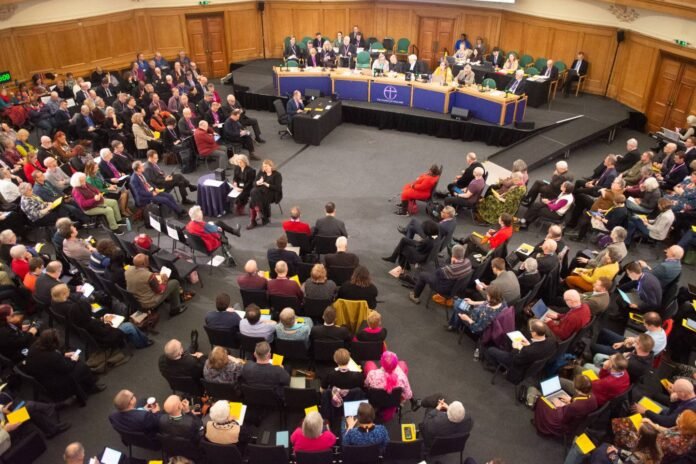
At the July 2025 General Synod there was scheduled a debate on a potentially highly divisive Private Members Motion (PMM) from Mae Christie, a known critic of the church’s current teaching. It related to the place of Issues in Human Sexuality in the discernment process for ordination and was originally and rightly seen by many committed to the church’s current teaching and practice as undermining of that teaching. Much to people’s pleasant surprise, as a result of discussions and good will and careful amendment, it resulted in an outcome which secured widespread support across different views on sexuality. This, as Ian Paul noted on this blog, was in part because of the approach of the person who introduced the PMM in Christie’s absence:
Here we have someone who is clear he is campaigning for change in the Church’s doctrine of marriage, but recognises that this cannot be brought about by sleight of hand, and has worked actively with those upholding the Church’s historic teaching to come to a workable and reasonable agreement.
This July, at the final General Synod before the Synod elections, there will be a debate on another potentially highly divisive PMM, this time from Professor Helen King, another critic of the church’s current teaching. At 12th May, as at the end of March, it was just one signature short of being top of the current PMMs with 169 Synod members (up from 161 mid-Feb) supporting it.
Headed “Same-Sex Relationships Compatibility With Christian Discipleship” it reads
That this Synod affirm that there are no fundamental objections to being in a committed, faithful, intimate same-sex relationship, and that such a relationship can be entirely compatible with Christian discipleship.
The motion is significant for at least two reasons.
First because of its timing as the LLF process draws to a close but a new process is about to be launched and as elections take place for the next 5-year Synod (which might have been thought to be an argument against scheduling a debate, leaving it for the new Synod to consider the matter perhaps under a new PMM).
Second because of its substance. If it is debated then it will arguably, and surprisingly, be I think the first substantive debate in Synod focused very specifically in its wording on the question of the ethics of same-sex relationships for Christians since the Higton motion back in 1987. This was overwhelmingly passed as a statement of traditional Christian teaching on sex and marriage (for wording and context of that motion see here).
How is the motion to be interpreted? The PMM & Church Teaching
It is clear that given its provenance and wording most who uphold the church’s teaching and believe it to be based on Scripture are very concerned about Synod passing the motion. CEEC reports that “The Evangelical Group on General Synod (EGGS) will be working to defeat the motion in as an effective way as possible”.
Sadly, one contributory factor here is simply the polarisation which has marked this Synod. In some cases it seems the logic almost amounts to: if this motion comes from Helen King and is supported by this group of people then it can only be hostile to the church’s teaching and require opposition from those who support that teaching. But if votes are decided on those terms rather than the wording of the motion and corporate deliberation then we appear to have abandoned all attempt to reason together and instead be willing simply to mimic general “party politics”, forgetting the surprising outcome of a year ago.
So what about the wording of the motion? That has led some to conclude opposition is the only viable approach. Martin Davie, for example, has set out his reasons “Why Faithful Christians Should Reject Helen King’s Private Member’s Motion” (he has since added further reflections supporting his approach and critiquing the motion here).
I want here to explore in more detail Martin Davie’s first reason for taking this position – “that the precise meaning of the motion is unclear” and that the motion “lacks clarity about the precise nature of this relationship”. This raises the question as to whether—by intention or inadvertently—the motion will have the effect, in Ian Paul’s words about the original motion last year, of bringing about a change in the church’s teaching “by sleight of hand”. Davie clearly believes it would and thus it must be opposed.
The motion would have that effect if its wording was opposed to what is stated in the Pastoral Guidance for Prayers of Love and Faith, namely that
The Church of England teaches that Holy Matrimony is a lifelong covenant between one man and one woman, blessed by God in creation and pointing to the love between Christ and the Church; a way of life which Christ makes holy. It is within marriage that sexual intimacy finds its proper place.
In other words, the current position of the Church of England is that there are “fundamental objections” if a same-sex relationship presents itself as Holy Matrimony or involves “sexual intimacy”. It is these two areas which are the major fault-lines in the church and which have caused so many difficulties in relation to Prayers of Love and Faith and the pattern of life the church expects of its ordained leaders.
It is, however, these two contentious areas on which the PMM is notably silent although its proposer and the overwhelming majority (perhaps even all) of its signatories are known to dissent from the church’s teaching in relation to one or both of these elements. Perhaps inevitably in the current climate this silence but partisan support makes many suspicious that the motion is intended to undermine the teaching and this is all indeed “sleight of hand” or a Trojan Horse. In fact, it will be argued below, that if this is the intention of the motion and the effect of it passing then it risks undermining much more than the church’s current approach to same-sex relationships. But is this the only possible interpretation or is there the possibility that its supporters might, in Ian Paul’s words on what happened last year, “work[ed] actively with those upholding the Church’s historic teaching to come to a workable and reasonable agreement”?
Read it all in Psephizo