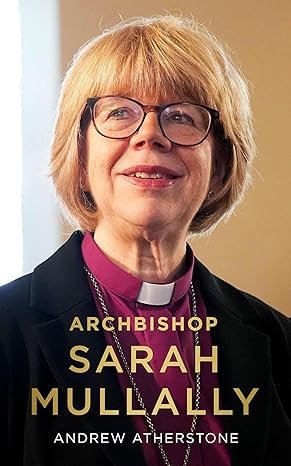
Andrew Atherstone, Archbishop Sarah Mullally (Hodder Faith, 2026)
Andrew Atherstone’s biography of Archbishop Sarah Mullally, published in time for March 2026 installation as the first female Archbishop of Canterbury, offers readers an unintentionally revealing portrait. While the book presents a celebratory narrative of a “trailblazer” who “smashed the stained-glass ceiling,” careful readers will discern a more troubling story: the theological transformation of a young evangelical convert into an ecclesiastical progressive whose current positions bear little resemblance to the faith that initially shaped her.
The Evangelical Sarah
The early chapters of Atherstone’s biography paint a vivid picture of Sarah Bowser’s formation in the conservative evangelical world of 1970s-80s suburban Surrey. At St. John’s Woking, young Sarah was immersed in what can only be described as robust, conversionist evangelicalism. The church ran regular “guest services” and special missions where American evangelist Bob Watters saw hundreds “take the first step of asking Jesus into their lives” and begin “trusting in Jesus.” When Sarah was twelve, the parish hosted a children’s mission led by Scripture Union evangelist Oliver Styles. The church’s quarterly magazine, Forward, proclaimed an “energetic Christian confidence and passion for growth” focused on proclaiming the gospel’s “stupendous and awesome” events.
At age fourteen, during confirmation preparation, another teenager’s simple question—”Are you a Christian?”—led Sarah to what she later described as her personal commitment to Jesus Christ, “the true beginning of her Christian discipleship.” Atherstone records that she participated enthusiastically in youth group Bible studies, Spinnaker Cruises on the Norfolk Broads featuring “quiet time” for personal Bible study and devotional talks, and “Meeting House” events in London that ended with evangelistic appeals.
At Woking College, Sarah immersed herself in the Christian Union, whose stated purpose was “building up and encouraging Christians in their faith and reaching the rest of the College with the Good News that Jesus is alive.” The CU tackled topics including “the second coming of Christ, living the new life, following God’s plan and spiritual warfare.” Most tellingly, Atherstone notes that at university, Sarah became active in the Universities and Colleges Christian Fellowship (UCCF), an organization requiring doctrinal adherence to biblical infallibility, substitutionary atonement, and justification by faith alone.
This was no nominal Christianity. The teenage Sarah Bowser was a committed evangelical believer shaped by conservative Protestant theology, biblical authority, and conversionist faith.
The Progressive Archbishop
Fast forward to 2026, and the reader encounters a very different figure. Atherstone’s later chapters reveal an Archbishop whose primary theological commitments center on “Christian compassion, inclusion, and care for the marginalised”—language notably devoid of the gospel categories that defined her youth. Her advocacy work focuses on migrants, the poor, domestic abuse victims, and opposition to assisted dying legislation—important social concerns, but ones that could be embraced by any humanitarian of goodwill, Christian or otherwise.
The mature Mullally’s theological framework rests on imago dei—that every person bears God’s image with inherent dignity. While this is certainly biblical doctrine, Atherstone presents it as her primary lens, disconnected from the evangelical convictions about sin, redemption, and justification that once shaped her worldview. Her House of Lords speeches and cathedral sermons emphasize justice and equality, themes she connected to the 800th anniversary of Magna Carta during her Salisbury years, but the evangelical doctrinal content of her youth appears largely absent.
Atherstone describes how her twenty-plus years at St. Stephen’s, South Lambeth—a racially diverse, urban parish—”broadened her understanding of inclusion and justice.” This is revealing language. Did her understanding broaden, or did it fundamentally shift? The book suggests the latter but presents it as the former.
The Unexplained Gap
What is most striking about Atherstone’s biography is what it doesn’t explain: how did Sarah Bowser, the UCCF-affiliated evangelical who participated in evangelistic missions and Christian Union ministries focused on conversion and biblical truth, become Archbishop Sarah Mullally, whose public ministry appears oriented primarily toward social justice and institutional inclusion?
The book documents her participation in the “Leading Women” mentorship program designed to advance female clergy, her work navigating NHS bureaucracy, and her development of management skills. But it provides no theological accounting for the apparent abandonment of her evangelical moorings. Where is the gospel proclamation that defined St. John’s Woking? Where is the emphasis on conversion that marked her teenage faith? Where are the UCCF doctrinal convictions about biblical authority and substitutionary atonement?
Atherstone notes that Mullally “evolved” and that her theology “developed,” but he offers no critical analysis of whether this represents organic growth or fundamental departure. To his credit, Atherstone provides extensive documentation that allows readers to perceive the disconnect, even if he won’t explicitly name it. The reader is left to draw their own conclusions from the evidence he meticulously presents.
The Institutional Pattern
What makes this biography significant for Anglican.Ink readers is not merely one woman’s theological journey but what it reveals about institutional Anglicanism’s assimilation power. Mullally’s trajectory—from conservative evangelical youth to progressive episcopal leadership—mirrors a well-worn path in the Church of England. Evangelical convictions that might prove inconvenient for institutional advancement are quietly set aside, replaced by the acceptable vocabulary of “compassion,” “inclusion,” and “justice.”
Atherstone notes that Mullally often perceived herself as an “outsider” in the Department of Health and Church of England due to her polytechnic education and lack of Oxbridge credentials. Yet on the questions that truly matter—theological orthodoxy, biblical authority, gospel proclamation—she appears thoroughly assimilated to establishment progressivism. Her “outsider” status is merely credentialing; her insider status is theological.
The biography reveals institutional mechanisms that facilitate this transformation. The “Leading Women” program didn’t merely build confidence; it socialized participants into institutional priorities. Her twenty years in urban ministry didn’t merely expose her to diversity; it apparently reshaped her theological commitments. Her nursing career emphasized “care for the vulnerable,” language that could describe either Christian mercy rooted in gospel truth or secular humanitarianism.
The Question for Evangelicals
Atherstone’s biography leaves Anglican evangelicals with an uncomfortable question: If the teenage Sarah Bowser—confirmed at St. John’s Woking, active in UCCF, shaped by conversionist evangelicalism—could become Archbishop Sarah Mullally, what does this say about the staying power of evangelical formation? What does it reveal about institutional pressures that incentivize theological conformity to progressive norms?
The book documents a remarkable career achievement—the first female Archbishop of Canterbury, the first from a polytechnic, the first to spend decades outside ordained ministry. But it also documents something more troubling: the apparent ease with which robust evangelical convictions can be transformed into generic progressive Christianity, provided sufficient institutional rewards.
For those who knew the young Sarah Bowser at St. John’s Woking or in UCCF circles, Archbishop Sarah Mullally may read less like a celebration and more like a cautionary tale.
Rating: Essential reading, though not for the reasons Atherstone intended.
N.b., This post has been updated after Dr Atherstone kindly pointed out a mistake. The book is not an “authorized” biography.