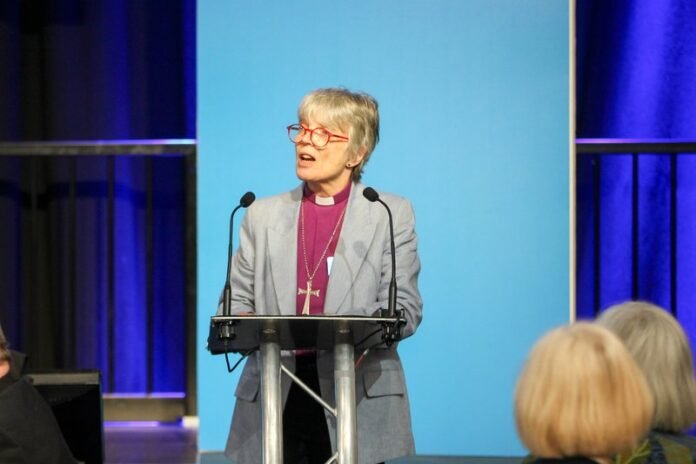
Alleluia. Christ is risen. He is risen indeed. Alleluia!
We gather here as an Easter people with the words of the angel at the tomb still ringing in our ears: ‘He is not here but has risen.’ ‘He has been raised from the dead and indeed is going ahead of you to Galilee. There you will see him.’
I hope that each one of you has had a joy-filled Easter and has glimpsed something of the reality of the risen Christ in your lives as you have celebrated the resurrection in your churches and congregations.
We gather here these next few days to worship and take counsel together in that same spirit of joyful celebration, knowing that the risen Christ comes to us as he did those first disciples that first Eastertide. We gather with renewed faith that the risen Jesus is with us in the darkness of despair as he was with those gathered in the upper room; that he meets us in our grief and sorrow as he did to those on the road to Emmaus; that he appears to us in our work as much as in our prayer, as he did to those who’d gone back to their fishing, still confused, still not really understanding.
We gather as an Easter people with Alleluia as our song, trusting that Jesus can and does and will transform the darkness into light, the despair into hope, the sorrow into joy. Knowing, even if incompletely, that he offers new life, words of welcome and invitation, and sustenance for all that he asks of us. For that is what Easter proclaims.
Christ is risen. He is risen indeed. Alleluia!
But as we gather, in the relative security of this place, this country, we’re aware that Christians elsewhere have celebrated Easter in a very different context; amidst wars and destruction, amidst fear and uncertainty; amidst suffering and grief that is almost beyond our imagining. We cannot and must not forget our sisters and brothers in Christ in Ukraine and in South Sudan, in Iran, in the middle east and the Gulf States, and in those very places where Jesus was born, where he lived and ministered, where he died and rose again. The meaning and significance of Easter is brought into sharp focus in those contexts which today feel much more like Good Friday than Easter Day. Whilst we pray daily for peace and the cessation of violence and war, we pray also for our Christian sisters and brothers that in the power of the resurrection, they might find strength, courage and hope to remain faithful and to bear witness that Christ is risen indeed. His love has triumphed over evil, sin and death.
I know that many of us here are also seeking to support families, friends and communities practically in some of those places too, through personal contact, financial giving and writing to elected politicians both in the Senedd and in Westminster. Such actions can feel very small, insignificant and inadequate when set against the horrors we see and hear about on our newsfeeds. They are, nevertheless, acts of care and compassion, and expressions of solidarity which in some small way can be signs of hope, bringing small chinks of light into the darkness.
Closer to home, whilst we may not be at war, we’re certainly feeling the effects of the wars that are raging abroad and many here are suffering additional hardship as a result. In the midst of the turmoil and uncertainty, it’s heartening to see so many of our churches up and down the country living out their Easter faith through their missional outreach and service to their communities. This is a vital part of our life as Christians; our witness as Christ’s Church. Without social action, our Easter message rings hollow. Without the Easter message, our social action renders us no different to any other charity or branch of social services. For us, the two are held together. The gospel of Jesus Christ is the motivator, the driver, the shaper of our life and witness as individuals and as a church. We live out and share the good news by serving others. And, in serving others, we draw them into the love of Jesus and the salvation he offers.
In just over three weeks’ time, our country will be going to the polls. Whatever the outcome, it will be an historic election. A new Senedd made up of 96 members rather than the current 60, and 16 new constituencies, each with 6 members. For the first time, young people 16 years of age and over are able to vote. As always, it’s important to reflect carefully on how we are going to use our vote and on how our faith might inform our choice. Of course, there are Christians in most political parties. I’m not for a moment saying that one party is more Chirstian than the others. But there are values that our faith teaches us which might inform our voting, as they do our behaviour; values that encourage us to look beyond ourselves and our own self-interest to the interests of others and to the common good. Loving our neighbour. Welcoming the stranger. Caring for the widow and the orphan and those who are in need of the support of others. Jesus’s parable of the sheep and the goats never fails to challenge me. What matters to the king is not how religious we are, but that we provided food for the hungry, drink for the thirsty, clothes for the naked; that we cared for the sick and visited those in prison.
We elect our politicians, whether Christian or not, to foster a society where all are valued, all can find a place and all can have a sense of agency and belonging. It’s a complex picture with no easy answers or solutions, but the Hate Hurts Wales campaign that has been running in this country for the last 5 years or so is surely a timely reminder that hate, fear and mistrust not only hurt the people or groups that are the specific targets, but all of us; the whole country. Because it breeds suspicion, division and, all too often, violence; which affects us all. Our streets become less safe and we ourselves feel less safe.
We are an Easter people and Alleluia is our song. But we’re not immune to feelings of fear and mistrust, even within our church. I’ve had conversations over the past 6 months with a number of groups and individuals who are anxious, fearful, uncertain of their future within our church. Anxious that their presence is not really wanted in the Church in Wales. Fearful of being excluded or further excluded from the church’s life and ministry. Uncertain of where they are going to find themselves in the next 12 months. And just for clarity, these conversations were with people from both the catholic and evangelical wings of the ecclesiological spectrum. What heartened and encouraged me was that they felt able to come and share their fears and anxieties; that they were able to be open and honest – critical, even – about their experiences as clergy and laity. What saddened me enormously was to hear that this was, indeed, their experience, their concern, their fear.
In the first letter of John we read, ‘perfect love casts out fear’. (1 John 4:18) If there’s fear amongst us, then I suggest that it’s because we’ve not learnt to love one another well enough. Not learnt to love as Jesus loves us. And that love is not just about us being nice and polite to one another but about genuinely wanting the best for one another; genuinely wanting to create a church where everyone feels affirmed, valued and cherished for who they are in Christ and what of his gifts and mercy and grace they bring. One of the commitments stated in the Church in Wales Dignity Charter is to ‘promote an environment which values all people’s differences’. This, as it happens, is also very biblical if we take the image of the body of Christ seriously. No one part, St Paul reminds us, can say to another ‘we have no need of you.’ (1Cor 12:21)
‘Love one another as I have loved you’, Jesus tells us (John 15:12) This is the new commandment which Jesus gave us the night before he was to be betrayed by one of his closest friends, abandoned by all those he’d spent his last three years with, denied by Peter, the Rock and killed.
But we don’t love one another. Certainly not as Jesus commanded us. There’s a tendency to try and score points, to play out our own little wars, to seek our own interests rather than those of our sisters and brothers in Christ. As someone whose MDR I did recently said, ‘Intransigence and the deep desire to win every argument seems to be a destructive characteristic of the church I love…I don’t know how we can be an inclusive church while at the same time believing we are absolutely right on every theological issue. Being an inclusive church means having to admit to each other that we are flawed and only God is perfect; that we may disagree but we can still love each other; that no-one needs to be outside the love of God.’
‘Beloved, let us love one another because love is from God.’ (1 John 4:7) Let’s work at building relationships of mutual trust and respect that will, little by little, cast out the fear and mistrust that is between us and enable us to learn just what it means ‘to love as he loves us’. For only then will we be able to witness to the world the transforming power of God’s love which broke through death, evil, suffering and sin that first Easter day.
Because it is that transforming power of God’s love that matters. That’s what we are called to share for the sake of the world. We do not proclaim ourselves, St Paul reminds us in another letter. We proclaim Jesus Christ as Lord. That is the treasure we’ve been entrusted with – and we have it in the clay jars of our broken and flawed humanity, ‘so that it may be made clear that this extraordinary power belongs to God and does not come from us.’ (2 Cor 4:7) It’s not the clay jars that we’re offering, but the treasure within; not the outer shell of who we are, but the gospel of the glory of Christ who is the image of God; the joy of Easter when Christ burst from the tomb; the good news that we’ve received and that has transformed our lives.
Be assured of my prayers for each and every one of you, and for your churches and dioceses, and of my renewed commitment to promote an environment which honours and values all people’s differences so that together we can indeed be the body of Christ fulfilling God’s mission here in Wales.
Christ is risen. He is risen indeed. Alleluia!
Y Parchedicaf Cherry Vann – Archesgob Cymru
The Most Reverend Cherry Vann – Archbishop of Wales
April 15, 2026