“This is my message for you,” said the angel to Mary Magdalene, “he has been raised from the dead and is going ahead of you…” – Matthew 28. 7
When I was a Parish priest – some years ago now! – a Convent that was downsizing gave us a new crucifix it no longer needed. A friend and colleague of mine, Martin Warner, now the Bishop of Chichester, delivered it. As we hung it on the wall behind the altar, he told me that whenever he looked at a crucifix, he asked himself which of Jesus’ seven words from the cross this crucifix brought to mind. As we looked, we both agreed that this image of Jesus reminded of his words from John’s gospel, as he dies Jesus says, ‘I thirst.’
Then, in 2003, just the year before I was ordained as a bishop, I was asked to write the Archbishop of Canterbury’s Lent book. I could write it on just about anything I fancied – well, as long as it wasn’t football!, it had to be something to do with Lent, Holy Week and Easter – and I chose these words; I thirst.
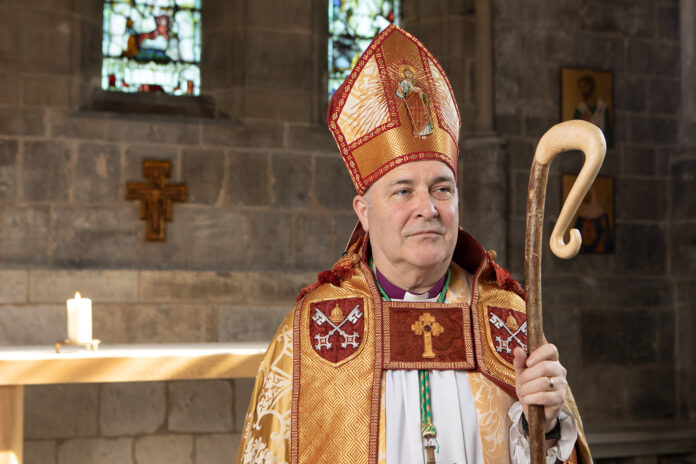
And in 2020 when I became the 98th Archbishop of York and well-wishers in the Diocese of Chelmsford where I had served and others paid for a new episcopal ring to be made for me to mark the occasion, the person making the ring asked whether I wanted any inscription.
It’s a ring! It’s actually quite a big ring, a real knuckleduster! I’m wearing it this morning. So there isn’t room to say much. I seized again on these words, though now in Latin where the two words ‘I thirst’ are the one word sitio.
I thirst.
For me, these words condense and encapsulate the whole beautiful and painful meaning of Christ’s passion, death and resurrection. They are spoken, St John tells us, to fulfil scripture, though it isn’t entirely clear which scripture is being referred to – there are so many passages in the Old Testament where we hear of God’s thirsting love for us and where we express our passionate thirsting, longing for God. Or even if it isn’t a passionate, thirsting longing for God, a longing for peace, a longing for hope, stability and meaning in our lives, for our families and for our world.
And these words also speak painfully and poignantly of Christ’s agony on the cross. He was, literally, dying of thirst. And the wine and vinegar the soldiers offer him was not, as we might think, a mockery, it was to help dull the pain. It also fulfils words from Psalm 69, ‘For my thirst they gave me vinegar to drink’.
But there are other meanings.
I thirst for you, means ‘I thirst in your place.’ The just consequence for all our sins, and all the ways we have hurt and damaged each other and the world around us, the punishment that should be ours, is his. He becomes the one who is ‘wounded for our transgressions, crushed for our iniquities; upon him was the punishment that made us whole, and so says Isaiah and by his wounds we are healed. (Isaiah 53. 5).
But this isn’t some bloody transaction where a tyrannical, fickle and ‘ever needing to be appeased’ God demands a pound of flesh.
Jesus goes willingly to the cross; it is a sign of his obedience to the Father’s will, an obedience he learned in the agony of Gethsemane, and a sign of what I want to call, the triumph of love. Jesus wants to take our place. Isn’t it what any loving parent would do if they could? It is the last of which no other love can be greater, to lay down one’s life for one’s friends. I thirst for you, says Jesus.
As the sabbath day approaches, Pilate sends the soldiers to check that the crucified men are dead, and to break their legs, to break the cycle of suffering, to hasten their death, if they’re not.
When they get to Jesus, they find he is already dead. But to be certain, they pierce his side with a lance and then in one of the most beautiful and mystical verses in the whole of scripture, we are told there flows out water and blood.
Water: the sign of God’s thirsting love for us, the river of life that flows from the heart of the crucified and risen Jesus, the waters of baptism which cleanse us from sin, and sisters and brothers, save us from death.
And blood, Christ’s shed blood on the cross, which we receive day-by-day, and Sunday-by-Sunday, and year-by-year in the Eucharistic meal which we have come to share in this Cathedral church this morning, the meal which renews and sustains our life in Christ. The meal we receive today. The bread of angels. The food of eternal life. The wine of the new covenant.
I thirst for you, means ‘I long for you.’ ‘I love you.’ ‘I want what’s best for you.’ Why? From the very first moment of your being, when each of you was just a couple of cells dividing into life, in the floodtide of your mother’s womb, you were known and loved. I simply want you to know that Christ died for you, it was for love of you, it was for the things that have gone wrong in your life, for your hopes and your fears. I thirst for you.
The love we see and receive in the dying and rising of Jesus plumbs the depths of what it is to be human, plumbs the depths of death itself, harrows hell, and is risen glorious on the first Easter day. So, when Mary Magdalene goes with the other Mary to the tomb to anoint the dead body of Jesus, the angels tell them to their amazement, he has been raised from the dead and is going ahead of them to Galilee. It is there that they will see him; and Mary Magdalene, the faithful women who wait by the tomb, they become the first apostles and bearers of this good news, rushing with fear and joy to tell the disciples that their thirst, our thirsts, all of our thirsts, and the thirst of the world can be quenched.
And it will be fear and joy, because the resurrection of Jesus changes everything. And it requires us to change, to respond, and to live differently and to learn how to love.
‘Like as the hart desireth the water brooks, so longeth my soul after you.’
Sisters and brothers, we live in a very thirsty world.
There are too many thousands of people literally dying for lack of fresh water. On visits to Kenya a few years ago, I saw this for myself. Children begging for water and children drinking from a dirty stream.
But there are so many other things we thirst for too.
We thirst for peace between the warring nations of the world and on this Easter morning cry out for an end to the literally pointless conflict consuming the Middle East at the moment.
We thirst for justice in a world where norms of international law are eroded and ignored, where basic human rights are denied.
We thirst for unity within the church of Jesus Christ, itself so painfully divided by the conflicts of the past and an easy acceptance of a scandalous status quo in the present.
We thirst for hope, praying for the leaders of our nation, and all the nations, praying that we can find ways of rising out of the destructive and rude siloes and echo chambers of social media which so controls our narrative.
We thirst for belonging, for eyes to see and hearts to love one another and, acknowledging our common humanity, build communities of diverse, good and peaceful loving, for Jesus tells us not to be afraid and commands us to love one another and says that it is by this life that people will know we are his disciples.
We need this in our communities here in Yorkshire and across the north of England, where so many people feel left behind and where so many young people grow up with little hope of a better future.
We need it across our whole world, we need it urgently. For today, Easter Day, Christ is risen. He still bears the wounds of his suffering love. He goes on thirsting, showing us the Father’s love, longing for us to receive the water of life and the cleansing baptismal waters of Faith. His message to one and all, for everyone here in York Minster and across the world is, ‘Sitio. I thirst. I thirst for you.’
So here is my invitation. Slake your thirst this Easter morning.
Here, in the waters of baptism available in the font. In the Eucharistic food available at the altar.
And if you are not yet a follower of Jesus, do not delay. Come to the waters. Drink and be refreshed.
And know this: if you are really thirsty, the chances are you will drink any old dirty water available. Sadly there is lots available. But here is the water of life and in it your souls can be refreshed. ‘Whoever drinks this water,’ said Jesus, ‘will never be thirsty again’ (John 4.14).
Which is also why this Easter day, I thoroughly recommend it, we must quench other thirsts as well. Open the beer. Crack open the champagne. Make that Margarita. Pop another olive in your Martini, or if it is your thing, just do that very English thing, and put the kettle on.
But what we see and receive in Jesus, and celebrate again today, is nothing less than irrigation for the soul.
Rejoice! Drink up! Have a very happy Easter.
You can watch the service in full on York Minster’s YouTube channel