It seems like a long time ago that a letter was written to the Daily Telegraph suggesting that churches should close and that congregations should be relieved of the pressure of maintaining ancient buildings. In the Diocese of Leicester the answer to declining congregations and a budget deficit is ‘Shaped by God Together’, which when fully implemented will have created 20-25 Minster Communities across the Diocese.
One such Minster Community will consist of approximately 30 parishes and will be cared for by three clergy. Many of the parishes are small rural parishes where congregations are in single numbers. The vicar of one of the larger, growing churches in a market town has described the sacrifices required of them as like cutting off the arm of a fit and healthy person and roasting it so the small churches can have one last meal.
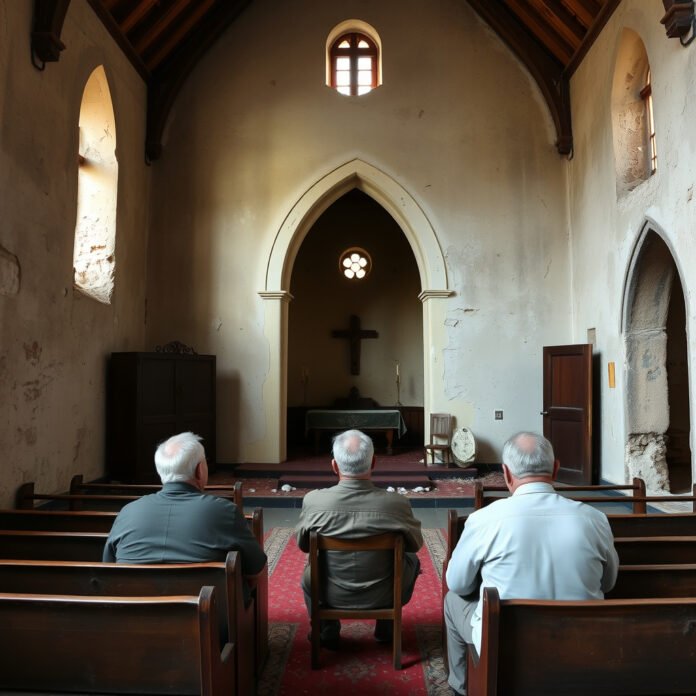
Another clergyman was recently asked to take a service in a small village church because they had no vicar. On arriving, he discovered the church was cold, dark, and largely unloved – the warden from another church in the benefice had yet to open up. Three men came to the service, all of them appeared to be Christians who trusted in Jesus Christ. On reflection, he said, “The service felt very sad, almost like attending a funeral. The church is approximately two miles from a thriving church with a lively congregation. You have to ask the question: why not transport those three Christian men two miles to be part of a thriving congregation and close at a church that, to me, seems no longer able to serve its local community, and whose community appears to have ceased to care for it?”
The following is an extract from a letter sent to the Bishop of Leicester regarding the possible impact of the “Shaped by God Together” policy.
“If I understand the finances correctly, 2024 parish giving amounted to £3.94 million, which, based on the clergy cost of £66,000 per clergyperson, equates to 60 clergy. This will mean we need to reduce clergy numbers by approximately 34%, leaving areas of desert where there is no effective ordained ministry or where clergy are burnt out and disillusioned, trying to cover an ever-increasing number of parishes. More importantly, giving will have declined further as churches shrink and close, having been subject to managed decline.
“In the report, “From Anecdote to Evidence”, where leadership was discussed, the report said, “The survey results show a strong correlation between those clergy who prioritise numerical growth and those clergy whose churches grew in numbers.” It is therefore to be implied that the church where you refuse to replace clergy will move into maintenance mode, lose the impetus to prioritise growth and continue to shrink. Please bear with me, I don’t know, I’m just rehearsing facts that you are more than familiar with.
“I know this could turn into everybody moaning, “But I’m not getting a vicar”. I believe we are at significant risk of a cataclysmic decline in clergy, congregations, and finance, which will lead to the closure of buildings and the death of churches. If it is handled well, a conversation like this may generate positive ideas, as I believe the majority of clergy and laity in this diocese wish to see the kingdom of God grow in Leicestershire. You and I both know the findings of the report I mentioned earlier clearly show that:
‘Analysing data across a range of congregation size categories shows that amalgamations of churches are more likely to decline. Moreover, the larger the number of churches in the amalgamation, the more likely they are to decline. This is exacerbated when amalgamations have more churches. For Team Ministries, there is no evidence of greater numerical growth than for amalgamations. Team ministries are less likely to grow than non-teams and perform markedly worse than churches with their own incumbent.’ “
It is said that the Bishop of Leicester’s response was to agree with the analysis but also to wait and see how things work out in the long run.
The Diocese of Leicester is not the only diocese to be facing these problems and to be fair, despite their Average Weekly Attendance (AWA) still being 20% lower than pre-Covid levels, they have seen a slight rise in attendance between 2023 and 2024. Fifteen of the other forty-one dioceses have failed to maintain the post-Covid bounce-back in attendance and recorded stagnant or decreasing AWA in 2024.
More worryingly 25% of Church of England parishes have an AWA of 9.5 or fewer, with no children at all involved in their worshipping community. It seems likely that these smaller churches have a higher than average age profile – which means well over 35% of the congregation would be over 70. Unsurprisingly, this figure rockets in more rural dioceses, with Bath and Wells, Sodor and Man and Truro all reporting that more than half those worshipping in their diocese are over 70.
Closing churches is rarely popular but there are ways to do it well. The last good meal can be a celebration for all involved. With care and patience, the story of the worshipping community can be honoured, their grief acknowledged and the final chapter of a church’s life can bear witness to the gospel. Practical support can enable congregants to find a new home in a church where they can thrive.
The vicar quoted above told Anglican Futures:
“It is no longer possible to live, or afford to live, with the rosy image of the parish priest cycling to Matin’s on his sit-up-and-beg bicycle, a faithful congregation flooding in to hear him preach an eloquent message from the pulpit. It is necessary to leave behind John Betjeman’s idealistic image of the parish church; neither the manpower, finance, nor congregations are available to sustain it. And furthermore the basic structures that underpinned it no longer exist in modern society; people are less connected to the spaces they live in and the communities they inhabit, instead they are more connected online, and there is a more consumerist approach to church attendance.
“The parish churches are an incredible gift and heritage, but many are no longer able to meet the demands placed upon them by the centralised diocese and structures, because of a lack of people attending and the lack of finance. It is surely delusional to believe that the three men who met for prayer in their parish church will be able to produce a leader from amongst themselves, who will then be able to work with a remote clergy person to grow the church.
“I fully understand that we can no longer afford the number of clergy we had, and, by extension, the number of churches we have. We cannot support them, resource them, equip and train the congregations for evangelism, or even provide the sacraments in any guaranteed way on a regular basis. A radical new way of thinking needs to be formulated, centring on local house churches in remote communities and rural hamlets, church planting in new developments, and church revitalisation projects where it is appropriate.
“The day is going to come when clergy will need to be able to be confident, to say to the local bishops either ‘I cannot, for the sake of my health’, or, ‘I will not because it makes no sense to continue to try to support and maintain an unsustainable system.’
“I realise this is going to be painful for congregation members, but one has to question whether it is fair to ask lay people to play the role of pseudo-clergy in struggling and dying churches.
“We must focus our resources on areas of growth. Where the gospel is preached, God is giving growth; where there is pastoral care, God is giving growth.
“Anecdotally, there is a church in the Diocese of Leicester with a faithful Gospel focus; they have seen young men walk through the door seeking God, completely separate from anything they have done missionally. They have conducted 12 baptisms since Palm Sunday 2025. What was the basis of this growth? A simple and profound prioritisation of prayer, preaching and pastoral care.
“We are in a mess, and we should be praying and pleading with God for his mercy and forgiveness, keeping the main thing the main thing, and having the courage to put our resources to wise use.”