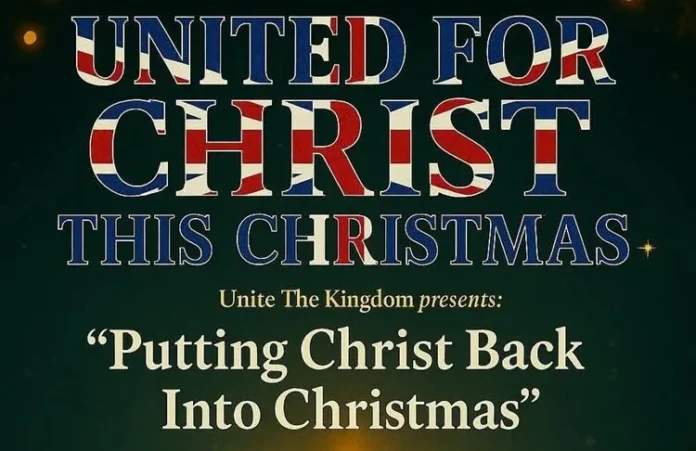
The fury over a Christmas carol event exposes the ideological gatekeeping hollowing out British Christianity.
Over the last few days, my social media feeds—shaped by the strange, selective algorithms we all live under—have been replete with progressive and left-leaning Christians condemning the upcoming “Christ in Christmas” event in London linked to Tommy Robinson. Anecdotally, those are the voices I see most loudly. And beyond my feeds, the national news and radio have been wheeling out predominantly Anglican clergy (as they always do) to denounce the gathering in firm, moral tones, with warnings of the ‘Far Right’ and ‘Christian Nationalism’.
I understand why people feel uneasy. I am no Tommy Robinson supporter. But I also sense that something deeper is happening here—something revealing, something uncomfortable, and something worth paying attention to. Because if we only focus on the personalities involved, we risk missing what this moment is saying about the soul of the UK, and perhaps the state of Christianity itself.
We seem to have had Christian groups who have spent months entirely at ease under pro-Palestine banners, Islamic slogans, rainbow flags, LGBTQ+ causes, BLM symbolism, climate change flags, and anti-colonial rhetoric, who are suddenly and seemingly scandalised by a carol event—and not primarily because of the carols. That contrast alone should make us pause.
Anglican and other priests have been arrested for supporting a proscribed extremist organisation—Palestine Action—whose activists violently assaulted a police officer with a sledgehammer. Yet many of the same voices express horror at a proposed carol service, immediately castigating it as ‘far right Christian nationalism’. It is a revealing moment in our public discourse: outrage is not always proportionate to actual harm, and moral energy is, I suggest, often spent denouncing the wrong thing.
Policing Faith
For years now, huge numbers of ordinary Brits have felt ridiculed, unheard, and publicly shamed simply for being British. And the moment some of them reach for Christian symbols, language, and tradition—the very things Christianity once assumed belonged to all—those who preach tolerance respond with moral panic and purity tests. The contradiction is hard to ignore.
Beneath that reaction lies something more uncomfortable: the instinct to decide who is “allowed” to reach for Christ, who may “recover” Him, who counts as worthy of invoking His name. As though Christ belonged to some ideological tribe or moral elite. As though we could curate where Christ is permitted to appear.
But here is the truth few want to say aloud:
The most unsettling element of this carol event will not be Robinson. It will be the crosses, the icons, the voices publicly shouting, “Jesus is King.”
That will disturb many who have been perfectly comfortable with other ideological symbols dominating public space all year. The offence is not nationalism; the offence is Christ showing up in a place we did not approve.
And if anyone imagines the attendees will be the fever-dream caricature of the “far right,” it is worth remembering how elastic that label has become—a catch-all category deployed for almost anyone who disagrees with a dominant progressive moral imagination. It functions like a modern heresy charge, shutting down conversation rather than opening it.
This caricature stands in stark contrast to Trevor Phillips’ firsthand account after attending the Unite the Kingdom march with 150,000 taking part in London this year. Many of whom might well be at this Christmas Carol Event:
The vast majority seemed normal, not like the stereotype of some far-right extremists.
Exactly. The people attending will mostly be ordinary folk—neighbours, parents, tradespeople—people reaching for meaning, identity, and yes, perhaps even faith.
And that prompts a difficult question: If we casually call this gathering “far right,” are we prepared to label everyone condemning it “far left”? Of course not—and that’s precisely the point. These labels are flattening our moral vision and impoverishing public discourse. They tell us more about our cultural anxieties than about the people themselves.
Here is another irony: Some of the voices denouncing this event come not from worshipping communities or from people living a discipleship-shaped Christian life, but from cultural and professional Christians—those whose functional faith has migrated into ideological symbols, activist liturgies, and moral slogans. Their causes have become their creed, baptised with Christian symbols and terminology.
Yet they insist that those gathering in London have “no right” to use Christian imagery. Misappropriation is a serious charge — but it is being levelled by many who have done the same thing with their ideological beliefs. And they can appear as cultural middle-class Christianities, offended by their sensibilities, unable and unwilling to have empathy for those in their sights.
And yet, to be fair and truthful, not everyone raising concerns fits that description.There are many thoughtful Christians genuinely troubled about co-option, distortion, or Christian symbols becoming vehicles for grievance or identity conflict. Those concerns matter as much to me as they do to you.
But even here, a question lingers: Why is it so easy to publicly denounce this event, yet so hard to critique the ideological culture of the progressive left and their ideological capture in public?
Their symbols, chants, and moral framework have dominated public space for months with scarcely a murmur from the same people now speaking so forcefully. That asymmetry reveals something about the state of Christianity in Britain—people often more willing to critique unfashionable expressions of faith than fashionable forms of ideology.
The danger of co-option is very real. Christian symbols can be bent into political tools and have already been used by the progressives and left this year. But it is hard to name that danger without first acknowledging how we ourselves—left and right—are discipled by cultural ideologies that function like anti-Christian liturgies.
Resistance Is Futile
Tommy Robinson now speaks openly about having found faith and believes a kind of revival is stirring outside the established church—among people who, like him, feel they would never be welcomed by its leaders. Whatever we make of his claims, the dynamic he is describing is not unfamiliar. Time and again in Christian history, those on the edges of church respectability have insisted they are encountering God, while the institution has responded with suspicion, distance, or outright rejection. Often, the church has been uneasy not only with the individuals involved but with what their presence might say about its own life and witness.
Read it all in Psephizo