
If you needed any evidence that there are two entirely different religions both claiming to be Christianity in Britain at this juncture, the London Carol Service crisis has made it plain that that is the case.
A carol service has been organised under the banner ‘Unite the Kingdom’ for Saturday the 13th of December, celebrating the intention of putting the Christ back into Christmas, scheduled to take place in central London. One of the effects of this has been to produce repudiation and protest from other churches.
I don’t think ever before in my life I have seen a notice of a Carol service being advertised in the public square the effect of which has been to produce a response by other churches, expressed with denunciation and vituperation.
There are a number of reasons for this and no doubt the primary one is that the main organiser is Tommy Robinson.
Tommy Robinson has long been what is euphemistically called a divisive character in British politics. However, since we’re talking about a Carol service and Christianity we might ask ourselves the question as to whether or not anything has changed recently between Tommy Robinson and the Christian faith?
The answer is something has changed. And it took place in the last few months.
Having been locked away in solitary confinement as effectively a political prisoner of the state, for refusing to accept the decision of a court in a libel case, Tommy Robinson found himself deeply affected by the work of Christians in prison and has become a practising Christian.
In particular, a pastor called Riky Doolan, who is associated with the ‘Spirit Embassy’ Church in North London, gave an interview to Premier Radio where he described how three weeks before his release he, Doolan, had spent two hours with Tommy Robinson talking about the gospel; and during that time Robinson received Jesus Christ as his personal Lord and saviour.
It’s certainly true that after his release in May 2020 Doolan and others observed Robinson wearing a cross and talking openly about his faith. Doolan‘s exact words in the interview were:
“I know he took a Bible into prison and that he was also being visited by the Prison Chaplain three times a week. I had a two hour visit, we spoke about the gospel and he received Jesus Christ as his personal Lord and Saviour, right there in the prison.”
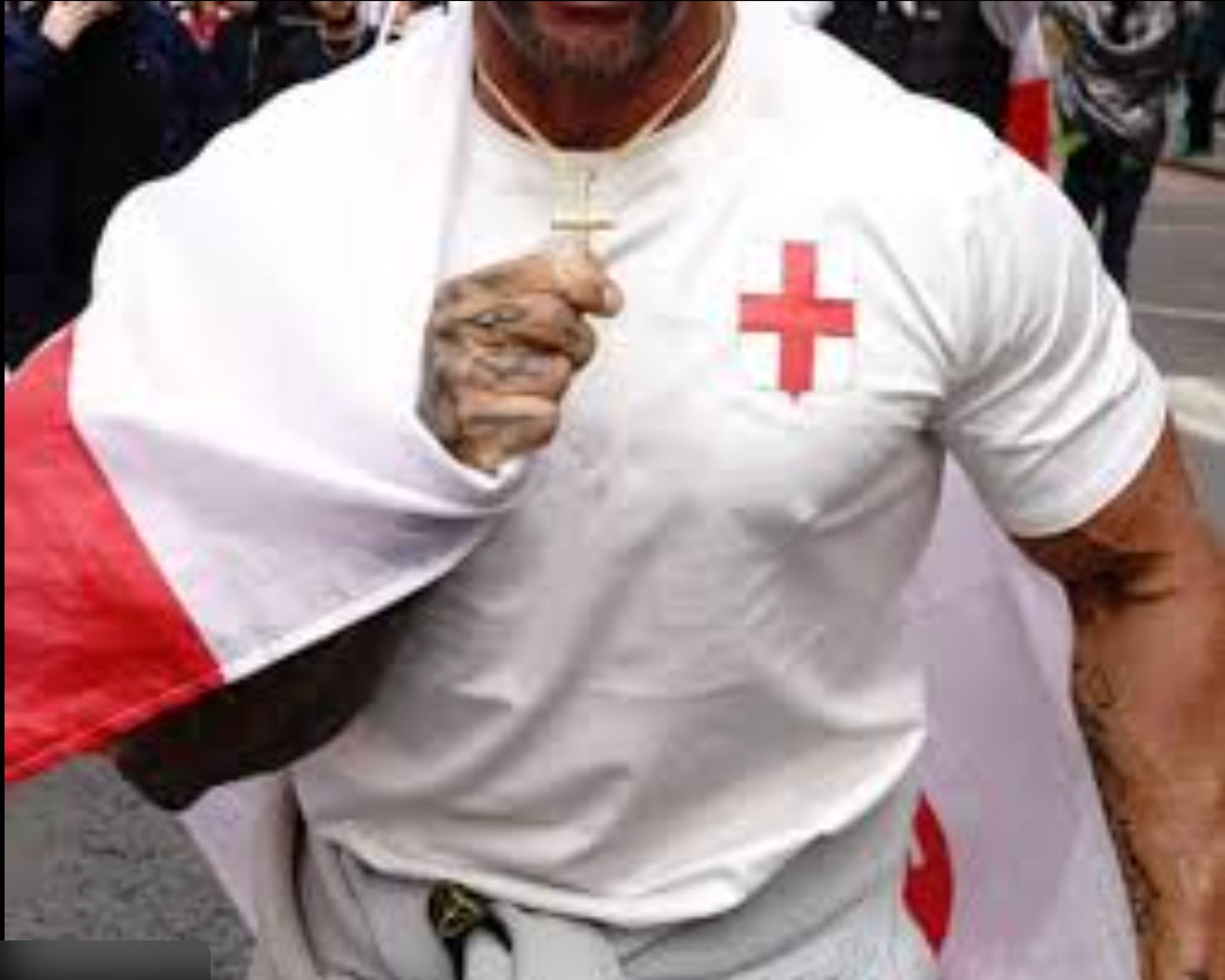
The way in which Tommy Robinson’s pilgrimage and encounter with Christ is described depends on the nature of his baptism. On the one hand, if he was not baptised as a child, this becomes a conversion story of dramatic proportions.
If on the other hand, Robinson was baptised as a Roman Catholic by his practising mother, and subsequently reacted against the faith in disgust with paedophile priests and a ‘feminised’ clergy (as he has indicated previously) then his encounter with Christ would have made him a Catholic revert to the Church.
In either circumstance, following the Christian understanding of an encounter with and a surrender to Christ, his former life becomes a slate that has been wiped clean. Whatever the ramifications in his political work, his organising of a carol service, shorn of political commentary, becomes the penitential work of a forgiven prodigal who gets to start again.
In which case, why has a service inviting the public to celebrate Christ and Christmas caused such anger?
There has been no real critique of his claim to have become a Christian. It seems to largely have been ignored or overlooked. The anger is because it is assumed that the organisation of a carol service with readings from the Bible MUST have a political component if Robinson is involved.
A Paradox in the Public Square
The response this carol service has produced is either a paradox or a contradiction depending on your own judgement.
We have the rather extraordinary situation of the Church of England, which is a national Christian Church (by definition), attacking a denominationally neutral Carol Service as being nationalistic and Christian.
This requires some untangling.
Is the Church of England itself politically neutral? There have been rumours that Anglicans led by a former Archbishop of Canterbury are going to stage a rival carol service outside St Paul’s involving large montages of refugee boats and images of economic migrants. You could not get much more political than that. Yet it is the Church of England, with a migrant (political) boat in its eye, claiming to see a political mote (or speck) in the eye of Tommy Robinson.
For an example, let’s turn to the Diocese of London. In a statement it claimed that:
“We affirm that freedom of speech is a vital democratic right, and at the same time pray for a nation where that freedom is exercised not to deepen fear or exclusion but to foster compassion and unity.
Every day in our church, in our streets we see a very different city to the one that Robinson supporters portray. One where people from all cultures, religions, beliefs and classes can work, worship and live together. We take pride in the city that welcomes everyone now and always; we reject intolerance and division in the utmost terms.”
Nobody could describe this as a classical statement of Christianity. It is instead an expression of a different philosophy which we might call a religion consisting of the political philosophy of ‘liberal inclusion.’
Theo Hobson’s Claims in The Spectator
Theo Hobson is a well-known Anglican commentator who has given vent to his analysis of the issue in the Spectator.
“But here’s a crucial thing: a Christian should separate his affirmation of Christianity from his affirmation of pride in his nation. Why? Because the modern Britain ought to be proud of his nation for its ability to unite people of different religions and ethnicities. He should be proud of his nation’s liberalism. Robinson joins together what should be kept asunder.
What does the Church of England think about this impact of re-integrating religion and politics? You might think that as an established Church it fundamentally believes in the unity of religion and politics. No, it has come to see itself as the established Church of a liberal state. It sees political and cultural liberalism as God‘s will.”
It may be that Hobson and those Anglicans who have been completely captured by the secular liberalism of the state have so lost sight of what Christianity actually is that they cannot see they are practising a wholly different philosophy, a wholly different religion to what Christianity has classically understood as being.
Hobson continues:
“It is time for greater clarity, so that this minority view (of Robinson’s) is firmly excluded. It used to be a sort of academic experiment or game. Now it is politically dangerous. The Church of England should explicitly state why Tommy Robinson is wrong: our national Christian tradition affirms the liberal state. It’s really as simple as that.”
Hobson gets to the heart of the matter. The Church of England has replaced authentic historic Christianity with the philosophy of the secular state – which is, as he says, political and cultural liberalism.
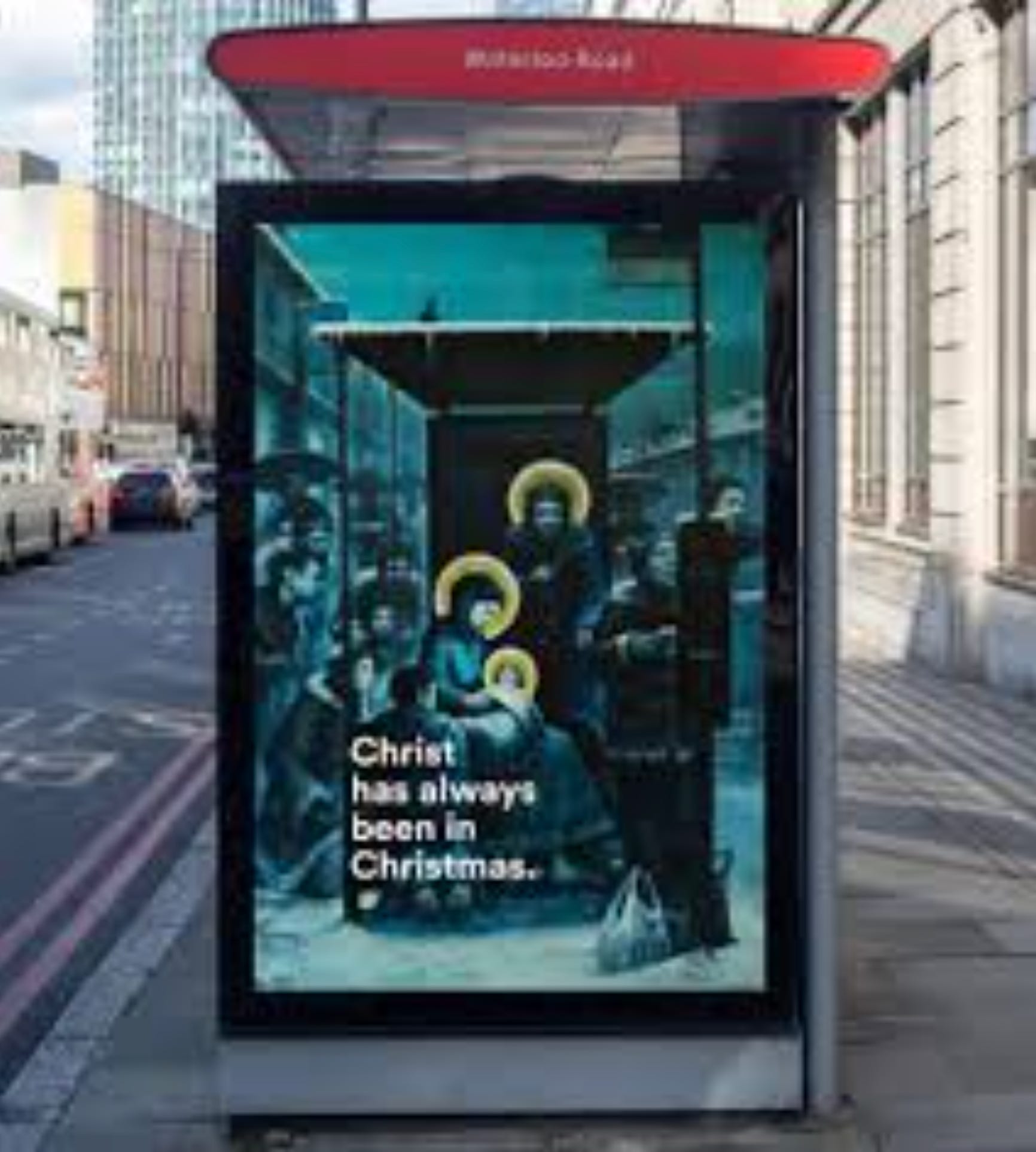
The national Christian Church, in this Alice in Wonderland scenario, is so convinced of the position that Hobson has enunciated that it has rushed out an emergency poster campaign to denounce the principle of putting Christ back into Christmas by singing carols and reading from the Bible as ‘Christian nationalism.’
The C of E posters are part of a wider response to Robinson and Unite the Kingdom from a number of churches. The Joint Public Issues Team, a partnership between the Baptist Union of Great Britain, the Methodist Church and the United Reformed Church, is offering a “rapid response resource” for local churches trying to “navigate the complexities” of Christian nationalism and the “co-option of Christian language and symbols – including Christmas – for a nationalist agenda.”
The Rev Arun Arora, bishop of Kirkstall and co-lead bishop on racial justice for the C of E, said:
“We must confront and resist the capture of Christian language and symbols by populist forces seeking to exploit the faith for their own political ends,”
as he tried to exploit the faith for his own political ends.
Which were, as he then described without any sense of contradiction:
“As we approach Christmas and recall the Holy Family’s own flight as refugees, we reaffirm our commitment to stand alongside others in working for an asylum system that is fair, compassionate, and rooted in the dignity of being human.”
In what world exactly does the promotion of an asylum system at Christmas not constitute political ends?
Refugee Fixation
The religion of political liberalism seems to have become so fixated on the concept of a refugee that it has lost any sense that refugees might come in different sizes, configurations, motivations, and aspirations.
Because the Holy Family spent the earliest years of Jesus’ life fleeing from the political retribution promised by King Herod and finding sanctuary in Egypt, this has resulted in the rather fundamentalist and myopic conclusion that all refugees are as sacred as the Holy Family.
It appears to be a distinction too far to notice that the Holy Family consisted of three people rather than millions, and that they returned to the place from which they had come as soon as the danger and threat had passed.
The conflation of the experience of the Holy Family with the phenomenon of unlimited economic migration by a rival religion appears to have escaped the perceptions of the progressive-seized liberal establishment religion.
The part of the account where the migration of the refugee Holy Family turned out to be of a temporary nature, after which they returned to their home country, hits some kind of blind spot. At that point any parallel with the Holy Family ends, and political fury about enforced re-migration begins. Refugees are only ‘holy’ when they invade a foreign country, not when they return.
The Diocese of Southwark adds its voice when it insists in its press statement:
“Any co-opting or corrupting of the Christian faith to exclude others is unacceptable, and we are gravely concerned about the use of Christian symbols and rhetoric to apparently justify racism and anti-migrant rhetoric.”
The concerns of the host nation that unmonitored migration has produced the rape of children in grooming gangs, the creation of a climate of terror in cities where women cannot walk alone for fear of sexual molestation, where murder of innocent Christmas shoppers in Christmas markets hangs like a dark pall over western towns, aggressive demands for sharia law, and threats of imprisonment for those who express a distaste for the culture, politics and theology of Islam, is reduced to a “failure to love the stranger, justifying racism and constituting anti-migrant rhetoric.”
The Catholic Perspective.
The Catholic Church has kept a dignified silence over the issue. One good reason for this is that Stephen Christopher Yaxley-Lennon (to give him his baptismal name) has yet to clarify where he believes his fresh encounter with Christ places him in terms of ecclesiastical accountability.
Equally sensibly, what good reason is there for commenting on a (so called) non-denominational meeting of the public to venerate Christ in a carol service. The original focus of the carols service was declared to be a ground swell reaction to the ‘winterval’ movement; the left-leaning secularisation of Christmas on the spurious and misleading and improper grounds that it gives offence.
As Robinson’s Christian pilgrimage develops, the exercise of discernment may very well become more complex, depending on where he places himself, and how the resistance to economic refugees (who are almost uniformly Muslim) continues to be endorsed on a large scale by a left leaning political blob that endorses a cultural assault on Christianity at the same time.
The Christian Crisis
What this crisis reveals is not a dispute about a carol service, but a collision between two religious movements with the same name, wearing the same clothes, but embodying opposing values. One proclaims Christ as Lord; the other proclaims liberalism as lord and tolerates Christ only as a metaphor for its political programme. The fury directed at a man singing carols tells us far more about the new liberal religion behind the Christian mask than it does about Tommy Robinson.
This Carol Service controversy makes one thing unavoidably clear: when the established Church denounces Scripture readings as “nationalist,” it is not Christianity that has changed, but a Church that has converted—to a secular creed masquerading as faith. The line between the two religions has finally become visible.
In the end, the real question is simple: who governs the Church’s conscience—Christ or the state? The reaction to this carol service suggests that, for Britain’s established denominations, the answer is no longer theological. And that is the true scandal of Christmas 2025.