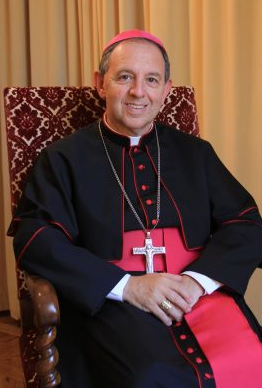
In his pastoral letter, Bishop Antonio Suetta issues a cautionary note regarding the perils of witchcraft, superstition and Halloween, particularly among the younger generation. “This is not a harmless fun night. The devil disguises himself as an angel of light,” he says. The response lies in faith, prayer and the sacraments: “Those who abide in God’s grace have nothing to fear”
Halloween is not a harmless fun game. Masquerades and pumpkins can hide more than meets the eye, warns the Bishop of Ventimiglia-Sanremo Antonio Suetta. “The deceiver’s ploy is to show things as they are not”. In his pastoral letter, the bishop cautions against witchcraft, superstition, and the allure of the occult, which thrives particularly among the young. He says that the solution is not fear, but faith: “Those who abide in God’s grace have nothing to fear.”
Your Excellency, what prompted you to write a pastoral letter on this sensitive issue?
I noted a specific and worrying trend of a large number of people seeking exorcism services, including in our own diocese. These cases are not just instances of confusion or psychological fragility, which also exist and require discernment. Unfortunately, there are also actual cases of demonic disturbance, ranging from mild to severe. And these cases are increasing. This has prompted me to investigate the phenomenon further and to write the Letter.
Your starting point was, then, a specific pastoral experience?
When I spoke to priests, I asked whether these cases were uncommon or representative of a more widespread phenomenon. The answer was clear: we are not just dealing with psychological fragility.
There are indeed forms of spiritual disruption, and they are increasing.
In the Letter, you caution against the use of witchcraft and superstition. Why do you consider them so dangerous?
As St Augustine reminds us, the shepherd is a sentinel, their duty is to watch over the flock and warn them of dangers. We are seeing a resurgence of paganism today, which thrives on idols, and witchcraft is always connected to idolatry. Witchcraft originates from man’s fear of higher powers and his desire to dominate them. Ultimately, it stems from ignorance and a lack of knowledge of the truth.
However, some people think that witchcraft is just deception and superstition. You, on the other hand, maintain that there is more to it than that.
Absolutely. As St Paul says, an idol is nothing. But the father of lies is always lurking behind such idols.
Witchcraft does not keep its promises; it may promise power, protection or fortune, but it is actually a deceptive trap.
False promises often conceal a more or less conscious link to the satanic world.
Origin of Halloween
Halloween originated from the ancient Celtic festival of Samhain, which was celebrated on 31 October to mark the end of summer and the harvest season. It was believed that on this night, the barrier between the living and the dead weakened, allowing spirits to wander the earth. Evangelisation saw the Church place the solemnities of All Saints’ Day (1 November) and All Souls Day (2 November) on these same days, offering a Christian perspective of hope and communion that ultimately led to the transformation of ancient pagan traditions. Over the centuries, alongside this substratum of religion and popular culture, a commercial aspect was added. Today, some consider Halloween to coincide with the “Satanists’ New Year”, attributing ritual significance to the night of 31 October within an occult context. Halloween’s traditional masks and costumes, along with the practice of “trick-or-treat”, have become visible symbols of this, but they often conceal a deeper and more controversial experience.
This phenomenon involves young people, too. To what extent are parents and Christian communities responsible?
The gravest danger is silence. Parents and clergy must not neglect their duty of cautioning people. Young people are drawn to these practices out of curiosity or delusion. In reality, they are trying to fill a void that is actually a thirst for mystery. However, this yearning should be directed towards God and not be misguided by substitutes such as witchcraft and superstition.
Halloween is often considered a harmless holiday. However, you argue that this is not the case. Why?
Because the deceiver’s trick is to present things as they are not.
On the surface, Halloween is just a fun game. In reality, however, it is like leaning over an abyss.
It makes death seem not as a time of hope and responsibility, but of fear and anguish.
How is this dangerous?
Without the light of Christian hope, death breeds despair. Despair can lead to two harmful attitudes: attempting to dominate occult forces or taking a ‘carpe diem’ approach to life where rules are disregarded. In both cases, the deception of the evil one is concealed. It is the same temptation Satan offered Jesus: “All this I will give you if you kneel down and worship me.”

You also associate Halloween with a specifically satanic aspect.
We must remember that this date is also the New Year of Satanists and is the most important night for Satanist worship.
The Bible says that the devil disguises himself as an angel of light, so Halloween presents itself as harmless amusement, but in reality, it touches on situations that are objectively dangerous.
So the problem is not just the holiday itself, but the loss of the Christian perspective on death.
Without Christian hope and the communion of saints, death returns to being a terrifying superstition, much as it was for the ancient pagans.
In your Pastoral Letter, you wrote that those who abide in God’s grace have nothing to fear. Specifically, what are the spiritual weapons of Christianity?
St Paul uses the image of spiritual armour — a helmet, breastplate, sword and shoes — which he links to the gifts of grace. The two fundamental gifts are prayer and the sacraments.
Why is prayer so important?
Prayer is the concrete expression of our relationship with God. It is faith that becomes dialogue, invocation and trust.
Prayer is the most powerful tool to protect against the evil spirit.
And the sacraments?
The sacraments are pathways of grace, enriching and regenerating us. Those who abide in faith and grace are protected from the attacks of the evil one. The Church is Christ’s sheepfold; its members are protected, but those who wander off are exposed to danger. Saint Peter describes the devil as a roaring lion seeking whom he may devour.
Did this sense of responsibility prompt you to write the Letter?
Yes. Minimising these warning signs lowers our guard. This is where my responsibility as a bishop comes in: to warn and encourage people to return to the faith. Those who abide in God’s grace have nothing to fear.