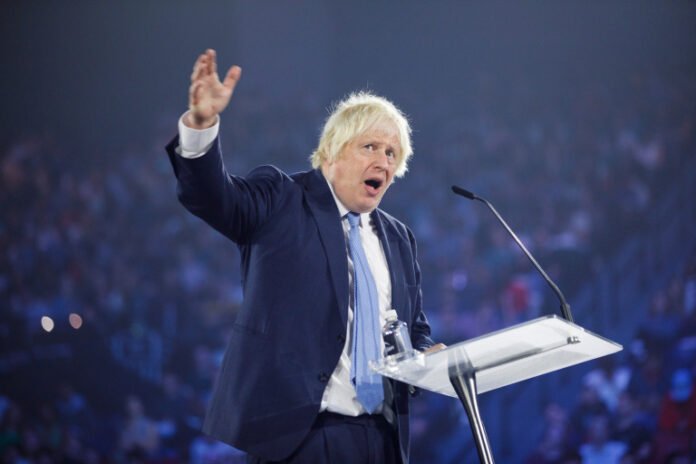
Former British Prime Minister Boris Johnson delivered a passionate address to Liberty University students this week defending free speech and pushing back against the erosion of civil liberties. Speaking to over 16,000 students at Liberty’s Convocation on 8 Oct 2025 Mr. Johnson positioned the Christian university as a “bastion of freedom” and issued a stark warning about threats to Western civilization.
The former prime minister spoke of the September 10 assassination of Charlie Kirk, the 31-year-old founder of Turning Point USA who was shot and killed during a campus event at Utah Valley University, declared Kirk “a martyr to our inalienable right as human beings to say what is in our hearts and what we honestly think”.
“There can be no clearer proof of the threat to free speech than the tragic murder, one month ago, of Charlie Kirk,” he told the Liberty audience. “And I hope, by the way, that I’m looking at the next generation of Charlie Kirks”, framing the murder of Kirk as emblematic of broader assaults on conservative speech rather than as an isolated act of violence.
The assassination, carried out by 22-year-old Tyler James Robinson, has become a flashpoint in American political discourse. Robinson, who confessed to the shooting through text messages and Discord conversations, reportedly told his partner he was “tired of [Kirk’s] hatred” and had been planning the attack for over a week Evidence presented in court included DNA found on the rifle trigger and inscribed bullet casings with anti-fascist and trans messages.
Central to Johnson’s address was his portrayal of Liberty University as a crucial defender of Western freedoms. “This university is a bastion of freedom — freedom of thought, freedom of conscience, freedom of association, religion, and of course, speech,” he declared. “And all of those freedoms are increasingly precious and are under threat in the world today”.
Johnson’s praise comes at a time when many American universities face criticism from conservatives for suppressing right-wing viewpoints.
Johnson’s emphasis on Liberty’s role reflects broader conservative concerns about academic freedom. During his subsequent appearance at Yale University on October 9, he elaborated on these themes, contrasting Western universities like “Oxford, Yale” with those in “Moscow, Pyongyang, Tehran or Beijing” as places where “intellectual freedom is the root of all creativity and prosperity”.
Johnson also drew explicit parallels between American independence and Britain’s departure from the European Union. “You threw our tea into Boston Harbor,” he told the crowd, which “erupted in applause.” “I support you because you did not want to be ruled from overseas by bodies you did not control. And I understand those feelings. One of the reasons I was determined to deliver Brexit was because I love that spirit of freedom in this country. And I wanted to bring that spirit of freedom back home”.
Johnson provided “a brief survey of global geopolitics, outlining the rising conflicts between Israel and its surrounding Muslim nations and the tensions between Russia and Ukraine. His analysis positioned these conflicts as “a direct result of the divergence from freedom”.
Johnson recalled the Reagan-Thatcher partnership and Jerry Falwell Sr.’s role in the conservative coalition of the 1980s. “I remember in the late 1970s and early 80s, how Jerry Falwell mobilized the freedom-loving spirit of the American people to back Ronald Reagan and to win the Cold War, and boy, do we need that spirit today,” Johnson declared.
This historical reference resonated with his audience in light of Jerry Falwell Sr.’s role as the university’s founder and his significance in the American evangelical political movement. Johnson continued: “We need all the strength and clarity and determination that was shown by Ronald Reagan, Margaret Thatcher, and Jerry Falwell, standing up to tyranny because the autocracies of the world are gaining ground every day. And I’m afraid that the West looks ever weaker and more confused”
Johnson’s Liberty University address was followed by an appearance at Yale University on October 9, where he appeared before the Buckley Institute to discuss “The U.S. & U.K.: A Special Alliance that Must Work Together to Save the West”. This speech, attended by approximately 400 people with heavy security including metal detectors, saw Johnson take more explicit political stances.
Johnson offered a robust defense of President Donald Trump, declaring himself “one of the very, very few European politicians who’s willing to say that I like Donald Trump”. He argued that Trump’s “sometimes boisterous treatment of journalists” cannot be compared to Vladimir Putin’s suppression of journalists in Russia, emphasizing the need to distinguish between Western democracies and authoritarian regimes.
Johnson also condemned pro-Palestinian protests, which he said go against Israel’s “legitimate attempts” to stop attacks like those of October 7, 2023. He criticized Western responses to the war in Ukraine, arguing that “the West is doing nothing like enough to prove Putin wrong”.
Johnson’s American speaking tour comes at a significant moment for both British and American conservative movements. His willingness to defend Trump publicly when many European leaders maintain distance reflects the increasing alignment between populist movements across the Atlantic. His framing of current conflicts as struggles between freedom and authoritarianism offers intellectual coherence to what critics see as increasingly authoritarian tendencies within conservative movements themselves.
The timing of Johnson’s appearances is also significant, coming amid what he describes as a crisis of Western confidence. His warnings about autocracies gaining ground and the West appearing “ever weaker and more confused” reflect broader conservative anxieties about democratic resilience and Western unity.
Johnson’s tour signals a deepening integration of conservative movements across the Atlantic. His explicit support for Trump, defense of Brexit as analogous to American independence, and positioning of current conflicts as civilizational struggles all contribute to a narrative of shared conservative identity transcending national boundaries.
His warnings about Western weakness and rising authoritarianism, combined with his call for students to become “the next generation of Charlie Kirks,” represent more than nostalgic conservatism; they constitute a call to action for a new generation of conservative activists. Whether this message resonates beyond university audiences and translates into broader political influence remains to be seen, but Johnson’s tour clearly represents an attempt to energize and unify conservative movements on both sides of the Atlantic around shared civilizational concerns.