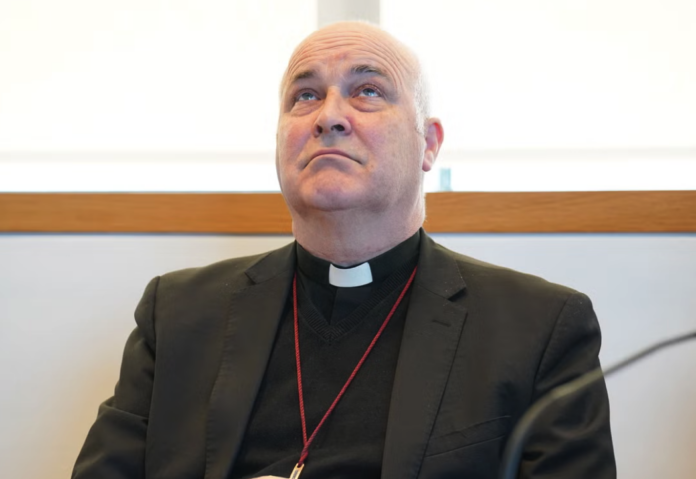
In the last few days, the ecumenical gift that keep on giving, Stephen Cottrell, the Archbishop of York, has taken it into his head that the nation needs to hear his views on illegal immigration and taxation policy.
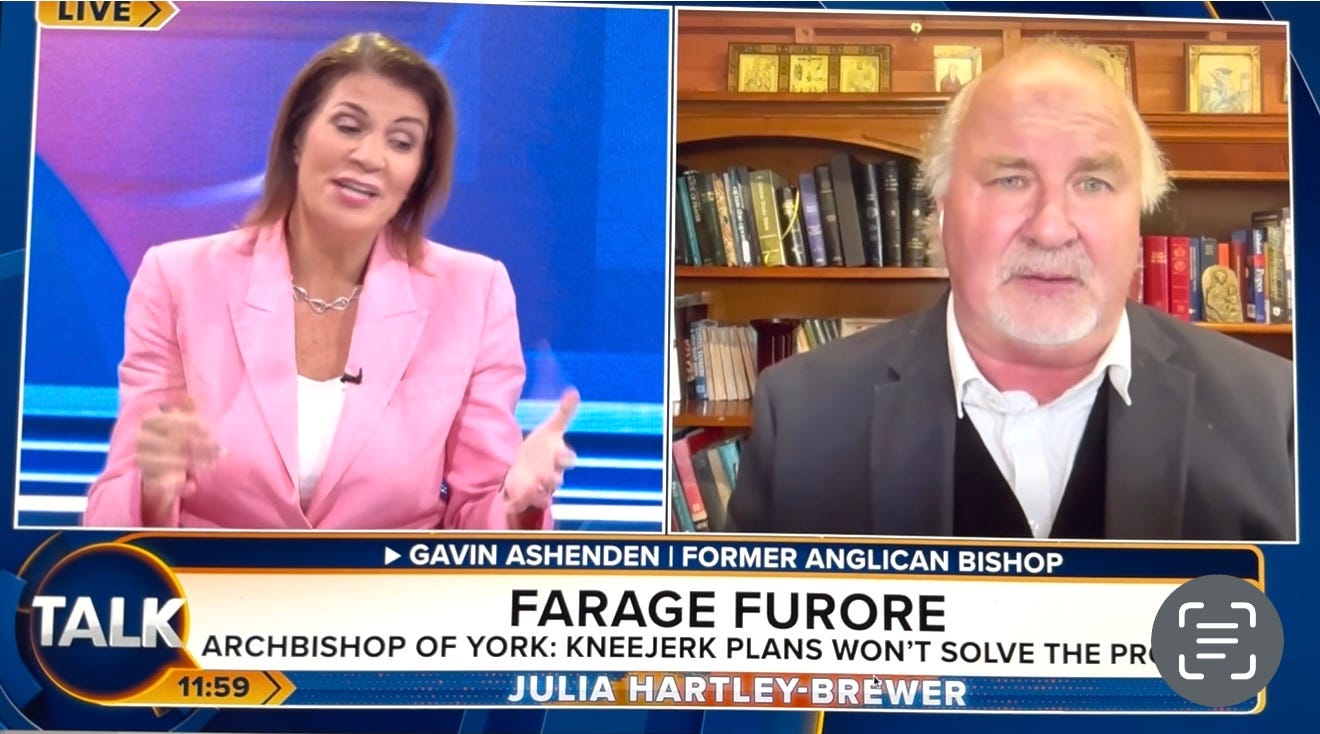
As Julia Hartley Brewer put it succinctly, in an interview with me on Talk TV, this is all from a man who has a degree in media studies from a not very demanding educational establishment for which to use the descriptor ‘higher education’ would be thought by the experts to be over-generous. His qualifications for makign the kind of comments he offered are thinner than slim.
Is that mean?
Well, we wouldn’t be discussing it if he hadn’t decided quite gratuitously, to offer his opinions in the media as ‘acting head of the Church of England.’ No one asked him, but he obviously felt that the Government may have been in such a quandary that they couldn’t find their way out of unless he helped. They had just forgotten he was there, on hand to help.
Why the ‘ecumenical gift that keeps on giving?’
Simply because one is more inclined to take the view that the Catholic Church neither can nor should change in order to accommodate the Protestant religious movements who left it in a theological and existential huff five hundred years ago. Because the effect of which has been disastrous, leading to the corrosion of rationalism, then atheism, then post-modernism, post-truth, and the wholly uninspiring phenomenon of Archbishop of York himself. There could be few more enticing or persuasive arguments to give up on the state Christianity experiment which has run is course.
This will become a serious piece of writing rather than a satirical article in just a moment. But the satire is too obvious to pass over and ignore.
Such is the quality of senior Anglican clergy that they cannot get their heads around the fact of the political discontinuity of the relationship between the people in the pews and the clergy.
The people in the pews consist of the whole spectrum of political opinion; left, right, middle, non-aligned and past caring. They come to church to have their souls tended to. They come for forgiveness, spiritual inspiration, hope, the Christianising of the world view. They haven’t come to church to have their faith morphed into the political activism of the utopian Left.
It is widely recognised that there is a serious disconnect between the Anglican clergy, and in particular the bishops. Except by the bishops themselves. They hold hard line socialist views, and the people in the pews who if anything veers to the centre right.
During Brexit for example , there was only one bishop who backed the campaign to leave. Yet a majority of the voting population voted to leave. Apart from this one dissident suffragan bishop, the whole of the state church’s house of bishops backed the anti-nationalist European bureaucratic collectivist status quo.
Irrespective of the higher clergy’s political views it is, to say the least, an unintelligent strategy to alienate the greater majority of the people who belong to the organisation you have responsibility for.
Then there is a question of whether or not the archbishop of York is right in his analysis of illegal migration and the particular solution Nigel Farage advocates?
Since everything that has been tried so far driven by ideology from the left has failed and nothing driven by the ideology of the Right has been tried, it shows either overconfidence or some real lack of imagination to be so dogmatic in such a political analysis.
There is of course scope for arguing about the extent to which the Christian Gospel has or ought to have some form of political expression. It’s an argument that has been taking place for sometime. But it ought to be obvious that the political context in which this discussion is taking place has changed drastically in the last 20 years.
Never before have we had to deal with the criminalisation of ‘thought-crime’in the United Kingdom.
The fact that the police are made fun of for ignoring shoplifting and burglary while they send groups of half a dozen policeman to arrest people who are believed to have published the wrong kind of Facebook memes, or caused offence on Twitter, ought to give us pause to reconsider the context.
The critical issue for consideration is that we have moved with some speed out of the protection of the democratic arena into the threatening orbit of a very different political framework. The very fact that ‘thought-crime’ could become criminalised is the indication that we have slipped from democracy towards the grasp of totalitarianism.
Not enough credit is given to the Christian faith for one of its unique characteristics. It is not shared by other faiths and certainly not shared by more extreme political parties of either left or right. Christianity contains within it the conviction that human life is sacred. And in so doing has played a powerful role in the development of authentic human rights. The Catholic Church is clearest on this. Many of the Protestant Communities have compromised with the brutal pragmatism of the abortion industry, or the epicurean escapism of the euthanasia project.
But this shift from democratic debate to state coercion changes everything.
If I can be personal for a moment, having read my way through much of Alexander Solzhenitsyn’s exposée of the Soviet Union, I became a Bible and Samizdhat smuggler in the 1980’s. I wanted to help the persecuted church. I ran a number of trips into the Spviet Union, in particular into Russia and what was then Czechoslovakia. I got caught and interrogated several times. And was threatened with long terms of imprisonment if I did not give up tghe names and addressed of the Christians I had been given as contacts.
I was particularly touched by the imprisonment and persecution of two men; a Baptist pastor called George Vins, and a Russian Orthodox priest called Fr Gleb Yakunin.
and a Russian Orthodox priest called Fr Gleb Yakunin.
They defied the anti-Christian ruthless authoritarianism of the Marxist regime. Their courage and determination not to be tortured and bulled by the regime was deeply impressive. They were marginalised, tortured and imprisoned. The Soviet state was characterised by the dominance of the collective over the individual. Christianity defends the individual over the collective. Christianity was theoretically tolerated but in practice outlawed, repressed and persecuted.
It is precisely at the tipping point where we slip from democracy into the first exploratory throes of totalitarianism that the Church finds itself under an obligation to expose and resist the anti-Christian and anti democratic ambitions of the state.
For a clergyman, for an Archbishop, for the acting head of the state church to be so fixated on his own secular expertise that his primary concern is to lecture the government on its obligations to continue to encourage the laws of immigration to be flagrantly broken, not only contradicts his primary responsibilities, but suggest he is disastrously insensitive to what is taking place politically and spiritually in his country.
In our country too, Christianity is theoretically tolerated but in practice repressed, disavowed and beginning to be criminalised. This is the point where the leaders of the Church need to speak out. To be distracted by third-rate socialist parroted dogma from the collapse of democracy, the principle of the protection of the individual, and the onset of an imminent totalitarianism is indefensible.
The argument has moved from the unacceptability of Christian clergy taking refuge from the hard challenging work of Christian apologetics and pastoral care by immersing themselves in the political jargon of Left wing secularism, to the urgent need to defend what is left of Christendom and Christian civilisation.