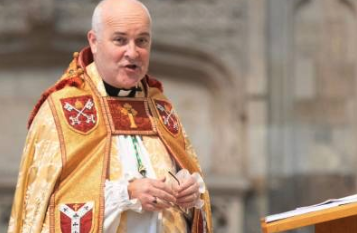
Dear Stephen
I read with interest your address to York Diocesan Synod on 5th July, and one word leapt out for me: ‘final’. Near the end of your address, you comment:
The Living in Love and Faith process is not yet complete. Some final proposals will be brought to the February 2026 meeting of the General Synod.
If that is the case, I am and countless others (on all sides of this debate) will be delighted. This has been a disastrous and divisive process since 2017; I wonder whether you realise how damaging it has been, and whether you will ever publicly acknowledge that. It sprang out of Justin’s spontaneous and ill-conceived phrase “radical new Christian inclusion rooted in scripture and Christian theology” which was both incoherent (how can this be new if it’s rooted in existing theology?) and immediately open to misinterpretation—almost everybody who wanted to see change forgot the second half of the phrase.
And this summer’s ‘consultation’—which has been widely rejected, since there have been no new proposals to consider—have amply illustrated that. In every diocese that has discussed it, as far as I can tell, the discussion has highlighted how divided we are, and that the LLF process, far from enable us to ‘live with difference’, has exacerbated division. I suspect the conversation in York won’t have been much different.
But there were other comments in your address that I feel I need to respond to.
The church was divided on how to receive and celebrate the presence in our congregations and the ministry of people in stable, committed same-sex relationships.
Well, this all depends on what you mean by ‘the church’. The Church of England is not divided at all in its doctrine. As you know very well, canon law is very clear on both where we get our doctrine (that is, our understanding and our teaching; ‘doctrine’ is just the Latin-based word for teaching), and what our doctrine of marriage is:
A 5 Of the doctrine of the Church of England
The doctrine of the Church of England is grounded in the Holy Scriptures, and in such teachings of the ancient Fathers and Councils of the Church as are agreeable to the said Scriptures.
In particular such doctrine is to be found in the Thirty-nine Articles of Religion, The Book of Common Prayer, and the Ordinal.
B 30 Of Holy Matrimony
1. The Church of England affirms, according to our Lord’s teaching, that marriage is in its nature a union permanent and lifelong, for better for worse, till death them do part, of one man with one woman, to the exclusion of all others on either side, for the procreation and nurture of children, for the hallowing and right direction of the natural instincts and affections, and for the mutual society, help and comfort which the one ought to have of the other, both in prosperity and adversity.
The implications of this (that sexual intimacy outside the context of the marriage of one man and one woman is sin and should be met with a call to repentance) has been reiterated both by statements in the House of Bishops and by answers to questions on General Synod on multiple occasions, including in LLF debates. You have been part of the HoB which issued such statements.
So where is the ‘division’ here? It can only be that the Church of England on the ground is divided on whether it knows, understands, and believes the doctrine of the Church itself. And you yourself are part of this. When you made your statement after the February 2023 debate, on Radio 4, that sexual intimacy is appropriate for anyone in a ‘permanent, faithful, stable’ relationship (without defining any of those terms), you contradicted the doctrine of your own Church, something you vowed to uphold.
When I have challenged you on this, you have denied that they are contradictory, and claimed that you still believed the doctrine of the Church, and that in February 2023 you ‘misspoke under pressure’. Stephen, these claims are not credible! The heart of our problem is that we have bishops and archbishops who do not believe the doctrine of their own Church!
You then go on to say:
I believed that this was not an issue that should divide the Church; that I respected and valued the conscientiously-held theological convictions of those who saw the issue differently.
On what basis do you believe this? Where has the theological work been done on this? You appear to be saying, by archiepiscopal fiat, that this subject is a ‘thing indifferent’, one of the adiaphora, despite the fact that, all through scripture, and all through the history of the Christian church, it certainly is not. Liberal, critical scholar, the late E P Sanders, commented:
Homosexual activity was a subject on which there was a severe clash between Greco-Roman and Jewish views. Christianity, which accepted many aspects of Greco-Roman culture, in this case accepted the Jewish view so completely that the ways in which most of the people in the Roman Empire regarded homosexuality were obliterated, though now have been recovered by ancient historians…
Diaspora Jews had made sexual immorality and especially homosexual activity a major distinction between themselves and gentiles, and Paul repeated Diaspora Jewish vice lists.
In other words, the belief in marriage as between a man and a woman was the ethical distinctive in the first-century world, and the first followers of Jesus, even if they were gentile, adopted the same (Jewish) position. On what grounds should we dispense with this? I cannot find anywhere where you have given an answer to this.
But I’ve always also said that actually, this is the real business of preaching the gospel. The gospel of Jesus Christ is about breaking down barriers of separation, confessing our sinfulness and our need of God.
Breaking down barriers is indeed the gospel of Jesus Christ, which is why the term ‘reconciliation’ is, I believe, at the centre of Paul’s theology. But breaking down barriers between whom, and about what? I cannot see any evidence that Paul (or Jesus) are concerned to make central issues of the gospel unimportant, and pretend we can ‘agree to disagree’ on vital matters—rather the opposite! The heart of Jesus’ message (according to the gospels) is that the holy God is coming; we need to turn from our sin to be ready to meet him; and he offers forgiveness and new life to those who do so.
This whole debate is precisely around what does indeed constitute the ‘sinfulness’ that we need to repent of—and it cannot be reduced to ‘disagreement’. All our canons, all our liturgy, and all the previous statements of the House have been clear on this. Why are you confused?
You continue:
Sisters and brothers, the Bible is clear on this: we are each of us fearfully and wonderfully made. We are all precious to God. God has a purpose for everyone’s life. God does not make mistakes. Each of us is made in God’s image. We know that sexual orientation is part of who we are and how God has made us.
Stephen, you are making an extraordinary claim here. First, you appear to be claiming that sexual orientation is something we are born with, when all the scientific evidence says this is not so. (Babies are not born even knowing there are two sexes; this is something they must learn. So how on earth can we be ‘born’ with our sexual orientation?)
Secondly, you appear then to be claiming that whatever we are is what God intended us to be. Are you serious? Are you suggesting that our sexual orientation is the one area of our life that is free from sin and its effects? And which particular sexual orientations are you referring to? Are all patterns of sexual attraction and desire part of ‘how God has made me’, or only some? And how might we tell the difference? Are not these the kinds of questions that the LLF process should have explored—notwithstanding the Church’s own already well-formed answers to these questions?
Not prayers of blessing on the union itself, but recognising the many goods that are clearly evident in people’s lives, the Church can gladly bless these people and pray for them.
Thank you for noting what was actually agreed by Synod; if it has not said this, then this would be indicative of a change of doctrine of marriage. But presumably, when we ‘pray for them’, we pray that they will grow to be ‘full mature in Christ’ (Col 1.28)—which must include accepting his teaching on the nature of marriage?
However, while I also know it is not enough for many people in our Church, it is too far for others who, because of their theological conviction, do not want to exclude people of same-sex relationships from their church, but do not feel able to offer the Prayers of Love and Faith.
Stephen, in saying this, you demonstrate that you do not understand the position of those who disagree with you. This isn’t a matter of personal ‘theological conviction’; it is a matter of whether we believe our own doctrine and the teaching of Jesus himself. This is not about ‘feeling able’ to do one thing or another. It is about whether or not the Church of England has the integrity of its own convictions.
I want the Diocese of York to know that I and my colleagues, Bishop Flora, Bishop Barry and Bishop Eleanor, will support and defend the right of clergy in the York Diocese to use the Prayers of Love and Faith according to the House of Bishops’ guidelines.
And what action will you take then they are used outside these guidelines, and in a way which is indicative of a change of doctrine? In York Minster a few months ago, Canon Tim Goode presided over an act of blessing a same-sex couple, in which the service appeared to be a special occasion, it involved the exchange of rings over which Tim prayed a pray of blessing (in secret, except for posting a picture on Facebook), and afterwards there was a celebration described as a reception. All this is outside the guidelines, and will have been experienced by those attending as a quasi-marriage celebration. I know you know about it because I wrote to you at the time.
What action did you take? If none, how can we take seriously your commitment here?
These prayers are what are sometimes called a ‘pastoral accommodation’.
No, they are not, and to claim so it to misappropriate this term. Oliver O’Donovan expounds this idea of ‘pastoral accommodation’ as a pastoral strategy in Christian ethics where the Church temporarily makes allowances for human weakness or immaturity, while still upholding the full moral ideal of the Christian life. By contrast, you are setting this out as a permanent provision which affirms an alternative view of the doctrine of marriage. For O’Donovan, the goal is that those who are thus accommodated should, in time, return to the unchanged teaching of Jesus. You seem to take a different view.
But I also realise it increases anxiety for clergy who are opposed to these developments, and they wonder what provision they will receive if they consider themselves to be out of step with their bishop or their diocese on something which, from their perspective, seems to fundamentally threaten the Church of England’s doctrine of marriage. I understand this concern.
No, you don’t appear to understand it, and your language here about ‘anxiety’, ‘from their perspective’, and ‘threaten’, betray this. ‘Clergy who are opposed to these developments’ do so because they are indicative of a departure from the doctrine of the Church, they are being pushed by people (like you) who clearly don’t believe the doctrine of the Church, and there has been manipulation, secrecy, and dishonesty in the process.
We will do all that we can to ensure that every parish can flourish, whatever their theological conviction.
So you see your role as encouraging all parishes to flourish, whatever their view on the doctrine of the Church to which they belong? Whether they accept or reject the teaching and discipline of the Church? And presumably that includes clergy, regardless of whether they uphold or deny their own ordination vows? What became of your solemn commitment expressed at your ordination:
Will you teach the doctrine of Christ as the Church of England has received it, will you refute error, and will you hand on entire the faith that is entrusted to you?
You then go on to say:
I welcome the documents offering theological underpinning for our decision-making. They will be available soon and I rather wish we had had them earlier.
This is a very odd claim! For, with Justin, you were surely responsible for the rush to bring things to Synod in 2023 without the proper theological work having been done. And when you were given theological and legal advice, you refused to publish it—presumably because what was being said did not support the ongoing aims that you wanted to pursue. The whole process has been back to front, and should have started with theology. The idea that you now welcome this is, again, completely unconvincing.
As ever, I will continue to be guided by my reading of scripture, my discernment of the theological advice, and my concern for the unity of the Church, which means actually that my views haven’t changed much over 21 years.
How can you claim you are ‘concerned for the unity of the Church’, when you have been one of those pressing ahead with a process that has been so divisive? To act in a way which creates division, and then claim you are doing the opposite—and then appearing to suggest that it is those who are pointing out the division you are creating who are the problem, has a term, which I think is ‘gaslighting’. You constantly portray those who highlight the seriousness of the issue as the ones who are the problem. Just look at the impact that the LLF process that you and Justin have driven has had on the Anglican Communion—deeply and possibly definitively divided.
I do believe you that your view has not changed over 21 years—but of course this implies that, in all that time, you have never actually believed the doctrine of the Church as set out in Canon B30.
No one in the York Diocese needs to feel that they must sacrifice their deeply held theological conviction. But nor do we need to retreat into parallel jurisdictions which end up creating churches within churches.
Those who ask for ‘parallel jurisdictions’ are not ‘retreating’; they are seeking to maintain the ‘doctrine of Christ as the Church has received it’, and asking you not to bulldoze us into something different. But why do you think you can tell us what we should and should not do? Did you not read the recent paper from the Faith and Order Commission, whose theology you say you welcome? They make it quite clear in para 139:
It is a failure of Christian love for one side to declare what kind of disagreement is being experienced by the other. It must surely be the case that those who disagree with a given decision are themselves determinative of what kind of disagreement is in view, not the content majority. Those who dissent from the majority view or decision get to define the nature of their disagreement: if it is widely held that such-and-such a belief or practice calls into question apostolic communion or ecclesial communion, then the disagreement simply is a first- or second-order disagreement, regardless of whether the majority think it merely strains communion (third order).
Please read this carefully: ‘a failure of Christian love’.
As we head into General Synod in York, those of us who do believe ‘the doctrine of Christ as the Church has received it’ on questions of marriage and sexuality are faced with being led by an archbishop who does not actually understand our concerns, who does not appear himself to believe that doctrine, who has created immense division in the Church of England and the Anglican Communion, who has led a process that has avoided starting with theology, and who fails this test of love by telling us how we ought to feel about it.
Is it any wonder that clergy feel stressed and demotivated? Stephen, I implore you, change direction, and allow us to return to focussing on the gospel of Jesus in love and true unity around his teaching.
Very sincerely
Ian