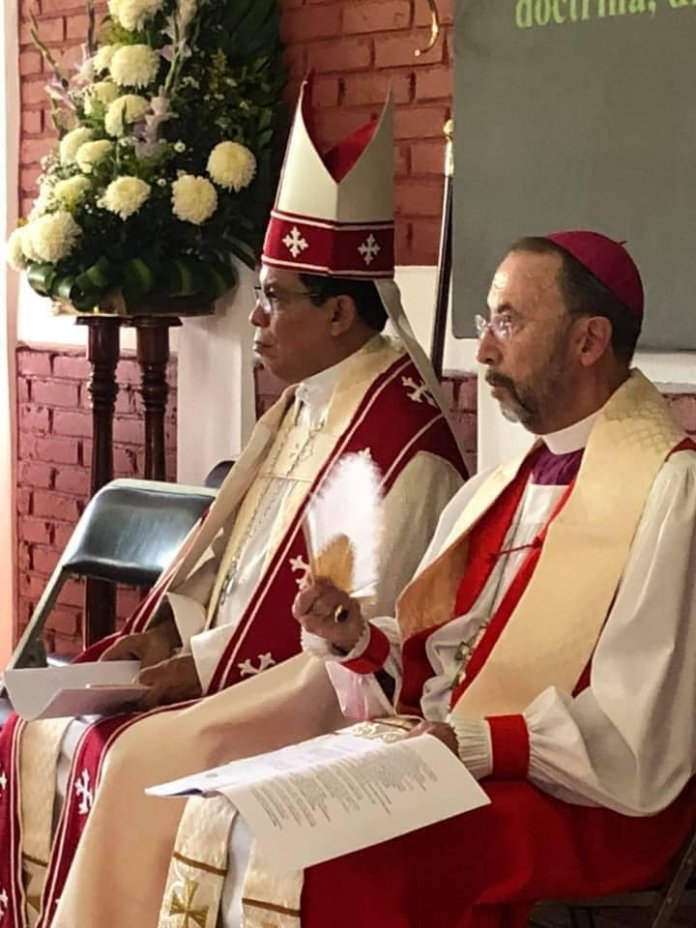
The five-diocese Anglican Church of Mexico has split into two parallel provincial structures, each claiming legitimate authority after disputed elections triggered a constitutional crisis that Mexican federal courts have failed to resolve.
The crisis began at the June 2022 General Synod when the Most Rev. Enrique Treviño Cruz was elected primate in what observers called a flawed and unlawful election. The dissidents, led by the Rt. Rev. Julio César Martín of Southeastern Mexico, withdrew recognition from Bishop Treviño and re-installed the retired former primate, the Most Rev. Francisco Manuel Moreno (74) as “acting primate”. However Archbishop Moreno passed away unexpectedly on April 30, 2024.
The schism has created parallel episcopal structures that show no sign of reconciliation. The Anglican Communion Office continues to recognize Bishop Treviño internationally, while roughly half of Mexico’s Anglican dioceses and clergy remain aligned with the dissidents, who insist “there is currently no valid primate.”
The dissenting bishops make specific accusations that Bishop Treviño’s election was “fraudulent” and canonically invalid. They claim he failed to achieve the required two-thirds majority for a valid primate election, manipulated the voting composition by excluding legitimate delegates, and used an unlicensed notary public to validate official church documents.
The fraud allegations trace back to an April 2022 diocesan election where “five clerics were prevented from entering the voting site” for the election of Oscar Pulido as bishop of Northern Mexico, Bishop Martín reported. The excluded clergy filed written protests claiming they had “suffered threats and coercion” both before and after the election.
When competing delegations from Northern Mexico arrived at the June 2022 General Synod, Bishop Treviño as acting primate admitted only the Pulido’s slate while “blocking attendance by the second delegation.” Bishops Martín and the Rt. Rev. Ricardo Gómez Osnaya of Western Mexico walked out, declaring the primatial election invalid.
Bishop Martín has used his Facebook page to wage a public campaign against Bishop Treviño’s legitimacy. In a June 2025 communiqué titled “Communication to the people of the IAM,” he declared that an “Extraordinary National Synod” convened by Bishop Treviño had “no power to depose diocesan bishops” and that civil habeas corpus actions meant any synodal acts against dissenting bishops were “legally void.”
The bishop has documented what he calls a “historic pattern of electoral manipulation” within the church, claiming “it has long been a practice that certain groups within the church impose their candidates and decide who votes.” He frames the specific incidents within broader institutional corruption, denouncing “a lack of transparency, a tolerance for corruption, and a deficit of democratic values.”
Mexican federal courts have issued contradictory rulings on the dispute. One March 2024 judgment apparently sided with the late Archbishop Moreno and the dissidents, upholding “the deposition of Archbishop Treviño.” However, Treviño has appealed, and final resolution remains unlikely before 2026.
The dissidents have filed federal habeas corpus actions to prevent any synodal actions against them, arguing that “until a ruling is issued and all appeals have been exhausted,” no synod can have “legal, canonical, or judicial effects.”
The church now operates with two parallel provincial structures. The Treviño camp controls the dioceses of Cuernavaca, Mexico, and Northern Mexico. The dissident camp controls Southeastern and Western Mexico dioceses. Each side issues its own synodical calls and communiqués while refusing to recognize the other’s acts.
Treviño has strengthened his position by consecrating bishops who support him, including Alba Sally Hernández as Bishop of Mexico, securing a pro-Treviño majority on the provincial board. He brands Martín and Gómez as “rebels” accused of financial irregularities.
The dissidents counter that Treviño was “not willing to negotiate” and has engaged in “fraudulent acts” by reconstituting the provincial board through “an illegitimate Zoom meeting” without proper procedures.
The Anglican Communion Office continues to list Treviño as primate and invites him to global meetings. Anglican Communion mediators urged dialogue but said the Communion will “recognize Treviño until further notice.” However, the dissidents possess “written testimony supported by audio recordings and signatures of more than 25 clergy and lay people” documenting the alleged electoral fraud.
The next ordinary General Synod, due in 2026, is already contested. Bishop Treviño has called for it to be held in March 2026 in Mexico City, while Bishops Martín and Gómez insist only a court-mandated synod can be convened.
The Anglican Church of Mexico appears headed for prolonged schism. With neither side able to force a final settlement through the courts, canonical processes, or competing synods, the church will likely continue operating with parallel leaderships—Treviño recognized abroad, the Martín-Gómez bloc controlling much of the domestic church structure. Coincidently the geographic divide within the Anglican Church of Mexico also mirrors the north/south, indigenous/European divide within Mexican culture.
The crisis illustrates how disputed elections can fracture small Anglican provinces when canonical procedures fail and civil courts lack clear jurisdiction over internal church governance. Until either a definitive legal ruling or mutually recognized synod emerges, Mexico’s Anglicans face an indefinite period of ecclesiastical division.
Update July 10, 2025. Bishop Martín writes: The very comprehensive and excellent report in the Anglican Ink in broad strokes tells you the truth. Here are some clarifications: 1.-There have been no contradicting court rulings (contrary to what the other side says); all the judges have ruled in our favour. 2.- The entire Judiciary recognises us as the legally Board of Directors and therefore the legal bishops of our diocese and legal representatives of the entire church in Mexico. 3.- There is no schism in the sense that no one has pretended to stablished a parallel structure: we have not called any alternative synod.