
There’s an inherent tension between the world of religion and the field of social science. Lots of people of faith have a worldview that is based, in large part, on a belief in supernatural phenomenon. For them, the existence of angels, demons, and the Holy Spirit is just an assumption of their worldview. When they are confronted with some data that is saying that one church in their community is growing, they often want to attribute that to some type of supernatural cause. “They have God’s anointing” is a common refrain you hear in evangelical circles.
But, social science cannot work from that same set of epistemological assumptions. There cannot be supernatural causes for natural phenomenon – that is completely incompatible with an empirical worldview. If something happens in the world, we should ideally be able to quantify and explain why we are seeing such an occurrence.
The rise of the American megachurch is one of those areas in which these two worldviews come into direct conflict. I’m sure if you polled one of the original members of Life.Church in Norman, Oklahoma to find out how they understand the growth of their congregation to more than 30,000 on an average Sunday, they aren’t going to point to county-level demographic information. But that’s exactly what I’m going to do today. My working assumption is simply this – the geographic area surrounding megachurches provides fertile soil for rapid growth. Yes, I believe good preaching matters and I’m sure that there are some spiritual forces at play, but it’s the macro-level factors that I want to focus on today.
My data sources are two-fold for this exercise. The Hartford Institute for Religion Research’s Megachurch Database contains information on about 1600 churches in the United States that have at least 1800 regular worshippers across all services. I grabbed that information, then merged it with county-level demographic data that is furnished by the United States Census Bureau. After a whole lot of cleaning and merging – I’m ready to show you how I think that megachurches are unique in their geographic location.
Let’s start with a pretty simple question – what does the population growth look like in counties that have a megachurch on the list?
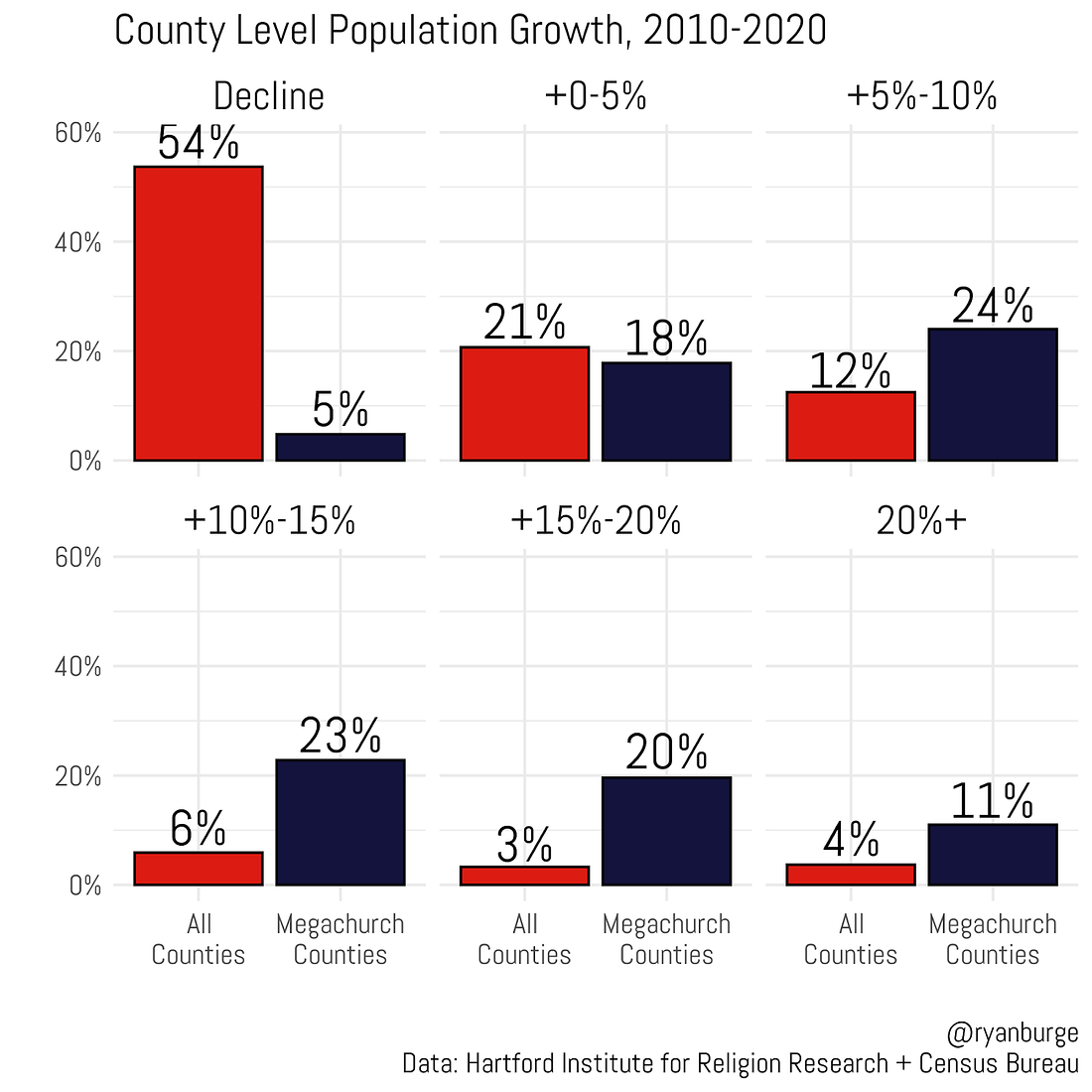
Here’s a pretty stunning fact – of the approximately 3,400 counties in the United States over 1,800 of them experienced a population decline between 2010 and 2020. If your county grew in the prior decade, know that you are in the minority. In this dataset, 54% of counties were smaller in 2020 than a decade prior. In counties where there was a megachurch, just 5% of them reported a smaller population in 2020, that’s just 76 megachurches in total. Where are they? Mainly in the South and the Midwest. But there’s an important caveat to this – very few megachurches are in counties with significant population decline. Only 23 churches were situated in places where the population was at least 3% smaller and just 13 were in counties where the decline was at least 5%.
But the bottom row of this graph basically tells the whole story. Nationwide, about 13% of counties were at least 10% larger in 2020 than they were in 2010. Among counties that contained a megachurch, 54% of them had experienced population growth that was in the double digits between 2010 and 2020. Nearly a third of all megachurch counties experienced at least a 15% growth rate, compared to 7% of the entire country. Of the ten megachurch counties that experienced the fastest population growth, six of them were in Texas, two were in Georgia, and one was in Florida. If you have designs on building a megachurch, head to the South.
So we’ve now established a pretty simple fact – megachurches are almost exclusively located in counties that are experiencing rapid population growth. But does that impact their actual attendance? First, let me show you the distribution of attendance in the entire sample of megachurches…
Read it all at Graphs about Religion