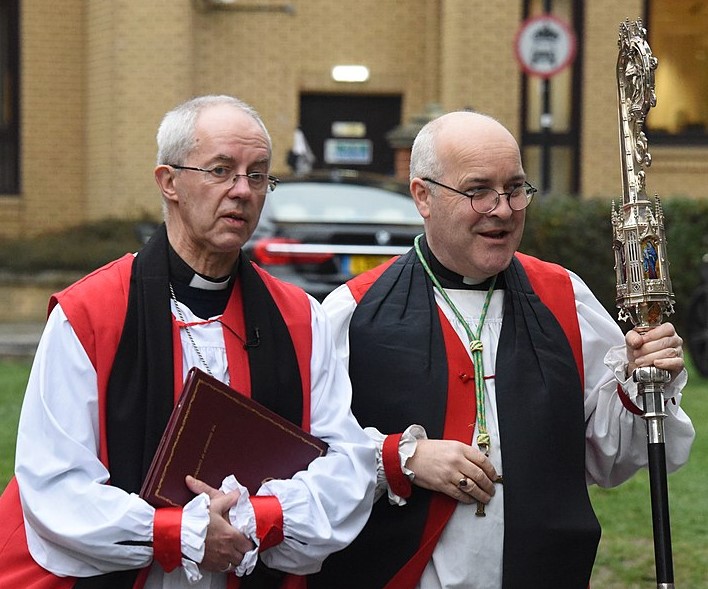
On 15 July Lambeth Palace Press Office issued a statement from Archbishop Justin Welby announcing, among other things, new arrangements for the consecration of bishops who do not accept the ordination of women. These protocols were agreed with Archbishop of York Stephen Cottrell after consultation with the Bishop of London and the House of Bishops.
That same day Will Hazelwood, Bishop-designate of Lewes, was consecrated in Lambeth Palace Chapel by Norman Banks, Bishop of Richborough, assisted by Bishop of Ebbsfleet Jonathan Goodall and Bishop of Fulham Jonathan Baker. All three consecrating bishops are members of the traditional catholic Society under the patronage of St Wilfrid and St Hilda, supported by Forward in Faith.
The concession of allowing a traditional catholic to be consecrated by bishops who do not consecrate or ordain women was made to Philip North by Archbishop of York John Sentamu in 2015. Last week’s announcement and consecration marks a regularisation of the practice. Archbishop Welby’s view that the new arrangements represent the Church of England ‘stepping forward’ in inclusivity is not shared by Chair of Women and the Church, Canon Emma Percy, who detects an unacknowledged ‘theology of taint’ in play.
Although we are repeatedly told that Forward in Faith does not adhere to a theology of taint, this is exactly what the rejection of consecration by the Archbishop or any other (male) bishop who has ordained women looks like. It is, we are told a theology of impaired communion and any Bishop or Archbishop can restore the communion with society priests and bishops by repenting of their support of women’s ministry.
In 2018 the Church of England’s Independent Reviewer, Sir William Fittall, accused the Parochial Church Council of St George’s, Headstone of articulating a theology of taint in its request that the bishop provided by the Bishop of London should ‘not merely be a man who ordains only males to the priesthood but should himself have been consecrated by someone who has not consecrated a woman as a bishop’. Ostensibly oblivious to five hundred years of Anglican practice, Sir William stated that it was ‘doubtful whether such a theology comes within the spectrum of Anglican teaching and tradition, even interpreted at its broadest’.
The Church of England does not need to be in full communion with another Church in order to accept the validity of its orders. Such is the case with the Anglican Church of North America, the Free Church of England, REACH-South Africa, and the Roman Catholic Church – through which Anglican orders are derived.
Traditional catholics have not considered themselves in full communion with most bishops of the Church of England since the ordination of women to the priesthood in 1994, even if – as in the case of Justin Welby and Stephen Cottrell – they accept their orders as valid. This fact, and the large number of parishes to have availed themselves of traditional catholic extended episcopal oversight – some 420 – has commanded a responsive, evolving provision. Two and a half years after the Establishment watchdog savaged a PCC for raising the outstanding issue of consecration, the Archbishops’ arrangements have enabled many traditional catholics to consider their place in the Church of England to be significantly more secure.
Similar arrangements will be used in future consecrations of conservative evangelicals, although they are more exercised by sex than ecclesiology (Rod Thomas seemed content with Justin Welby as his principal consecrator in 2015) and currently focussed on the outworking of the Living in Love and Faith process.
Last week saw the Church of England’s senior management deliver on a necessary aspect of facilitating mutual flourishing. But for both traditional catholics and conservative evangelicals the question remains how long Parliament, egged on by woke warriors, will tolerate its client church allowing a minority of adherents to practise and preach the prescriptions of historic Christianity.


“and the Roman Catholic Church – through which Anglican orders are derived”
No, they aren’t. Anglican orders are derived from the Bible, as with all churches.
Insofar as history is relevant, Christianity was widely established in Britain long before the first representative of the Church of Rome arrive.
The Reformation was a bit more significant than some Anglicans realise.
The Reformation was a bit more significant than some of all types of Christians realise. ;o)
Bishops, presbyters and deacons predate the New Testament, as does the Apostolic Church within which the books of the New Testament were written, compiled and afforded canonical status.
J A T Robinson, the great liberal, believed that all the documents comprising the canon were completed by 70 AD. They were almost certainly all done before 100 AD, with the remotely possible exception of John’s Gospel. I don’t think there were any official “orders” before Paul outlined his “rules” for elders and deacons.
The apostles appointed seven deacons in Acts before Paul was even a Christian. The presbyters in the Jerusalem Church were not appointed by Paul. I doubt that Paul was the first Christian to use the term ‘bishop’ (which he uses interchangeably with presbyter) in the context of church leadership.
The point is that the Church existed before Paul. The New Testament shows the Church at work. It didn’t begin with the writing of Paul’s epistles or cease to develop after his death, hence Newman’s remark that ‘to be deep in history is to cease to be a Protestant.’
“The point is that the Church existed before Paul.”
But not before the apostles. Just because Christ chose Paul to be an apostle later than the others doesn’t change the fact that the apostles came before the church. Jesus commissioned the apostles to deliver His teachings to His church.
From its inception, the church was under the authority of Christ and his apostles. The apostles delivered Christ’s teachings to the church both verbally and in writing, and there is no meaningful difference between either method. The church remains subject to the authority of apostolic teaching today (i.e. the scriptures).
To be deep in history means to be a Protestant.
500 years deep at most.
No, thousands of years. That’s why the Reformers were well-versed in the Church Fathers, for instance.
But not happy with their ecclesiology. The Church of England, however, retained the historic orders of bishop, priest and deacon.
We go back even further than the Fathers.
With a 1,500 year hiatus?
No hiatus at all.
I am glad you wrote “historic”. It is questionable whether the first is Apostolic. Cranmer agreed with Calvin that there was a good argument that “episkopos” in scripture really means the same office as “presbyteros”, i.e. head of a congregation. However Cranmer was happy to keep the office of Bishop for historical reasons, and because it was consistent with the practice we sometimes see in the New Testament of “pastors to the pastors”.
In the same way, Cranmer also agreed that Calvin had a scriptural basis for an order of female deacons, but since it had died out in the patristic church he did not see the need to resurrect it.
Note that both Cranmer and Calvin had a good knowledge of the Church Fathers, rather better than most of their critics today seem to have.
“But not happy with their ecclesiology.”
Not at all – the Church Fathers had little unity on ecclesiology, but the Reformers were in agreement with most of them.
You accept that the orders of bishop, priest and deacon are historic. The English Church became wholly Romanised in the wake of the the Synod of Whitby. Anglican orders are, therefore, derived through the Roman Catholic Church (not from it). That orders of ministry predate the writing of the New Testament is obvious – otherwise the book of Acts woud have been written before the day of Pentecost and the Council of Jerusalem. I don’t see how the views of Calvin, or even Cranmer for that matter, are relevant to the article.
Oh dear, so many misconceptions…:
“The English Church became wholly Romanised in the wake of the the Synod of Whitby.”
This is actually not that important (see following points) but I can’t let it pass – your assertion is inaccurate. Not even Bede, who was unashamedly pro-Roman Church, suggests as much.
“Anglican orders are, therefore, derived through the Roman Catholic Church (not from it).”
No, they aren’t. The church in Britain had bishops priests and deacons long before any Roman representative turned up there.
“That orders of ministry predate the writing of the New Testament is obvious…”
But they don’t predate the apostles, that is what matters. The New Testament is merely apostlic teaching written down as opposed to given orally, but its the same. The church was always under apostolic authority, from its first moment of existence.
“I don’t see how the views of Calvin, or even Cranmer for that matter, are relevant to the article.”
They are relevant to your assertions – you brought this up! In your posts here you have tried to suggest that protestants are out of touch with the Church Fathers, that we ignore 1500 years of church history, and that we aren’t aware of the historical basis of the orders of ministry. In response, I have pointed out that the reformation was in continuity with the early and medieval church, and that the reformers were well versed in the teaching of the church fathers.
Your devices to circumvent linear continuity well illustrate Newman’s obsevation about Protestantism and history. A link in a chain is connected to the rest by the next link. In the case of the Church of England that link is the Roman Catholic Church.
Your idea of the tidy coinherence of apostolicity and the New Testament is not shared by Martin Luther, who relegated some New Testament books to an appendix and said in his 1522 preface to the the epistles of James and Jude ‘What does not teach Christ is not apostolic, not even if taught by Peter or Paul. On the other hand, what does preach Christ is apostolic, even if Judas, Annas, Pilate, or Herod does it.’
The concept of apostolicity and catholicity in the Nicene-Constantinopolitan Creed, which Anglicans recite at Holy Communion, entails a recognition of the continuation of apostolic authority after the time of the apostles, not to reinvent the faith but to be led by the Holy Spirit into ‘all truth’. There were no Protestants at the Councils of Nicea or Constantinople, only Catholics.
“A link in a chain is connected to the rest by the next link.”
So since the church in Britain had bishops, priests and deacons before any Roman representative set foot there, you have just proved my point – thank you.
“not shared by Martin Luther,”
That’s a good thing – why would I want to share in Luther’s error?
“Nicene-Constantinopolitan Creed, which Anglicans recite at Holy Communion, entails a recognition of the continuation of apostolic authority after the time of the apostles”
It certainly does – in Scripture! That is apostolic authority. No human being has such authority, nor has had it since the last apostle commissioned by Christ passed from this earth.
“There were no Protestants at the Councils of Nicea or Constantinople, only Catholics.”
All those present were both protestant and catholic, just as protestants today are catholic, if they follow scripture.
The presence of bishops, priests and deacons in the British or Columban Churches is not in dispute. At the the time of the break with Rome, however, the English Church’s clergy had for centuries been ordained within the regimin of the Roman Church. The Roman Church is the immediate link in the chain and that is the reason why Roman Catholic orders are recognised as valid by the Church of England.
Is it by a different take on Martin Luther’s own principle of sola scripture that you find him to be in error? Do pre-sixteenth century Christians have the right to refuse honorary Protestant membership?
A credible, historically-informed understanding of apostolicity is found in the 1947 ‘Catholicity’ Report commissioned by Archbishop Geoffrey Fisher:
Among the diversities of office the apostolate is unique. The apostles were commissioned by our Lord, and had authority to rule, to teach and to ordain in the new Israel – representing Him who is King, Shepherd and High-priest. They were integral to the existence of the new Israel. They were the authorised eye-witnesses of the original events of the Gospel; but otherwise their functions remain in their successors – namely to teach, to rule, and to ordain in the name of Christ and of the whole Church. …
Out of (the) complex of Christian life, lived and embodied in dogma, worship and institutions, proceeded the Scriptures of the New Testament, which presuppose and interpret the faith and ‘the Way’ from within which they are written. To abstract them from the setting and life and belief which produced them (in other words, to oppose ‘Scripture’ and ‘Tradition’) is wholly artificial and arbitrary.
I don’t have the erudition of Michael A, but I do recognise a bit of arch-episcopal contradiction when I see it. The NT did not arise out of any “institutions”. It consists of apostolic documents, at least some of which were written before 70 AD and were written by people who had apostolic authority to teach, as Fisher says in the first paragraph. What he must have meant to say was “out of the Spirit-inspired minds of some of the apostles proceded the Scriptures…”. Those documents existed long before the canon of Scripture was formally recognised and at a time when “worship and institutions” were much more fluid than they became later.
On another tack, I don’t know why you continue to quite Newman, a great expert in sophistry.
The word “catholic” was retained by the Reformers and others presumably because they refused to let the word be the sole property of those who had departed very far from NT doctrine. Protestants are really more entitled to the word than “Catholics”!
Good point David.
Many today also do not realise that the word “protestant” did not so much carry an implication of protesting against something, but rather of testifying for the truth.
Hence it is reasonable to use the word to describe such early Christians as the church fathers at the council of Nicaea, as they were testifying for God’s truth against the heresy of Arianism which had infected many parts of the institutional church. This is the sense in which the 16th century reformers saw themselves as protestants. Semper reformanda.
“however, the English Church’s clergy had for centuries been ordained within the regimin of the Roman Church.”
That is the assertion by Romanists, but it is simply not correct. You are trying to assert that the orders of an English priest or bishop in the 4th century AD were somehow different to the orders of an English priest or bishop in the 8th century AD (or in the 15th century AD or whatever), because the latter now had a connection with Rome. That won’t wash. Bishop Restitutus of London in the 4th century was just as much a bishop of the church as Bishop Grosseteste in the 13th century – no more, and no less.
At different times in history, the English church has consented to the primacy of the Bishop of Rome, to varying degrees. But at no time did such consents (or their withdrawal) change the nature of English orders.
“The Roman Church is the immediate link in the chain”
Even to the extent that is accurate, it is irrelevant. See above.
“and that is the reason why Roman Catholic orders are recognised as valid by the Church of England.”
That is obviously not true. The Church of England recognises the orders of many different churches, including those of churches that are older than the Roman church.
“Is it by a different take on Martin Luther’s own principle of sola scripture that you find him to be in error?”
Not at all. While we are on the subject, why do you find him in error on this point? – because if you are truly Roman Catholic then you agree that Luther was wrong to argue that the books of Jude and Peter are not scripture.
Also, please note that the principle of “sola scriptura” is not “Martin Luther’s own”. It was used by theologians for centuries before Luther.
“Do pre-sixteenth century Christians have the right to refuse honorary Protestant membership?”
Do they have the right to refuse honorary Roman Catholic membership? I suggest you check on the meaning of both catholic and protestant. You will be surprised.
“A credible, historically-informed understanding of apostolicity …”
Archbishop Fisher’s teaching is scriptural, until the point where he writes: “but otherwise their functions remain in their successors…”. Nothing in apostolic teaching justifies such a conclusion. The apostles made clear that even as a body they could not commission another person to join their ranks – such a choice could only be done by God’s direct action (Acts 1:23-26). In this post-apostolic age, the church commissions bishops, priests and deacons but it has no power to commission apostles.
I will draw this exchange to an end content that anyone who cares to read it may find food for thought.
Theological identity in Christ is not commensurate with the empirical identity of the Christian Church. There is English and there is Roman, but there is neither Jew nor Greek.
Identity in Christ is not theological, but ecclesiological – by membership of his body, the Church.
Point taken. It is a divine institution with a social expression.
I think we may be at cross purposes. I didn’t say that the Body of Christ constitutes a social expression of the divine institution. As the ‘blessed company of all faithful people’ It constitutes redeemed society.
The Church is the visible instrument of the Gospel in England and in ‘all nations’. The spiritual unity individual Christians have in Christ and the Father should be a feature of the visible Church which Jesus prayed ‘may be one … that the world might believe’. The extent to which the many expressions of the visible Church can demonstrate oneness in Christ depends on the degree to which they are possessed of catholicity – that which belongs to the whole. Women bishops, presbyters and deacons are uncatholic, hence the context of the article.
I am merely associating the Church of England with what it claims to be – part of the one, holy, catholic and apostolic Church, sharing the historic epscopate with other Churches, including the Roman Catholic and Orthodox Churches.
I have both ears to hear and eyes to see the words of scripture, which clearly stipulate the gender of bishops, presbyters and deacons – 1 Timothy 3.2, Titus 1.5-6, 1 Timothy 3.12.
The Church is not so glorious as to exist only in the nebulous realm of pious imagination.
Are you saying that the scriptural ‘assumption’ of the gender of bishops, presbyters and deacons is merely sociologically determined? What then of the biblical narrative from Adam and Eve to God’s marriage to Israel, Christ as bridegroom and the Church as bride, and marriage between a man and a woman as a sign of the ‘mystical union that is betwixt Christ and his Church’?
The catholic position was succinctly and eloquently expressed by C S Lewis (‘Priestesses in the Church?’ 1948):
Suppose the reformer … says that we might just as well pray to ‘Our Mother which art in heaven’ as to ‘Our Father’. Suppose he suggests that the Incarnation might just as well have taken a female as a male form, and the Second Person of the Trinity be as well called the Daughter as the Son. Suppose, finally, that the mystical marriage were reversed, that the Church were the Bridegroom and Christ the Bride. … Now it is surely the case that if all these supposals were ever carried into effect we should be embarked on a different religion.
I fail to see the relevance of your reference to skin colour and baptism into Christ. The quality of being a husband of one wife is, by definition, expressly gender specific.
That is something that both Catholics and true Evangelicals can read and understand clearly.
The words ‘wood’ and ‘trees’ come to mind.
I refer again to the ‘Catholicity’ report, cited above:
Out of (the) complex of Christian life, lived and embodied in dogma, worship and institutions, proceeded the Scriptures of the New Testament, which presuppose and interpret the faith and ‘the Way’ from within which they are written. To abstract them from the setting and life and belief which produced them (in other words, to oppose ‘Scripture’ and ‘Tradition’) is wholly artificial and arbitrary.
Female bishops, presbyters and deacons are both unbiblical and uncatholic.
If its unbibilical then its not the will of God, so that issue won’t arise.
Good point.
“If we are not simply proof reading, what the text does or does not say expressly is not decisive.”
With respect, that sounds like sophistry – trying to find a way to argue around the plain words of Scripture, simply because the prevailing spirit of our age doesn’t like what it says.
We aren’t called to proof-read scripture – we are called to read it and obey it.
“What I would say is that gender is incidental insofar as the express qualities required of bishops and deacons are moral, not biological (1Tim 3).”
The express qualities required of bishops/presbyters include that they must be male.
“but insofar as biblical language is gender specific it does not follow that masculinity is a theological category”
We can call it whatever we like. Scripture teaches us that leaders of congregations are to be male, among many other things. That is what matters.
“A link in a chain is connected to the rest by the next link.”
So since the church in Britain had bishops, priests and deacons before any Roman representative set foot there, you have just proved my point – thank you.
“not shared by Martin Luther,”
That’s a good thing – why would I want to share in Luther’s error?
“Nicene-Constantinopolitan Creed, which Anglicans recite at Holy Communion, entails a recognition of the continuation of apostolic authority after the time of the apostles”
It certainly does – in Scripture! That is apostolic authority. No human being has such authority, nor has had it since the last apostle commissioned by Christ passed from this earth.
“There were no Protestants at the Councils of Nicea or Constantinople, only Catholics.”
All those present were both protestant and catholic, just as protestants today are catholic, if they follow scripture.
I doubt that Paul was interested in formalised “orders”. The role of an elder or a deacon was for a particular task, usually in a specific place. An elder in Ephesus for example would probably not be recognised as an elder in and for Corinth. If he were to work as an elder in Corinth he would probably need to be set aside or “ordained” afresh. I once asked D W B Robinson why we ordain priests and deacons in a general way rather than to a specific position and he agreed that it was not the ideal. He added that at least in Sydney Diocese, where he had been bishop and archbishop, men were ordained to particular parishes or ministries, even though they were from then on recognised as “priests at large”, as he put it.
“The apostles appointed seven deacons in Acts …”
Precisely. The church was under the authority of the apostles from its inception.
“The point is that the Church existed before Paul.”
But not before the apostles.
“It didn’t begin with the writing of Paul’s epistles”
Correct – it began with the teaching of Christ and his apostles.
“or cease to develop after his death”
Of course, but its highest authority (Apostolic teaching) did not develop after the last apostle passed from this earth.
This is why we say that to be deep in history leads one to be a Protestant.
Correct, DM.
The church from its inception was under the divinely-ordained authority of the apostles. They gave their teaching to the church verbally and in writing.
By definition, the corpus of their writings were complete before the last apostle left this earth. Thus the church has never been without the teaching of the apostles, and the church has always been subject to that teaching.
“Bishops, presbyters and deacons predate the New Testament”
Not in any sense that matters. What we call the New Testament is simply apostolic teaching, as written or personally authorized by the apostles. From its first existence the church was under the authority of the apostles, and all its institutions including bishops presbyters and deacons came about from apostolic authority.
“as does the Apostolic Church within which the books of the New Testament were written, compiled and afforded canonical status.”
It is important we do not conflate the church and the apostles when discussing authority. The apostles ruled the church, by divine order (i.e. that’s what Jesus commissioned them to do). The apostles either wrote or authorized all new testament scripture. The corpus of scripture was complete by the time the last apostle left this earth.
The church could compile scripture, that is correct. And it could recognise the status of scripture. But the church could not of itself confer any status on scripture – it could only recognize and testify to the status that scripture inherently possessed from the time it was written.
“But for both traditional catholics and conservative evangelicals the question remains how long Parliament, egged on by woke warriors, will tolerate its client church allowing a minority of adherents to practise and preach the prescriptions of historic Christianity.”
A good point – the British government and parliament have not been kind to traditional Christianity in recent years.
What is ordination? What is consecration? Are they magical formulae by which a person is transformed into something else, or are they simply the recognition, with as much or as little ceremony as you like, that a man (or maybe a woman being deaconed) is deemed worthy of holding office as a church leader of some sort? As for “taint”, I am a tainted sinner ministered to by tainted clergy and ‘taint a bad thing.