
Beloved in Christ Jesus: Greetings in the name of the crucified, risen, and ascended King, our Lord Jesus Christ!
[28 Oct 2019] I write to you from Wittenberg, Germany, where Martin Luther began the Protestant Reformation 502 years ago by posting his 95 Theses on the doors of the Castle Church.
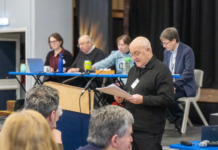
This month has seen an historic step in the life of the Anglican Communion. It was my privilege to be the chief consecrator, along with Co-consecrators, Archbishop Laurent Mbanda of the Anglican Church of Rwanda and Gafcon Vice-Chairman, and Archbishop Glenn Davies, the Archbishop of Sydney, as the Revd Jay Behan became the first bishop of the new diocese of the Church of Confessing Anglicans Aotearoa, New Zealand (CCAANZ) at a joyful ceremony in Christchurch New Zealand on 19th October in the presence of a congregation of 650 supporters, with 19 international leaders present and greetings from Anglican Primates around the world.
Archbishop Peter Jensen delivered a powerful sermon in which he reminded us that the Church must always align itself with the unchanging priorities of Jesus and his Kingdom. He said,
“What we are doing is only right if it is in obedience to the Lord Jesus Christ. We are to make disciples of all nations. This service is about Jesus and the gospel. We are not to become defensive and polemical but set to a grand task of preaching an authentic gospel to be preached throughout this land.”
We did not start a new Church in New Zealand. We simply did what we as confessing Anglicans have been doing since the Gafcon moment of 2008 became a movement; we are ensuring that faithful Anglicans can maintain a clear and certain witness to Jesus Christ in contexts where the existing Anglican leadership has effectively made orthodox biblical faith optional.
There are of course orthodox Anglicans in Aotearoa New Zealand who do not yet believe it is time to leave their traditional home. I admire the strenuous efforts of the CCAANZ leadership to try and preserve good relationships, but their overriding conviction is that the action they are taking is about ‘Not just us, not just now’.
They are convinced that ‘not just us’ means they must look beyond their own immediate parish context to address the shift that has taken place in the wider church. And that this is ‘not just now’; we only have to look at North America and the UK to see that that once the process becomes established, the secular captivity of the Church proceeds relentlessly, and it is only wise to be prepared. Although currently only 12 parishes, it must surely be only be a matter of time before the Canterbury recognised Anglicans in New Zealand follow the example of other liberal provinces by officially changing their canons to permit same sex marriage. CCAANZ is now the future of faithful Anglican witness in New Zealand.
Indeed, the wisdom of ‘not just now’ has already been illustrated by what can only be described as an intemperate attack on the newly formed CCAANZ by Archbishops Donald Tamihere and Philip Richardson who have issued a statement in which they protest about ‘boundary crossing bishops and their alleged ‘disrespect for the normal protocols of the Anglican Communion and the lack of courtesy shown to our church’. Here we see a leadership which is quick to protest when it feels that ecclesiastical geographical boundaries are being set aside, but happily condones the breaching of God’s clear moral boundaries taught in Scripture and by the Church for two millennia.
The collect for today, the Feast of Ss Simon & Jude, Apostles, gives us the perspective of the Church through the ages as we pray:
Almighty God, who built your Church upon the foundation of the apostles and prophets, with Jesus Christ as the chief cornerstone; so join us together in unity of spirit by their doctrine, that we may be a holy temple acceptable to you; through Jesus Christ your Son our Lord, who is alive and reigns with you, in the unity of the Holy Spirit, one God, now and for ever. Amen.
This is a prayer that takes us to the heart of the Gafcon movement and true Anglicanism because we find our unity first and foremost in the apostles’ doctrine. When this is abandoned, there is nothing to fall back on except appeals to protocol and ultimately, as we have seen in North and South America, litigation. This is a question which faces the whole Anglican Communion as bishops have to decide if they will attend Lambeth 2020. With the presence in good standing of four bishops in same-sex unions, it legitimizes and normalizes unbiblical marriage and will reshape the Canterbury Communion as a fellowship of churches bound simply by protocol and no longer by the Apostolic Faith.
Let us remember to pray for the renewal and revival of the Anglican Communion so that Christ may be faithfully proclaimed to our nations in the power of the Holy Spirit with a return to adherence to the teaching of Holy Scripture.
Your brother in Jesus Christ,
The Most Rev. Dr. Foley Beach
Chairman, Gafcon Primates Council



Some years ago I realised that Martin Luther Day (as I have named it) was a good chance to let people know a bit about the man’s significance and maybe get people thinking about the gospel. Last evening many children small, medium and large, with some parents in tow, called at the front door seeking a treat in the form of lollies (Americans please read “candy”) on pain of the threat of a trick otherwise being performed. They each received a small envelope, with sugary treat inside plus a short paragraph on the envelope about Martin Luther. Unlike the use of the saying by many Anglican leaders, in this case I think maybe I am justified (word chosen carefully, as per St James) in putting into practice the admonition of “if you can’t beat them, join them”. It is also clear that parents who let and sometimes encourage their children to dress as ghouls and talk of trick and treats can hardly complain if the householders thus threatened reply with an invitation to consider the teachings of the Bible.
A nice approach. Let the children have their sweets, and add the Gospel.
The 39 Articles include what appear to be the Calvinist doctrines of election and predestination (in Article 17). These doctrines are plainly heretical, being inconsistent with the overall teachings of the Bible on the nature of God and God’s relationship with people. Calvinism is very damaging spiritually. Please do “return to adherence to the teachings of Holy Scripture”. A biblical understanding of how God relates to us is essential for spiritual health. Calvinism is a human system that appeals to the intellect and pride of man. No church should countenance it.
May you tell me which of the articles you consider to be “plainly heretical”?
cancel
It’s not just Calvinism but many of the elitist super nuanced theological theories that drift so far from Christianity the message gets lost and the result is salvation is only available to the self proclaimed good people. Calvin’s experiment in practice in the Geneva commune didn’t go so very well. Reminds me of the missionaries sent to Christianized the savages of the Hawaiian Islands. Heaven wasn’t available to Hawaiians because if they were among God’s elect they wouldn’t be savages to begin with. As James Michener famously stated the missionaries went to Hawaii to do good and ended up doing well; Castle and Cook, Dole etc. There. We’re back at the prosperity gospel. God’s intention was all along to make his elected good people prosper. Whatever.
Election and predestination are so obvious in Scripture that I can’t see how they can be missed. Calvinism doesn’t appeal to our pride- just the opposite is in fact the case. If we believe that in the end our salvation is all of God and that we can contribute nothing there is no room for pride.
I suppose it was unwise of me to introduce this topic in the comments section. There is a vast body of anti-Calvinist literature (qv). But the topic is a bit like climate change, each side being impervious to the arguments of the other. My summary is that God cannot be said to have predetermined to eternal damnation some individuals, because God offers salvation to ALL (John 3:16). Scripture plainly says that God is not willing that any should perish (2 Peter 3:9). NT passages supposedly supporting Calvinism are about corporate (not individual) election and predestination, as in the OT. The individual is called on to repent (which therefore he must be able to do when unregenerate) contra the doctrine of Total Depravity. Christ died for all, contra the doctrine of Limited Atonement. Article 17 enforces the doctrine of Election and Predestination, seemingly for the individual.
So, you regard Sts Augustine and Aquinas as heretics also. Gotcha.
Maybe you’re right about broaching this topic on a comments section, but on the other hand, why not? It’s a forum for discussion. It’s a Reformation Day post… I’ll just say that the 39 Articles are notable regarding what they leave unsaid sometimes. This is especially the case re: article 17. It does not speak about double predestination. The logical inference which you, and others, draw from it needs to be left unsaid because it’s saying too much. There is, to state the obvious, a profound mystery here between individual freedom and divine providence. You’re right to say that the literature probing the intersection (in so far that we can comprehend the intersection) between the two is vast.
The basic question which the gang on your side needs to consider is what is the nature of the Lord God’s relationship towards the creation he has made and which he sustains. This extends to the individual soul as much as collectives – from subatomic particles to unfathomably massive galactic anomalies countless light years away from us.
If the Lord, in his omnipotence and precisely because of his omnipotence, allows us individuality (h/t Kierkegaard) and if this individuality includes freedom at the expense of providence, then you may be in the awkward situation of believing that the Holy Spirit has refused to be of effect in directing the life and witness of the Church. This is especially regarding the development of doctrine and not mere occasional or regular moral failings within the Church. It’s clear that you think Pelagius should have a feast day, and Augustine and Aquinas should not be Saints. But if our freedom can roam unfettered from divine providence, who’s to say? Quite apart from big Church development issues, if your salvation rests on your freedom alone, you must assume that your salvation fazes in and out of existence in accordance with your will. Do you trust your free will to this extent? I don’t trust mine much beyond the realm of my daily treadmill, and even then…
Article 17 was meant to be a comfort to believers and not a double predestination cudgel.
I might add that true Calvinists believe very strongly in preaching that commands all people everywhere to repent. That’s a major reason why almost all the men in England involved in the early missionary movement in the late 18th century were Calvinists, as were almost all the Puritans and great evangelistic preachers such as Whitfield, Edwards, Spurgeon, Rowland and Lloyd-Jones.
“We simply did what we as confessing Anglicans have been doing…”
Anglicans are not within a confessional Church. Never have been.
“…since the Gafcon moment of 2008 became a movement…”
The times, they are a changing.
Anglicans do not recognize marriages between people of the same sex. Never have.
See how the game is played? Now it’s your turn.
Yes. Allow me to add… Anglicans were not a “confessional church” while it prayed and believed in accordance with the 1662 (or a close variation of it, eg 1552 BCP or the Canadian 1962 BCP). In accordance includes the reformed catholic theology upon which the classic BCPs rest and which they express. The liturgy itself (along with key other documents linked to it) embodied the beliefs. There wasn’t theological homogeneity of course, as BCP revision indicates, but it was all more, rather than less, reformed Catholic. So, when rapid and localised liturgical innovation began, so too began (or accelerated) rapid and localised theological difference (and disorder). To be clear, there were also underlying theological tensions waiting to be released from the stricture of classical liturgy – liturgical innovation was like pouring an accelerant on a smouldering fire. Anyway… So, yes, theological anthropology is a key flash-point for our current debates surrounding what may or may not be oriented towards holiness, but it’s not the only issue. While GAFCON is rightly standing its ground on the specific issue of marriage within the context of broader theological anthropology and holiness, it does not represent a recovery of classical anglicanism in any sort of coherent way. But, GAFCON has a better chance of doing so than do the liberal protestants. GAFCON needs to pray in common and in communion with the saints of old. The classical BCPs and the 1 year lectionary help that to happen. Liturgical variation of the breadth that exists now confuses and hinders it. In this I think, while being quite good in some respects, the new ACNA BCP was a missed opportunity. Ho hum… Confessionalism isn’t ideal classical Anglicanism. It’s reactive.