
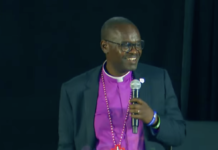
The Bishop of Western Louisiana has rescinded his permission to the clergy to celebrate virtual Eucharists. On 17 April 2020 the Rt. Rev. Jacob Owensby wrote to his clergy to state the Presiding Bishop of the Episcopal Church, the Most Rev. Michael Curry, had asked him to rethink the innovation where priests would consecrate the elements over the internet.
On 13 April 2020 Bishop Owensby wrote to his clergy on “virtual Holy Eucharist”. He stated:
“I’m writing today to send you Easter greetings, but also to introduce a new standard for Sunday worship. We will now move to what many are now calling Virtual Holy Eucharist.”
“We will continue the practice as long as the pandemic requires that we stay at home for the common good. I take this measure because there have been indications that we may be in for a longer haul than was initially anticipated.”
“Simply put, priests who have the technical know-how, the equipment, and the inclination will live-stream the Holy Eucharist on Sunday (or other appointed times). Instead, they may refer you to my weekly Eucharist. The people will attend from their own homes, maintaining physical distance as before. The people will provide for themselves bread and wine (bread alone is also permissible) and place it on a table in front of them.”
“The priest’s consecration of elements in front of her or him extends to the bread and wine in each of family’s household. The people will consume the consecrated elements.”
“Do watch for announcements from your own congregation. My worship service will come to you through Facebook Live. Others may decide on a different approach. As mentioned above, priests also have the option to direct their congregations to the Virtual Holy Eucharist that I will celebrate every Sunday at 10:00 a.m. CDT.”
“Take care of yourselves, my friends. Make space for your own time in prayer and study. Tend your body’s needs of rest and nourishment. Nurture your souls with friendship and outdoor time. Bless you all. You are loved.”
Creative solutions to continue worship for congregations locked out of their buildings by the Coronavirus epidemic has been seen in liturgical churches around the world. The Archbishop of Sydney the Most Rev. Glen Davies on 6 April 2020 asked his clergy to be creative during a time of pandemic-driven church closures.
He wrote:
“I see no reason why we could not broadcast a minister celebrating the Lord’s Supper with the customary bread and wine. Members of the parish could participate in their own homes via the internet consuming their own bread and wine, in accordance with our Lord’s command. Following the service on screen, as led by the minister, members of a household could actively share in the communion, the remembrance and the proclamation of our Lord’s death.”
This virtual communion would have spiritual efficacy, he argued. “Their fellowship with the body of Christ would be no less spiritual and no less real. We must not fall into the erroneous mindset of thinking that consecration of the elements is only valid for us if we are physically present to consume them, as if there were magic in the hands of the minister.”
He explained: “Cranmer’s prayer of consecration was a prayer offered to God, that the elements of bread and wine would become for us, the body and blood of our Lord. That is, their signification was no longer mere bread and wine (as a wedding ring is not merely a piece of precious metal). As we hear this prayer said by the minister, the Holy Spirit, in accordance with God’s promises to feed his flock, is the one who communicates to us the spiritual benefits of eating the body of Christ and drinking his blood. We may not be physically present with the church gathered on earth, but we are always present with the heavenly assembly.”
Presiding Bishop Curry, however, was not persuaded these approaches were permissible under the rubrics of the Episcopal Church.
In a follow up letter to his clergy, Bishop Owensby wrote on 17 April 2020:
“After a gracious conversation with the office of the Presiding Bishop,” Owensby wrote, “I understand that virtual consecration of elements at a physical or geographical distance from the Altar exceeds the recognized bounds set by our rubrics and inscribed in our theology of the Eucharist. I am grateful for the collegiality of the House of Bishops and the love expressed to me, and to all of us, in the conversations I have had.”


How does one become a bishop without having encountered the rubrics of the prayer book, or instruction in seminary? Or, for that matter, how does one become a bishop without having had a passing grade in one’s confirmation class?
How? Reminds me in one diocese a priest told me the election for a new bishop (this was in the days before the internet) after many ballots no decision could be made. It was asked if the 2 remaining candidates could present themselves so the delegates could see them. After this it was a landslide victory. The candidate who won, won a beauty contest. Unfortunately, I believe that most bishops are not elected based as the church likes to say by the inspiration of the Holy Spirit but by the criteria and desires of the people. Today that is are they socially progressive so it appears that the church fits into secular culture of today.
This reminds me of the old definition of a liberal Anglo-Catholic: “someone who believes the Body of Christ is literally present in the elements of the Eucharist while also believing that the Body of Christ is literally present in a tomb in Palestine.” It really astonishes me how some Episcopalians can be so literal in discussing the rubrics and the particulars of Eucharistic theology while being so loose about the teaching of Scripture in matters of Christian faith and morals.
because for unbelieving ritualists it’s not the remembrance of the crucified Christ, nor looking up to the Risen Christ, nor looking forward to his coming but what they do here and now, dressed up like the Mikado,.
That was Cranmer 1549. Cranmer 1552 has no consecration of elements , 1662 added the heading “Prayer of Consecration with an Amen after it. Cranmer’s intention in 1552 is that the high point of the service is not “consecration” but reception, with the words of institution ,( which are really words of invitation addressed to recipients not elements)