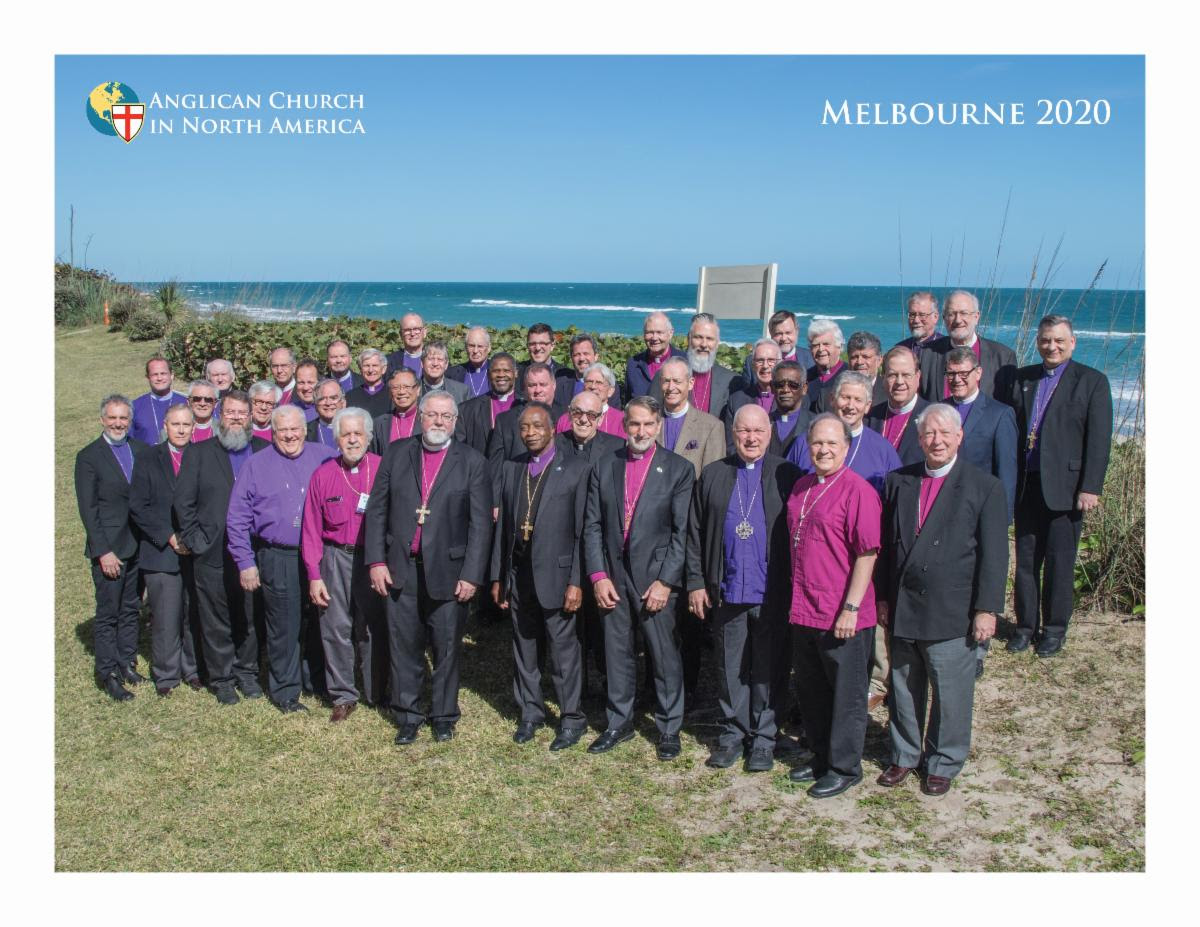
Introduction We began our meeting on Monday, January 6th by celebrating the Feast of the Epiphany, and concluded our meeting on Friday, January the 10th. We began each day in worship of Almighty God with preaching from the Scriptures and the celebration of Holy Communion. Our business and fellowship throughout the day was punctuated with Midday Prayer and Evening Prayer. It was a great joy to use the Book of Common Prayer 2019 for each of our divine worship services. On Thursday, we were blessed by the generous hospitality of Prince of Peace Anglican Church in Melbourne, Florida. Their clergy, staff, and volunteers hosted us for lunch, and, meeting in their consecrated space, we consented to the election of Bishop R. Charles Gillin as bishop ordinary of the Diocese of the Northeast and Mid-Atlantic (REC). More about the election can be read here.
Clergy Care, Health, and Wellness As bishops, we have an ongoing commitment to care for our clergy and their families and to equip our clergy to care for their people in the midst of the world. We gave thanks for Archbishop Beach’s Epiphany letter to the clergy of our province which provided practical, biblical advice for developing and maintaining a healthy and balanced life. We commend the letter in its entirety to all of our clergy, as well as those lay leaders, such as vestry members, who share a responsibility for the health of their parish culture. Recognizing the importance of the physical health of our clergy and their families, we spent time discussing our concerns about the rising cost of health care. Also this week, Jay Haug, representing the ministry Living without Lust, was invited to make a presentation to the bishops. In a measured but straightforward way, he reminded us of the staggering statistics of pornography involvement in all sectors of our society, including the church. The internet has radically increased access to pornography and dramatically lowered the age at which it is first experienced. Having drawn our attention to the huge challenge, which we must not ignore, Haug shared strategies and resources to go beyond the outward behavior to the heart of the problem, which is the root of desire. The good news is that there are effective support groups available and principles for recovery for the many who are caught in addiction and there is assistance for all to help avoid any involvement in pornography.
Prayerbook & Catechism We gave approval to a traditional language version of the Book of Common Prayer 2019. Parts of the traditional language version will be available electronically in the near future and the book will be in print by the summer of this year. We also received a report from the Prayer Book Task Force. They are producing an Altar Book for the Book of Common Prayer 2019, the book Occasional Services, and a lesser feasts and fasts book to be called Sanctifying Time. The College commends the work of the members of the Task Force and thanks God for the contributions they have made to the wider Church. The College also learned of the appointment of an expanded Music Task Force, now under the chairmanship of Mr. Mark Williams of Christ Church Anglican, Savannah, GA, and its new website, www.acnamusicresources.com. We received with great joy the final version of the Catechism, To Be a Christian. We were thankful to be joined by leaders of Crossway Books, Mr. Anthony Gosling, COO of Crossway, and Mr. Dane Ortlund, Chief Publishing Officer, who presented us with copies of the final edition of the catechism straight from the press. We expressed our appreciation for Crossway and the partnership we have developed over the years. The Catechism will be in stock later this month, and is now available for order.
Issues of Race Following a video presentation by the Rev. Dr. Esau McCaulley, Director of the Anglican Church in North America’s Next Generation Initiative, and the Rt. Rev. Alphonza Gadsden, Bishop of the Diocese of the Southeast (REC), the College spent time in discussion and prayer about issues of race, racism, and recent mass shootings. Particular attention was given to the great need for multi-ethnic outreach and church planting, ensuring that all peoples are reached for Christ and to addressing the public witness of the Province and our dioceses on matters of justice.
Via Apostolica Last year, on January 10, 2019, Bishop Todd Atkinson was accepted into the College, while the jurisdictional status of his churches in Canada, called “Via Apostolica,” was still to be determined. At this meeting of the College of Bishops, exactly one year later, the following proposal, moved by Bishop Charlie Masters, Bishop of the Anglican Network in Canada, was presented and accepted: “This College of Bishops recommends to the Provincial Executive Committee and Provincial Council the establishment of Via Apostolica as a Provincial Missionary District under Canon 12 and recommends Bishop Todd Atkinson be designated a ‘Bishop for Special Mission” to lead this ministry.’ This will next be presented to the Executive Committee in February of this year and the Provincial Council in June.
Global Relationships The Anglican Church in North America continues to maintain and develop strong, strategic, and growing relationships with Anglican provinces around the world. Through the international ministry of Archbishop Beach and as a result of his ministry as Chairman of the Gafcon Primates’ Council, the global missional relationships and outreach of the Province have been strengthened through new and existing partnerships. The Gafcon Primates’ Council represents the majority of the world’s active Anglicans. The bishops of the Anglican Church in North America welcome the invitation to attend and participate in the Kigali 2020 Bishops’ Conference in June which will provide an opportunity for the bishops of Gafcon to stand together, uphold the faith once for all entrusted to the saints, and strengthen gospel and ministry ties that bind us together in Christ. The College also received a report from Canon Phil Ashey and Bishop Bill Atwood (Dean of International Affairs) on the Global South Anglican Covenant adopted by the 7th Global South Assembly in Cairo on October 11, 2019. This Global South “Cairo Covenant” addresses the “ecclesial deficit” or lack of discipline for false teaching in the Anglican Communion. Gafcon continues to address the “gospel deficit” of false teaching by proclaiming Christ faithfully to the nations, and authenticating Biblically faithful Anglicans. The College recognized the different charisms that Gafcon and the Global South have expressed in upholding the faith once delivered to the saints (Jude 3) and rejoice in the renewed opportunity presented by the Cairo Covenant for both Gafcon and the Global South to work together for the sake of Gospel mission and the recovery of genuine Communion among Anglicans. The College received the invitation to review the Cairo Covenant in preparation for ratification by the Provincial Council in June 2021.
Ecumenical Relationships We celebrate the work of our Ecumenical Task Force and thank God for our ecumenical partners. We have endorsed concordats with the Episcopal Missionary Church and with the Independent Catholic Philippine Church (also known as the Iglesia Catolica Filipina Independiente). These concordats will be presented for approval to the Provincial Council in June. We continue dialogue with numerous church bodies with the goal of healing the Church and working towards Christian unity. Two guests from the New Day Kingdom Assembly Church were observers at the College as their church explores the “Anglican Way.” Archbishop Thomas E. Wallace and Rev. Theron Davis Ham made the trip from Houston to be with us, and we enjoyed their fellowship throughout the week. Finally, we want to encourage members of the Anglican Church in North America to attend our joint conference with the North American Lutheran Church entitled “DiscipleLife 2020” to be held in Orlando, FL on February 13-15.
Holy Orders Over the last three years, the Bishops’ Working Group on Holy Orders has continued to serve by proposing creative and innovative ways to continue the discipline of conversation, seeking to understand the varied differences in our perception of the nature of holy orders. During this time, we have discovered again and again that there are layers upon layers of differences in ecclesiology, hermeneutics, theology, and tradition. These layers result in deep differences in our perspectives on the nature of holy orders in general and the role of women in orders in particular. We recognize that there is great pain over these differences both within our working group and throughout the Province. During the week, we spent time in small group discussions on this topic, both formal and informal. The working group continues to encourage the College to lead in both lament and prayer as we seek a way forward.
Chaplaincy Ministries We heard a report from Bishop Michael Williams on behalf of the Special Jurisdiction of the Armed Forces and Chaplaincy about the continued strong growth of the Province’s chaplains. There are now 23 hospital and hospice chaplains, 17 community chaplains, 3 prison chaplains, 17 Commissioned Lay Chaplains, and 81 military chaplains, with an additional 24 actively engaged in the application, ordination, and endorsement processes. We gave thanks for this fruitful ministry and prayed for our chaplains, particularly for those serving in areas of conflict.
Sexuality We had an engaging and unified conversation around the opportunity for pastoral care to those within our churches who are same-sex attracted. We identified the ways in which the church has not always seen and heard the reality of men and women living with strong same-sex attraction, and we discussed the importance of developing greater clarity around this pastoral ministry and providing more theological leadership for our province. Our discussion included the greater debate within the larger evangelical church around the kind of language that should be employed to describe a faithful follower of Jesus who seeks to live under the authority of Scripture while experiencing the reality of unwanted same-sex attraction. The Archbishop assigned a task force, chaired by Bishop Stewart Ruch III, to develop a theological and pastoral statement for consideration at our next meeting that addresses the use of this language as well as an articulation of our heart as bishops for many who have various kinds of sexual brokenness.
Conclusion We thank all those across the Province who prayed for us last week. As the Lord moves us from strength to strength we give thanks for the blessing of fellowship provided by the collegial atmosphere and the common commitment we have to reaching North America with the transforming love of Jesus Christ.


“Justice.” I do not think that word means what some in ACNA leadership think it means.
A traditional language Book of Common Prayer? Say what? Are they now telling us the recently approved and official Anglican Book of Common Prayer 2019 wasn’t really based much on 1662 but rather just a rewritten ruse of 1979? We all should have known that. How about starting over from scratch with new players on the Prayerbook task force? My inclination is there are many clergy that would be happy to make it up as they go with little Prayerbook discipline.
Holy Orders? Which bishops allow the ordination of women? Hobby, Duncan, Hunter, Lawrence, Lowenfield, for sure. Exactly how many ordained women are serving? The HOB should know the answer. There is no great pain over this issue. It’s called power politics from the 1979 guys until they get their way. The HOBs has already done the Biblical studies. What are the prayers for? Are they praying the orthodox will roll over?
I’m praying that the Holy Spirit will bring correction and new appreciation of God’s gifts to those who believe that women can ever be priests! But in a different way, I could pray the some thing for some traditionalists because of their misogyny, or their hidebound short-sightedness.
Once again, I ask why WO went so horrible wrong in TEC? The main argument for WO back in the late 70s was to grow our churches they needed to change. They changed with regards to WO and diminished. Yes, I understand what a normal distribution curve looks like and it is possible way out on one wing there might be an outlier of a good female priest. I don’t know of any myself.
WO went wrong in the 70’s because unbelieving men ordained unbelieving women with no faith or calling on their lives other than to the feminist agenda. It was a political move not a spiritual act of obedience. The fault lay with an ecclesiastical system which allowed unbelief in scripture combined with a form of Godliness (style, form and polity) over spirituality, faith and The Word of God. The gatekeepers failed many decades before the 70’s. I believe women can have a call on their lives, and favor ordination to the Deaconate, I do not believe woman are called to be bishops or priests. However I do not equate WO in any way shape or form and reject any comparison to the current apostasy of ordaining homosexuals, two separate issues.
Sexuality? Here we go again. TEC redux. Let’s just start out slowly with celibate priest and bishops in same sex relationships. Please remind me why the ACNA exists. Is there more to it than just different players?
I’m making an assumption here about where you’re coming from — if you were in a parish which had to deal with people who struggle with sexual brokenness on an ongoing basis, perhaps you would understand this section of the communique better. It’s about the pastoral ministry to these people and their friends and family members, not about going along with the current zeitgeist of sexual confusion.
The difference could hardly be sharper. TEC only chose to accept the world’s ideas about sexuality, the College of Bishops has chosen to bring God’s plan “male and female created he them” to a sick and hurting world. They wrote:
“Our discussion included . . . the kind of language that should be employed to describe a faithful follower of Jesus who seeks to live under the authority of Scripture while experiencing the reality of unwanted same-sex attraction.”
One example of what this sentence means is a person who describes himself or herself as “a gay Christian” to the point of making his/her sexual feelings central to his/her own personal identity. One could say that rather than using such prefixes, such a “faithful follower” would do better to connote himself as, for instance, “a Christian being redeemed from unwanted same-sex attraction.”
Conclusion: please continue to beseech our Lord to raise up new and good priests and bishops for our sake.
When can we see a statement from a group of bishops from somewhere in the world where sex isn’t placed on a pedestal (given a line item all its own above every other sin).
This thing about “Sexuality” just has to pervade everything. I don’t understand why it even has to have a conversation around it. We keep treating it like it is something new. It isn’t of course. The Roman culture Christianity was born into was much more sexualized than we can even start to comprehend. What did the early church do? It simply shared the “Good News” and told those who believed they were now called out of the sin they once lived in. People in the church were (as in Paul’s letter to the church in Corinth) told–if someone refuses to change, then you cannot consider them brothers and sisters in Christ as they are still pagan at heart. Treat them as such–share the gospel ; let the Holy Spirit work.
This is true equality–there are only two kinds of people: those whose hearts have been turned and who have submitted themselves to Christ — and all the rest. To pastorally say anything different is to do them and the church grave injustice. This is why the early church was so heavily persecuted–they treated all sinners equally regardless of the cost.
Please stop making a special case for sexual sin!
Let me give you an analogy: would you counsel a friend trying to make his way out of an addiction such as alcoholism to just stop sinning, or would you also urge him to join a group such as AA? Someone whose Christian discipleship is hampered by, e.g., past sexual abuse, or exposure to pornography, or growing up in a broken home, needs pastoral care from people who thoroughly understand the issues, as well as the spirit of the times, and have the depth of pastoral wisdom to truly minister to them. The bishops need to learn and talk about these things, share their knowledge among themselves, and give and receive apostolic support to one another.
If my friend is a Christian i would first say “Thank God he has turned your heart. How can I help you in your struggle to honor and serve him.”
If my friend is not a Christian I say, “Let me be there when you realise you need help.”
Seems to me this is what Christians do without having to look for guidance from bishops. There is no ‘special’ or ‘unique’ sin that needs treated in a special way.
Now, if you want to talk about illnesses (mental or physical) we can discuss any number of specialized treatments.
And . . . people utterly obsessed with sex and sexuality complain that the ACNA spends too much time talking about sex and sexuality.
Can we come up with an understanding that such a thing is just going to happen?
There is a very good ministry for same-sex attracted people that ACNA could endorse which is Living Out. Its similar to the Roman Catholic Courage International, but is Evangelical inspired.