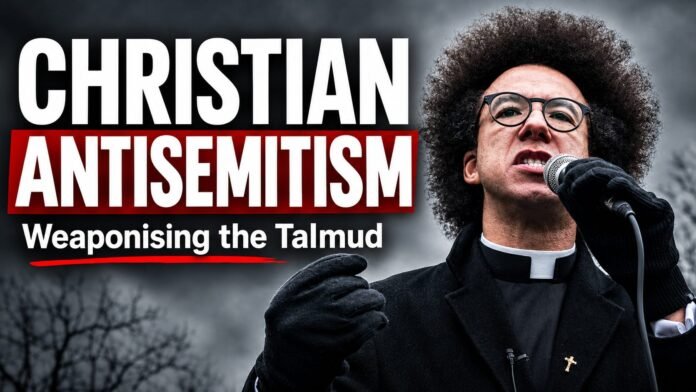
Antisemitism is back again in force.
It behaves a little like a virus that displays itself in occasional outbreaks.
The pattern of history is that in times of crisis and social uncertainty it rears its ugly head again.
There are different ways of trying to analyse what’s going on with antisemitism. Sociologically and psychologically, it often looks like it’s a way of projecting blame onto a scapegoat and trying to expiate the anxiety through punishing a chosen victim.
Spiritually or metaphysically, you might come to believe that God’s chosen people remain a constant target of hatred from all that is evil, and that this evil is constantly looking for vehicles or agents to express the hatred.
You may have your own preferred or chosen explanation for the way it breaks surface from time to time, but whatever your explanation, it’s here again.
It’s been a hundred years in Europe since the last devastating outbreak began to gather, which culminated in the ambitious attempt to exterminate all Jews in Europe and succeeded in killing six million of them.
And that’s where the link with today comes in, because for some strange reason people touched by the antisemitic ‘virus’, ‘ideology’, ‘tendency’, ‘infection’, ‘madness’, seem to take delight in explaining that the figure was somehow less than six million.
The Holocaust deniers appear to have a desperate need to prove the number an exaggeration, as if by rewriting history so that it was five million or four million or three million or two million or one million, it would somehow change the horror.
This is hard to account for rationally.
But whenever I see a figure who, with slightly staring eyes, is keen to explain how the mechanics of the death camps led to a miscalculation of some proportion in the six million, I know I’m dealing with somebody who is either a victim of anti-Jew hatred or has offered it internal hospitality for some reason.
Over the last few years, several Christian commentators have found themselves inflamed by this ancient hatred, most recently Candace Owens and Calvin Robinson.
Mr Robinson has only developed this energised fascination relatively recently. He’s only been in his latest denomination a few months, and I wondered if Mr Robinson’s bishop, who presides over a tiny denomination, might be a little ashamed or wary of his latest recruit’s toxic passion.
The ‘English Catholic Church’ is a Protestant denomination that has a total of nine parishes in North America and claims all of about 400 + members. Its current head is ‘Metropolitan Archbishop’ Jayden A. M. Hagood. It has become infamous as the sixth denominational stop of Calvin Robinson, who has been making his way through various denominations, (approximately one a year.)
I wondered if ++ Jayden Hagood might want to take action somewhere between an apology for Mr Robinson or even some form of discipline, but instead he decided to justify him and his sentiments by quoting the Talmud himself.
This is a move I’ve seen several times over the last few years, and each time I’ve looked into it, both the quotation and the source have always been more complex than the way in which the material has been presented.
I imagine that either the person quoting the Talmud hasn’t bothered to investigate it properly or they have just been looking for a source to justify their hatred. But this time it seemed right that the rest of us should look at the quotation, the source and the accusation for ourselves, so that ignorance doesn’t leave us open to the hatred the text was being used to promote.
I don’t wan to underestimate my readers, but I’m going to assume that you have not read much of the Talmud yourself. Very few people have, and that’s partly why an apparently self-confident quotation sounds more authoritative than it actually is.
So let me take you briefly into the Talmud in order to do what we can to deprive the antisemites of one of their clumsier and less convincing weapons.
This is what Archbishop Hagood wrote on X on 23 November:
“…while certain sects of Judaism have censored or edited the Babylonian Talmud, there are minority sects that still teach The Babylonian Talmud, tractate Gittin 57a, which contains a passage that explicitly identifies Jesus of Nazareth and says that his punishment in the afterlife is being immersed in or punished with boiling excrement.
This is not an internet fabrication, nor is it a quotation invented by Christian polemicists.”
What does the Talmud actually say?
The passage that has been quoted recently and which Archbishop Jayden A. M. Hagood relies on is lifted out of the tractate Gittin, where it is stripped of its context and presented as proof that some Jews, all Jews, most Jews? Believe, teach or document that Jesus Christ is boiling in shit in hell.
The intention of those who circulate it is to persuade Christians that Judaism, in its very essence and in every generation, consists of a conspiracy of contempt against Christ, and that applies to the Jews who wrote the Talmud and the Jews who are alive today and who live amongst us.
But not everybody knows what the Talmud is.
It is the central body of rabbinic Jewish teaching, interpretation and debate, consisting firstly of the Mishnah, which was compiled around AD 200 as a written codification of Jewish oral tradition, and the Gemara, which is subsequent commentary and discussion.
It comes in two versions. Firstly, the Jerusalem Talmud and the rather larger and more authoritative Babylonian Talmud, which was compiled round about the sixth century AD.
It’s worth all of us knowing that the Talmud is not just a collection of religious laws, but in fact preserves the history of disagreement between rabbis and their competing interpretations, theological speculation, historical narrative and moral observation.
In other words, not everything recorded in it constitutes authoritative Jewish teaching.
But that’s not how it’s used by the antisemites. When they quote from it, they quote from it as if this is fixed, universal Jewish teaching to which all Jews subscribe.
That itself is an ignorant and rather contemptible and clumsy misuse of the sources, but of course their misuse of it gets worse.
But please stay with the story for a little longer, because it’s important that we know exactly what it is the antisemites are misquoting, even if already we suspect we know why.
An exercise in necromancy
This particular story sits within a long cycle of narrative about the destruction of Jerusalem in AD 70.
It can be found at Gittin 56b–57a.
The central character here is called Onkelos and is presented to us as a nephew of Titus, who destroyed the Temple.
In the narrative, Onkelos is contemplating conversion to Judaism, but he decides, before he goes any further, to use necromancy to call up from the dead three of Israel’s great enemies in order to ask each of them how Israel is regarded in the world to come and what punishment each one of the three currently suffers.
So the first of them is Titus, who confesses that Israel is honoured above all nations and that his own punishment is to be burned and his ashes scattered over the seas, day after day.
The second one is Balaam, familiar to many of us as the prophet hired to curse Israel in the Book of Numbers. Rather graphically, his punishment is described in terms of boiling semen, a reference to the sexual sin of Baal Peor, for which the rabbis held him responsible, since Numbers 31:16 says it was on Balaam’s counsel that Israel was led into it.
And there is a third figure. He too acknowledges that Israel is honoured in the afterlife, and his punishment is boiling excrement. And the text explains why this is an appropriate punishment: whoever mocks the words of the sages is punished with boiling excrement.
So who is this third figure conjured up by necromancy to help Onkelos make his decision in this exotic story?
In the printed editions of the Talmud the name has been replaced by “the sinners of Israel”, the work of Christian censors after the Talmud was put on trial in Paris in 1240. But in the manuscripts the name is Yeshu, and in some of them Yeshu ha-Notzri. And this is taken by the commentators as being Jesus the Nazarene.
In fact, not everybody agrees that this is Jesus. One contemporary rabbinic commentator I was listening to explains that Yeshu ha-Notzri appears three times in the Talmud and was a student of Rabbi Yehoshua ben Perachiah, who lived a hundred years before Jesus.
Let’s leave aside the actual decision whether this is supposed to represent the historical Jesus or is in fact a disciple predating him by a hundred years, and notice that what the text is intended to do is to present the fact that when Onkelos asks the third figure how he should treat Israel, the answer is the opposite of Balaam’s.
Balaam counsels harm for them. But the Yeshu figure says, seek their good, do not seek their harm. Whoever touches them touches the apple of God’s eye.
So even in this hostile story, this elusive and ambiguous figure is speaking in defence of the Jewish people, not against them.
It’s all the stranger, then, that this text is the one that antisemites have grasped because they think it works as a weapon against the Jews.
The historical context
Interestingly, just in case it changes the way you look at the text, we are reminded that there are two Talmuds, the Jerusalem one and the Babylonian one. All the stories about this Yeshu, whoever he is, are found only in the Babylonian Talmud, the material of which reached its final form between the third and sixth centuries.
It’s all a bit elusive. But whatever we think of the third figure who was conjured up by necromancy, he hardly stands as a universally recognised symbol of Jesus in Jewish tradition.
Peter Schäfer has written about this in his book Jesus in the Talmud (2007), which is probably the most important modern study of the subject.
Schäfer’s argument is that these passages are not garbled memories of the historical Jesus at all, but deliberate and often sophisticated counter-narratives to the Gospel. They are intended to be a parody of the Christian story, composed by rabbis who knew what the story was.
They could be written in Babylonia because the Jews there lived under the Sassanian Empire, in which Christians themselves were suspected of being a persecuted minority.
If the passages had been written in Palestine under a Roman Empire that had become Christian, such mockery might well have been dangerous. And as it happens, the Jerusalem Talmud is entirely silent about this elusive figure conjured up from the dead.
So what we don’t have here is a belief held by many Jews in many places at many times. We have a rather odd piece of argumentative fantasy stuck in a very localised context, both chronologically and geographically.
It’s not the voice of Judaism as a whole, but of one community of scholars in one empire. It’s just the literature of a minority heckling in history.
Why would anyone want to take this weird story and present it as a reason for people hating all the Jews, all the time, in all places?
The history of a weapon
It’s worth noting that it does have a history, and the history is quite interesting, though much to our collective European shame.
It begins with Nicholas Donin, a convert from Judaism, who in 1238 lays before Pope Gregory IX a list of charges against the Talmud, amongst which, he said, was its treatment of Jesus and Mary.
The antisemites of the thirteenth century did exactly the same as Calvin Robinson and his bishop. They tried to find any passage that looked disrespectful, remove it from its context, present it as universal dogma, and then try and punish any of the Jews in their community for these odd sentences written in Sassanian Babylonia.
A German orientalist called Johann Andreas Eisenmenger published a book called Judaism Unmasked in 1700, which consisted of a two-volume compendium of extracts very much like this that became the arsenal of German antisemites for two centuries.
In 1871 August Rohling published The Talmud Jew, and when his scholarship was challenged and exposed by experts, he withdrew from public examination and chose not to defend it.
But of course the book fell into the hands of the Jew-haters and keeps on being requoted in the generations since.
How St Matthew deals with the problem
St Matthew gives us a model here, because he is one of the first to record that some in the Jewish community put about an untruth concerning the Resurrection.
In Matthew 28:15 he says that the guards of the tomb were paid to put the story around that the disciples had stolen the body, and that “this story has been spread amongst the Jews to this day”.
Matthew just drops the thing and leaves it there. He doesn’t show any interest in making every Jew of every age answerable for a piece of disinformation.
So we don’t have to worry about this particular quotation ripped out of context offering any particular evidence or argument of racial guilt down the ages that we need to punish any of our Jewish neighbours for.
It’s just a normal process of people who have given way to some kind of dark hatred against another group of people and will find any weapon of any kind to damage them with.
There are arguments to be had about how we relate to Judaism in general, the Jewish people over history, and our Jewish neighbours in particular, but in the end we are called to love and evangelise.
Reading to the end
So we come back to Onkelos and his three ghosts.
Archbishop Hagood quoted the punishment of the third figure, and then he stopped. He didn’t quote what comes next. When Onkelos asks how he should treat Israel, this figure, whoever the rabbis meant him to be, tells him: seek their good, do not seek their harm. Whoever touches them touches the apple of God’s eye.
That is the line the antisemites always leave out.
It’s in the same translation Hagood quoted from, only a few lines further on. The one text they have chosen to justify driving the Jews out turns out, when you read it to the end, to counsel care for them, respect for them and protection from harm. Even in a hostile Babylonian story, the figure they want to use against the Jews is speaking up for them.
I don’t think that’s an accident of the text. It’s what happens when people go looking for a weapon rather than the truth. They find the sentence they need and they don’t read the next one.
There are real and serious questions about how the Church understands its relationship with Israel and with the Jewish people. Christians have answered them differently down the centuries, and still do. Some speak of the Church as the new Israel; others, following St Paul in Romans 11, insist that the gifts and the calling of God are irrevocable, and that the Jews remain beloved for the sake of the fathers. These are arguments worth having, and worth having carefully.
But none of them, on any reading, licenses hatred. Nobody was ever brought to Christ by being driven out of their home, and the Christ whom we proclaim was himself a Jew.
We are called to love and to evangelise.