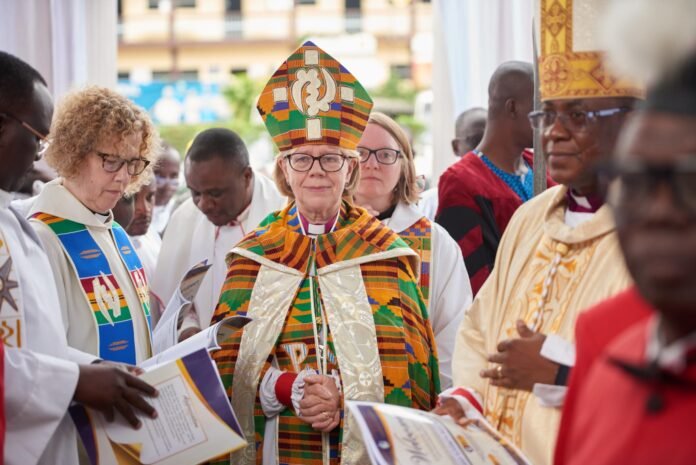
DURING the six months since her installation, the Archbishop of Canterbury has been on an Africa charm offensive. As most demographers agree, the future direction of Anglicanism lies with Africa, which accounts for at least 65 per cent of Anglicans worldwide, and is growing rapidly in influence. Archbishop Mullally is working hard to woo African support.
At her carefully choreographed installation, she was flanked by five members of the “Africa Six”: black women bishops placed in seats of honour on each side of St Augustine’s throne. In this high symbolism, at the inauguration of her new ministry, Archbishop Mullally chose to surround herself with African women from Eswatini, Kenya, Mozambique, and South Africa.
In July and August, she traversed Africa. First came a ten-day tour of the Province of West Africa, hosted in Ghana and Cameroon (News, 7 August), swiftly followed by a visit to Nairobi to meet the Primate of Kenya, and then on to Bujumbura to preach at the installation of the new Primate of Burundi (News, 28 August). All are conservative provinces. The invitation to preach in Burundi was a particular surprise: a sign that Archbishop Mullally’s African diplomacy is bearing fruit.
NOW, she has announced South Africa as the location for her first Primates’ Meeting, scheduled for Johannesburg in March 2027 (News, 25 September). It will be only the fifth Primates’ Meeting held in Africa, in a long line stretching back to Archbishop Coggan in the 1970s. It is a shrewd tactical choice.
Archbishop Mullally’s first Primates’ Meeting is a golden opportunity to rethink Anglican Communion relationships. High on the agenda will be efforts to diversify the leadership of the Communion away from its current English bias, building on some of the ideas in the Nairobi-Cairo Proposals.
One pressing reform is the importance of removing the double weight given to England’s voice at Primates’ Meetings. Each Province sends one Primate, but England sends two. This inequity was started by Archbishop Rowan Williams at the Primates’ Meeting at Dar es Salaam, Tanzania, in 2007.
In a period of heightened political tension surrounding proposals for an Anglican Covenant, and preparations for the 2008 Lambeth Conference, Archbishop Williams took along the Archbishop of York, Dr Sentamu, as “a spokesman for the Church of England”. A Global South coalition demanded Archbishop Sentamu’s withdrawal, to no avail. In the heat of those old battles, it was to Archbishop Williams’s advantage, symbolically, for England to be represented by a conservative African from Uganda.
But that temporary York measure has now become a fixture. At the Primates’ Meeting, England invites, England presides, and England magnifies its own voice. To suggest that the Primate of All England (Canterbury) is there to listen, whereas the Primate of England (York) is there to speak does not wash. The Church of England has stacked the decks in its own favour.
After 20 years, it is time for this preferential English treatment to be reversed. To level the playing field, the Archbishop of York should step back from Primates’ Meetings. For decades, under Archbishops Coggan, Runcie, and Carey, England was represented only by Canterbury. Mullally’s first Primates’ Meeting is a chance to reset.
HOW successful will she be in wooing other Primates to Johannesburg? We already know that four will be absent — Nigeria, Uganda, Rwanda, and Chile — because, as leaders of the so-called Global Anglican Communion, launched in Abuja, Nigeria, in March, they have formally disengaged from all Canterbury instruments.
A more pressing question for Archbishop Mullally is whether the Primates of the Global South Fellowship of Anglican Churches (GSFA) will attend. Read it all in The Church Times.
The Revd Dr Andrew Atherstone is Professor of Modern Anglicanism at the University of Oxford.