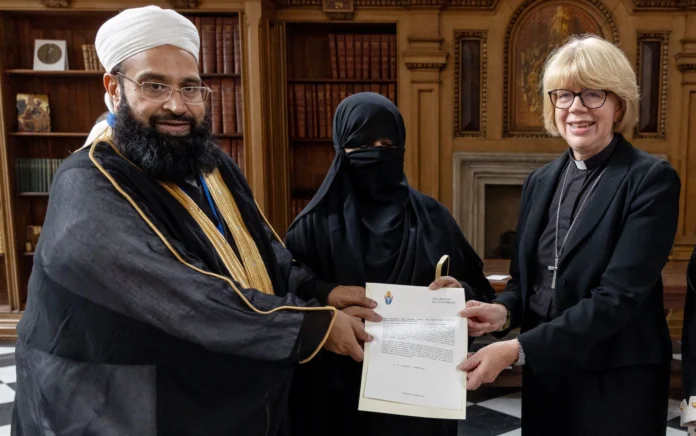
The Archbishop of Canterbury presented a prestigious interfaith award to a Pakistani Islamic cleric who once honoured Osama bin Laden as a “Muslim warrior”. The Most Rev. Sarah Mullally presented the Hubert Walter Award for Reconciliation and Interfaith Cooperation to Hafiz Muhammad Tahir Mehmood Ashrafi, chairman of the Pakistan Ulema Council and coordinator of the National Paigham-e-Aman Committee, at a ceremony in the Great Hall of Lambeth Palace on 11 September 2026 — the 25th anniversary of the September 11 attacks in New York that killed 2,977 people.
Ashrafi was one of 27 recipients across five categories of the Lambeth Awards, which Dame Sarah was presenting for the first time since succeeding the Most Rev Justin Welby. Archbishop Welby himself met with Ashrafi after the award and offered his congratulations.
In 2007, when the British government awarded a knighthood to the novelist Salman Rushdie — author of The Satanic Verses, against whom Iran’s Ayatollah Khomeini had issued a fatwa of death in 1989 — Ashrafi’s Pakistan Ulema Council responded by bestowing its highest honour on Osama bin Laden.
“If a blasphemer can be given the title ‘Sir’ by the West,” Ashrafi told Reuters at the time, “then a mujahid who has been fighting for Islam against the Russians, Americans and British must be given the lofty title of Islam, Saifullah.” He told AFP: “We are pleased to award the title of Saifullah to Osama bin Laden after the British government decides to bestow the title of ‘Sir’ on blasphemer Rushdie. This is the highest title for a Muslim warrior.” Saifullah — sword of God — is an honorific traditionally awarded for military prowess.
Ashrafi also described suicide bombings in Afghanistan as lawful, supported Pakistan’s blasphemy laws, which carry the death penalty, and claimed Jewish people and Christians were using a war against Iran to target its nuclear programme, the Dail Telegraph reported.
The reaction was swift, broad, and cross-party.
Nick Timothy, the shadow justice secretary and MP, posted on X on 16 September: “The Archbishop of Canterbury has given Hafiz Tahir Ashrafi an award for Reconciliation and Interfaith Cooperation. He’s the chairman of the Pakistan Ulema Council — a group of Islamic scholars” — before setting out Ashrafi’s record in detail. Timothy said the Archbishop’s naivety was “staggering,” adding: “Our leaders must face up to the reality that not all cultures are based on the same foundations as ours, and not all share our desire for co-operation and freedom. Western political and religious leaders should stand up vigorously for our own values and achievements, rather than apologising for our history or celebrating those who seek to do us harm”.
The Rev Dr Ian Paul, Anglican theologian and member of the General Synod, offered a carefully calibrated response to the Telegraph. “I understand that, in Pakistan, he has contributed to reconciliation,” Paul said. “But I think members of the Church of England will struggle to make sense of this in the light of his past statements about blasphemy, the death penalty, and suicide bombings, and how he is accompanied by a woman in a niqab. It will do harm both to the confidence of Anglicans in their own church and to the reputation of the Church of England among both its critics and its supporters”.
Tim Dieppe, head of public policy at Christian Concern, was less measured. “The absurdity of this beggars belief. How can a Christian leader give an award for reconciliation to someone who has honoured Osama Bin Laden? To someone who supports the draconian blasphemy laws in Pakistan which are a source of persecution of Christians? Mullally is clearly uninformed about both Ashrafi and about Islam.” Dieppe called for an immediate apology to Pakistani Christians and a public call for the repeal of Pakistan’s blasphemy laws: “The only justification for meeting such a man is to pressure him about the treatment of Christians in Pakistan. There is absolutely no justification for giving him an award”.
Pakistan’s blasphemy laws — Sections 295-B and 295-C of the Pakistan Penal Code — carry mandatory death sentences or life imprisonment for offences against Islam and have been used extensively against Christian minorities. The Asia Bibi case, in which a Catholic woman spent eight years on death row after a blasphemy accusation before her eventual acquittal and exile, remains the most internationally prominent example. Ashrafi’s public support for those laws sits in tension with the Church of England’s stated commitments to the protection of religious minorities and freedom of conscience.
Critics on social media argue the Hubert Walter Award — named for a medieval Archbishop of Canterbury who served as both royal chancellor and chief justiciar — should not be given to a man who endorses laws that imprison and kill Christians for speech offences.\
A Lambeth Palace spokesman said only that the palace was “aware of comments circulating online attributed to Hafiz Tahir Ashrafi” and was “urgently reviewing this matter”. That statement, issued after the *Daily Telegraph* and *Daily Mail* broke the story on 17 September — six days after the ceremony — suggests due diligence from the archbishop’s staff was not conducted or was not acted upon before the award was made.
Ashrafi dedicated the award to “religious scholars, leaders, intellectuals and people working for peace, reconciliation and interfaith harmony across the world,” and described it as recognition of Muslim scholars’ efforts to “counter extremism and terrorism”.