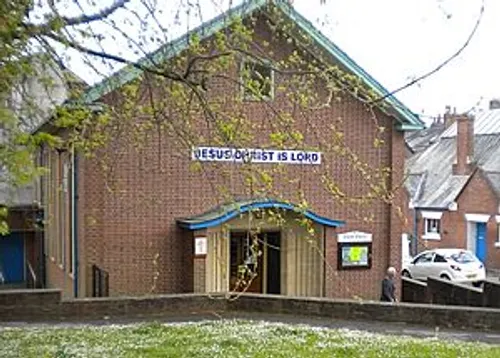
The High Court of Justice in London (Property, Trusts and Probate List) has held that the Free Church of England Central Trust—not the trustees of the congregation that withdrew from the denomination in 2023—is the charity trustee of Christ Church Exeter’s principal properties. The ruling turns on the legal meaning of “in union with” the Free Church of England and leaves unresolved the underlying accusation that the FCE has departed from its Protestant founding principles.
The decision in The Free Church of England Central Trust v Revd Steven Hanna & Ors [2026] EWHC 2260 (Ch), handed down by Master Brightwell on 8 September, concerns the ownership and administration of the church at Grosvenor Place, adjacent land, and the former schoolrooms used by the Exeter congregation.
Christ Church Exeter, one of the Free Church of England’s oldest surviving congregations, voted in 2023 to leave the denomination. It was one of several FCE congregations to depart at about that time, though the other churches were not parties to the proceedings.
The defendants were the Revd Steven Hanna, his wife Rachel Hanna, and Lazlo and Ludivinia Flores, trustees of the registered charity Christ Church Exeter, charity number 1138246. Mr Hanna was appointed as minister in March 2020; his permission to officiate within the FCE was revoked in June 2022. He continues to lead a congregation at the Grosvenor Place church, said in the evidence to number more than 30 regular worshippers.
The congregation’s case was that it had left because the FCE had “no longer remain[ed] faithful to its founding principles.” The defendants argued that the congregation, together with other former FCE churches, represented “the authentic voice of the FCE,” and that the central denomination had become friendly to Anglo-Catholicism—precisely the tendency from which the nineteenth-century founders of the FCE had separated.
The Central Trust, represented by Freeths LLP, brought the claim to determine the trusts governing the buildings and the construction of the local charity’s 2010 constitution. The Attorney General was joined as required in charity proceedings, but took no active part.
Master Brightwell observed that the issues behind the division were “redolent of the ecclesiastical disputes of the nineteenth century” rather than those usually associated with contemporary Protestant church conflicts.
The Free Church of England arose from evangelical congregations associated with the Countess of Huntingdon’s Connexion. Following conflict with Henry Phillpotts, the Anglo-Catholic Bishop of Exeter, and the wider influence of the Oxford Movement, the church was constituted by a 31 August 1863 deed poll. That instrument established the Free Church of England, governed by Convocation, upon a doctrinal basis drawn from Scripture, selected Thirty-Nine Articles, and the Connexion’s Fifteen Articles.
A 1908 declaration of trust provided for property to be vested in a Central Board of Trustees for use by the Free Church of England in accordance with the 1863 deed. The FCE united with the United Kingdom branch of the Reformed Episcopal Church in 1927, and its Central Trust was incorporated as a charity in 1941.
The present disagreement therefore reprises a familiar English Protestant question: when a denomination is accused of departing from its original doctrinal settlement, does property remain with the institutional church or with those who claim to preserve the original faith?
Four properties were before the court: The original church site at Grosvenor Place; The adjoining Laburnum Cottage site, now incorporated into the church building; The schoolrooms or hall; The former manse at 140 Pinhoe Road.
The church building is constructed across the original church site and the former Laburnum Cottage site. The schoolrooms, formerly used for Sunday school and church-hall purposes, are now used as a nursery. The congregation remains in occupation of the church premises.
The judgment did not finally determine the position of 140 Pinhoe Road. The evidence about its acquisition was limited, and further argument may be necessary.
Master Brightwell held that the Central Trust is a charity trustee—not merely a bare or custodian trustee—of the original church site, the Laburnum Cottage site, and the schoolrooms.
The original church site is held for the charitable purposes of the FCE and also to permit its use by the distinct local charity under the name “Christ Church (Free Church of England).” The judge rejected the Central Trust’s wider contention that the site could simply be used for any FCE purpose without regard to the Exeter congregation; the documents required a connection with Christ Church Exeter.
The Laburnum Cottage site is held for the charitable purposes of the Free Church of England. While the relevant 1962 declaration of trust could not be found, the court was satisfied from the available evidence that its charitable purpose was the FCE’s.
The schoolrooms are held under the terms of a 1962 Charity Commission scheme to be used as a Sunday school or church hall “in connexion with Christ Church Free Church of England Church in the City of Exeter.”
The court also rejected the defendants’ argument that the 2010 registration and constitution of the local charity had transferred the properties into the control of the local trustees. Christ Church Exeter had existed as a separate charity long before the 2010 constitution, the court found, and the adoption of that constitution did not rewrite the earlier property trusts.
The central point of construction concerned clause 3 of the 2010 constitution. It states that the charity exists for: “The advancement of the Christian faith in union with and according to the Principles and practices of the Free Church of England otherwise called the Reformed Episcopal Church contained within the Declaration of Principles …”
The defendants argued that “in union with” should mean fidelity to the FCE’s founding Declaration of Principles. On their case, a congregation could leave the FCE’s formal structures yet remain in union with its true constitutional and Protestant character if bishops and Convocation had departed from that inheritance.
The court accepted the Central Trust’s contrary interpretation. The phrase requires the advancement of the faith to be pursued **as part of the Free Church of England as an institutional body**, and in accordance with its Principles and practices. “Union,” in this context, means membership of and action within the denomination under its governing arrangements.
To give the words the defendants’ preferred meaning, the judge said, would effectively empty the reference to the named denomination of practical effect. A congregation could retain what it considered the FCE’s principles while rejecting the FCE itself. That was not the natural construction of the charity’s objects clause.
The judgment is a property and charity-law ruling, not a verdict on the theology alleged by either side.
Master Brightwell expressly declined to determine whether the Free Church of England, its bishops, or the departing congregation had adhered to or departed from the denomination’s fundamental doctrines. The judge noted that the evidence ranged well beyond the discrete issues suitable for determination in the Part 8 proceedings and that any disputed factual matters requiring cross-examination would require a separate hearing.
That reservation matters. The defendants had invoked the principles associated with the 1904 Free Church of Scotland litigation, in which property questions were tied to fidelity to the founding doctrinal trust. They argued that the FCE’s bishops and central leadership had embraced Anglo-Catholic traits incompatible with the church’s anti-sacerdotal Protestant settlement. But that case was not tried in Exeter.
The court therefore did not find that current FCE practice is faithful to the Declaration of Principles. Nor did it find that it had become Anglo-Catholic. It ruled only that, on these deeds and this constitution, a congregation that leaves the FCE cannot retain control of properties held on FCE charitable trusts merely by asserting that it, rather than Convocation and the bishops, preserves the denomination’s authentic principles.
For other FCE congregations considering separation, the case is a sharp reminder that ecclesiastical property disputes are resolved first by the words of the governing deeds, charity schemes, and constitutions—not by a civil court’s preference between competing theological claims.