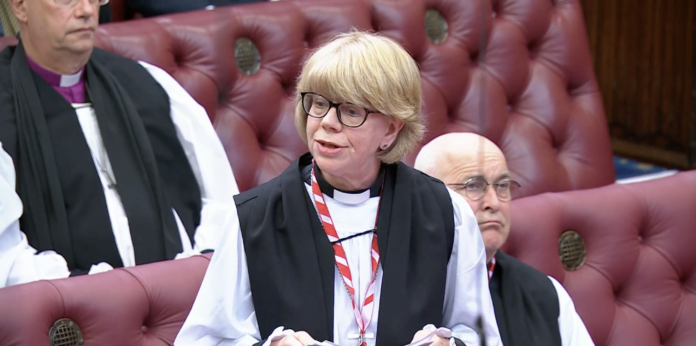
My Lords, I wish to thank the usual channels for allowing me to hold this debate today, and the parliamentary staff who have enabled it to happen.
In the Bible, the writer of the book of Hebrews, says of human beings, “You made them a little lower than the angels; you crowned them with glory and honour and put everything under their feet.”
God created human beings in his own image, with glory and honour. Each and every one of us, regardless of who we are or what we do. We carry an inherent dignity and immeasurable value.
This is not in spite of our weakness, vulnerabilities and limitations, but in many ways because of and through them. God made us to be relational beings, in need of him and in need of others, not sufficient on our own.
I start here because, fundamentally, our vision of what it is to be human, of our glorious humanity, must inform the rest of our debate about technology and AI.
Pope Leo’s encyclical, Magnifica Humanitas, begins here too.
God made us creative beings, and AI and wider technologies are a remarkable product of human creativity. They have led to extraordinary discoveries and breakthroughs at speeds that we could never have imagined. They have connected us across the globe and opened up endless new opportunities for working, creating, learning and travelling. I now carry vast information, processing power and connectivity potential in my pocket with me every day.
But this extraordinary product of human creativity, and the power it places in our hands, also raises urgent new questions. What are the implications for our human relationships, for our connections with family and friends? How does it impact on our working lives – the existence of, or the quality of our jobs? What are the implications for warfare, for climate change, for our engagement with information and democracy? Just because we could create something or deploy technology in a certain way, does that mean we should?
As C.S. Lewis put it: ‘We all want progress. But progress means getting nearer to the place where you want to be. If you have taken a wrong turning then to go forward does not get you any nearer.’
Wave after wave of technological innovation is taking place as we speak, and the question we should be asking is simple: Where are we going? What is our vision for how this technology will serve human flourishing? We are in danger of unleashing AI into our lives and societies without the theological, philosophical and spiritual framework with which to make decisions about creating, controlling, using or directing it.
Above all, we need to ensure that AI is being designed, built, regulated and used to serve our glorious humanity and not to diminish it. To be pro-human, as Pope Leo has said, ‘humanity – in all its grandeur and woundedness, must never be replaced or surpassed.’
This poses the question, does AI make human life more human?
The question matters for those designing, developing and building the technology, as they think about what ideologies and belief systems should underpin the models – for there is no such thing as values-neutral technology. It matters for governments and policymakers, as they determine what should and should not be permitted and regulated.
And it matters for those using the technology. Many feel that AI is affecting them hugely without having any say in the matter. Others feel that the things which make us unique as humans are at risk of being eroded, devalued and replaced by AI, as people turn to chatbots rather than other human beings for comfort or wisdom in moments of loneliness, loss, anxiety or pain. How should we adopt AI and what is the right place for it in our relationships, our families, our societies?
If humanity is to be placed at the centre of all thinking and decision making about AI, I would like to suggest there are three fundamental questions to help us work out what a pro-human framework for AI would look like, and how it informs practice.
Firstly, what does it mean to be human?
If God crowned humans with glory and honour, how will AI respect – indeed cultivate – that sort of dignity and value?
There are many ways in which AI is helping to enhance human dignity, to protect and uphold life.
If you want to look to the potential of AI to serve human beings, you need look no further than across the sciences.
In nursing, we can see the potential of AI. Nursing and medical care are areas where the value for human dignity is visible in some of the most tangible, practical ways.
I don’t believe that a robot or AI model will or should ever replace human beings in some of these settings. Sitting at the bedside of a patient to deliver very difficult news or supporting a woman through the delivery of her baby are deeply vulnerable moments where human touch, human eye contact, human emotional intelligence, are invaluable.
However, there are many ways in which AI is having a hugely positive impact on healthcare. AI is beginning to make childbirth safer – from automated ultrasound to predictive tools for pre eclampsia, to consistent foetal heartrate monitoring.
There are sadly other uses of AI today which, rather than enhancing human dignity, are providing new ways of degrading it or violating it.
A recent report from Durham University presented evidence that Chatbots are now facilitating violence against women and girls: allowing roleplays of incest, child sexual abuse and rape with few safeguards, risking the normalisation and the legitimisation of such abuse. These harms are not simply the result of user misuse – AI platforms design choices, policies and governance failures are encouraging and enabling them, and existing regulation is wholly inadequate to prevent them.
My second question is: What are we here for and what gives our lives meaning and purpose?
The Christian faith teaches that we are designed for relationship, relationship with God and with others, and with the created world around us.
We find meaning and purpose in these relationships, and in dignified work where we can partner with God to see his Kingdom come on earth. We are human beings crowned with glory and honour, here to glorify God.
Perhaps one of the most profound areas of purpose is work – we are already seeing record numbers of 18 to 24-year-olds neither in education, training, nor employment, and this is only set to worsen as agentic AI starts to come online. One of the areas of greatest gravity that this debate must address is how we, as the political class, are going to help young people navigate a rapidly changing world.
Yet AI impacts our sense of meaning in other ways that go beyond work. A fundamental quality of the human being, one source of our wellbeing and sense of purpose, is our ability to create, imagine, think and invent. God placed humans in the Garden of Eden to look after the garden, he asked Adam to name the animals and species there, an inherently creative task.
On the one hand, AI can enhance human creativity and imagination. It puts more information, people, networks, tools at our disposal. It can increase efficiency and take away the burden of more repetitive and administrative tasks.
But there are reasons to be concerned that AI is in fact having the opposite effect on our human abilities. There is already concerning evidence about the impact technology and particularly smartphones are having on the human ability to think and create. Mary Harrington wrote an article last year entitled ‘Thinking is Becoming a Luxury Good’. It highlights evidence of human brain power decreasing, with adult literacy scores levelling off and declining in the past decade in the majority of OECD countries, and some of the sharpest declines are among the poorest. Child literacy is also declining. Research shows that children who are exposed to more than two hours a day of recreational screen time have worse working memory, processing speed, attention levels, language skills and executive functions than children who are not.
A study has shown that heavy users of AI struggle more with critical thinking, as they stop thinking for themselves and their capability atrophies. And the irony is that while AI might make us feel like we are more creative, at scale AI’s inherent nature means ideas will in fact become more predictable, unoriginal, homogenised.
The human ability to think and create surpasses the capabilities of AI. We must work to ensure our human abilities are given space to grow and thrive, to be the thinking, creative beings God made us to be.
The Pope put this well last November during a live address to young people at a National Catholic Youth Conference in Indianapolis: “Be prudent; be wise; be careful that your use of AI does not limit your true human growth. Use it in such a way that if it disappears tomorrow, you would still know how to think, how to create, how to act on your own, how to form authentic friendships. Remember, AI can never replace that unique gift that you are to the world.”
My third question is: What is truth?
Pilate notoriously asked Jesus this question as he was being sentenced to death.
According to the Christian faith, truth is not something we define ourselves or alter to suit our own personal, political or commercial ends. Truth is embodied in the person of Jesus Christ – and expressed in loving God and loving others.
Truth is a fundamental foundation on which our personal lives and societies are built. Without common truth, a flourishing common life becomes impossible.
Generative AI cannot tell right from wrong, fact from fiction. Instead of truth it produces a statistical echo of what has been said before, in material it has been trained on. It reinforces biases inherent in the way that it has been coded, as well as social biases present in the material it has been fed. It also simply invents information – one study found that chatbots did this at least 3% of the time, some as much as 27%.
Even more concerning, is that AI can be weaponised by malign actors – it is the perfect tool for someone wanting to create fake news. Its ability to disperse disinformation, discredit legitimate information, censor other information, and game algorithms has the potential to distort and rewrite reality, to present fiction as fact, and all with the veneer of objective truth. It has the power to manipulate what we see and what we believe, at a speed and scale never seen before. What is often presented as a tool in the democratisation of knowledge could all too easily become the tool of the autocrat.
And the potential for real harm is still to be fully realised. There is a serious risk this will lead to a fundamental breakdown in trust across society. The real danger is not our rising gullibility, but our rising cynicism – it’s not that we will believe anything, it is that we will believe nothing.
If we cannot trust information we see online, then perhaps we cannot trust people we meet. And when the possibility for trust in another human being is eroded, relationships cannot be formed, nor can much of what we do in communities or our society be sustained.
Without a common understanding of truth, human relationships and the reciprocal ties which underpin our societal structures flounder. Truth, and the trust it inspires between people and within societies, must be cherished and protected.
My Lords, it is easy to feel overwhelmed when considering the current and future potential impacts of AI on life as we know it. What can be done to ensure that AI serves humanity and not degrades it?
Un-inventing AI is not an option, nor would we want to be without its many positive effects that it brings.
So, what are we to do with a technology which places great power in the hands of those who own, control, and use it?
Power is not inherently wrong – but it carries great responsibility and, often, great risks for human beings, as we have seen repeatedly through history. Power corrupts, and it takes people of great virtue and moral strength to withstand its temptations.
Archbishop William Temple described a central occupation of Christian social thought as being ‘man’s dignity, tragedy, and destiny’. I have spoken today of humanity’s inherent dignity, but it is our fallenness, the tragedy, which makes technology’s power so seductive and the risk of its abuse so often our story. In the Christian tradition, there is a call that overrides the lust for power – it is the call to service.
The distinctly Christian version of service is sacrifice, and Jesus’ life, death and resurrection is the perfect example.
This leads to the third of Temple’s triad: destiny.
Jesus’ sacrifice for us on the cross offers profound hope to all humanity, in every season and circumstance. It also offers us a model for living a sacrificial lifestyle, one where with him at work in us, we can choose to sacrifice our own personal ends in service of others and begin to see his Kingdom come on earth. Within this, I believe, lies the hope for our relationships, families and societies.
At every level of society, from individuals making decisions about how to use AI personally and with our families and children, to business owners choosing where to use AI in their processes and how this affects their workers, to owners of AI companies choosing what technology they invent and the features or limits they place on this, we can choose to make decisions sacrificially, in the service of our common humanity.
My Lords, we must cultivate the character to deal with the opportunities, challenges and temptations that such powerful technology places in our hands, personally and corporately.
Involving people, communities, civil society in the conversation about AI, drawing on the wisdom and insight of faith communities. Technology this revolutionary must not simply be unleashed on our societies: it must be developed with us and for us – at a human pace, with human objectives.
Above all, we must put people – our common, glorious humanity – ahead of profit, convenience or technological progress at all costs. To ensure that we harness AI to serve humanity, to be an extraordinary tool in the creation of a more just, abundant and hope-filled world.
I beg to move.