However compassionate the Church is toward those who suffer from the mental illness of gender dysphoria, we have long recognized that we do people no service if we reinforce them in the illusion — particularly if the illusion is about something that really matters.
Reality is the surest route to sanity and a holy reordering. If that is true in the area of sex and identity, it is also true in ecumenical matters and in ecclesiology.
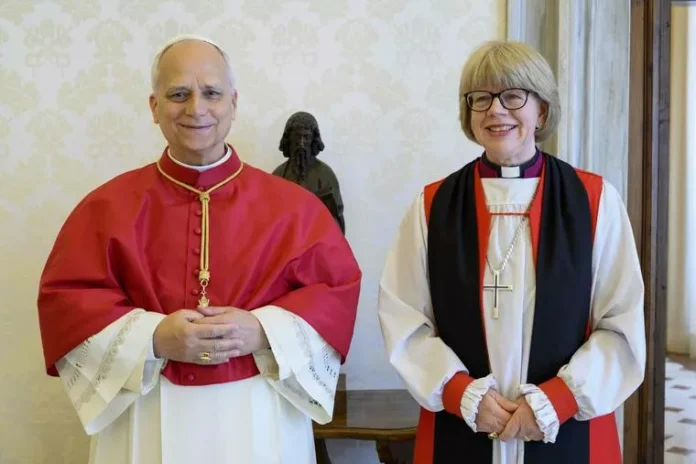
That is why so many people have felt a serious disquiet about the way in which the Pope has welcomed the Anglican Protestant archbishop of Canterbury, Sarah Mullally.
Apostolicae Curae made it clear why Anglican orders were null and void and how they always had been, while recognizing that this was in fact the original and deliberate intention of the Anglican ordinal and of the politicized ecclesiology of the 16th and 17th centuries.
The fact that Anglicans have since changed their minds and seek a degree of legitimacy from the Mother Church with which they are in schism does not change history or their credentials.
It does Anglicans no good to pretend that the longings of their ecclesial imagination can change the nature of reality.
The Journey of Sarah Mullally
We will come back to that in a moment, but first it might be worth spending some time on the character of the first woman Anglican archbishop herself.
Sarah Mullally has been on a journey. It’s not just been a journey from being a nurse to being a clergywoman. It’s a journey from conservative, evangelical clarity to progressive, fashionable liberalism.
In theological terms, one could say that she’s moved from Protestant biblical orthodoxy into the category of therapeutic deism.
In a recent review of Andrew Atherstone’s biography of Sarah Mullally, George Conger, a prominent Episcopal commentator, draws attention to this journey from conservative fidelity to progressive political fashion in Mullally’s life.
It is a historical fact that conservative evangelicals have been shunned by the Anglican establishment in England.
They are seen as an embarrassment theologically, culturally and politically to the Establishment, and the doors of preferment and promotion have always been shut firmly in their faces.
To attain greater responsibility or to be promoted, one has to allow one’s theology to develop or morph into a more politically sophisticated agnosticism with a social conscience — and perhaps more than the social conscience, a socialist political leaning.
George Conger points out that this was exactly the path Sarah Mullally took, which resulted in her being promoted with astonishing rapidity.
She began as a faithful conservative evangelical, a product and promoter of the Christian Union and its culture.
I suppose we might argue as to whether or not she deliberately decided to abandon her orthodoxy in order to satisfy her sense of secular ambition, but we would have to recognize that we don’t know the answer to that. It’s simply that the story of her life raises the question.
We do know, however, that she was seriously ambitious in the world of nursing, rising to head the bureaucracy overseeing nursing in the U.K., and so perhaps it’s not too much to wonder whether her capacity for ambition tainted her evangelical fidelity to the extent of being willing to sell out her convictions in order to be promoted rapidly within the Anglican Church.
Whatever caused it, that certainly is what happened.
Abortion and Homosexuality
As she took that journey, she moved into two areas of contested theological ethics that place her at the far end of progressive heterodoxy. …….
Read it all at the National Catholic Register