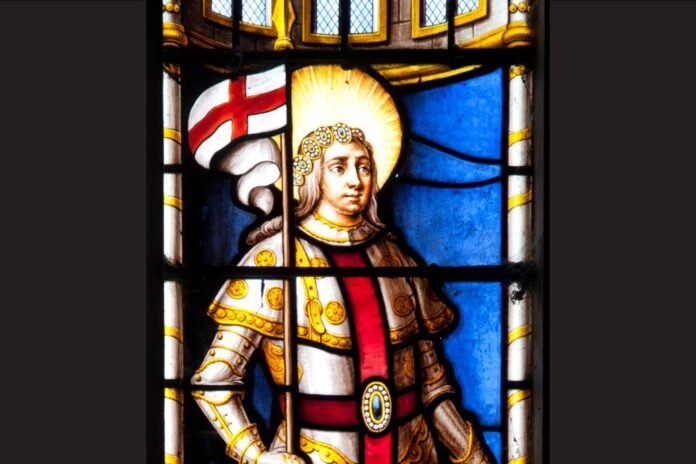
Each year on 23 April, we remember the life of a man whose name has become inseparable from courage and the defence of the vulnerable. Perhaps we have never paused to think beyond the image of a knight slaying a dragon, or of the red cross on a white field of a flag fluttering on lampposts on our streets. But St George’s Day isn’t just about flags or legends, and his story stretches far beyond England.
St George was a Roman soldier in Lydda, Palestine, likely born in what is now Turkey. He was a person whose life took him to work in many places, far from where he was born, who stayed true to his beliefs and in the end died for them. History only gives us glimpses of George’s life, but we do know that around AD 304 he was tortured and then executed for refusing to renounce Christ. It would take over a thousand years before George was formally named England’s patron saint in 1347, yet his story had already travelled across Christendom. He is a patron Saint of Ethiopia, Georgia, Greece, Bulgaria and Catalonia as well as cities like Genoa, Moscow and Beirut.
Over time, the image of George evolved from soldier-martyr into the idealised knight, a protector of the innocent and a symbol of justice, and a very English one at that. Dedicated to St George, the Most Noble Order of the Garter remains the highest and oldest order of chivalry in the British honours system. The legendary tale of him slaying a dragon emerged in the 1200s, capturing the imagination of artists and storytellers. While the dragon may be myth, the lesson it conveys is profound: courage rooted in faith confronts the forces that threaten truth and justice.
The legend helped cement George’s heroic image, but another symbol—the Cross of St George—has become just as enduring. This was not “given” to George himself. Adopted by crusaders and later by England, the red cross represents martyrdom and sacrifice, reflecting George’s witness to Christ even unto death. The white background signifies purity and hope, echoing the promise of resurrection and the transformative power of love.
But devotion to St. George is not quite so simple. It defies neat patriotic or narrowly nationalistic Christian interpretations. Across the Eastern Church, George is known as the great martyr. Muslims revere his memory, many of them going to the Eastern Orthodox shrine of St George at Beith Jala, near Jerusalem. This is also the place where Jewish people believe Elijah is buried.
The interest in St George developed in England in the 14th century as a way of fostering loyalty to the crown and developing a sense of national identity. I believe St George can speak to us in similar ways today. He lived and died at a time of upheaval, conflict and change. He was a man of complex heritage. His work took him across the world, and he had to encounter new cultures, strange languages and different customs to his own. He remained true to his beliefs, and he lived them out in service to others. In Palestine, he was venerated along with Moses, Elijah and Michael for his exceptional bravery, particularly as a defender of the poor. All this was shaped and inspired by a Christian faith that he knew transcended earthly boundaries and challenged earthly divisions. And since it turns out that our very English patron saint, St George, does not even come from England and is himself culturally diverse, might his multicultural and English identity help us navigate our English and multicultural identity today?
And he is also quite a challenge. Faith, for St George, was never a private matter as some would have it today. He knew what it was to be in a minority. He knew that there were some things worth dying for; for him, the citizenship of heaven and all the values, attitudes and practices that flow from it.
St George’s story also reminds us that sainthood is not limited to ancient times or distant lands. His example calls us all to face the ‘dragons’ of modern life—fear, injustice, intolerance, persecution, and moral compromise—with integrity and love. In this sense, the ideals of chivalry—courage, compassion, and care for others—are not just medieval ideals, but a living way of embodying faith in our everyday lives.
The red cross of St George, our national symbol, should be a signpost pointing to a way of life marked by devotion and service to others. On 23 April, we are invited to ask where that same courage, and an identity which transcends human difference and indifference, might be needed in our lives today?
This article was first published in The Times and has been reproduced with its kind permission.