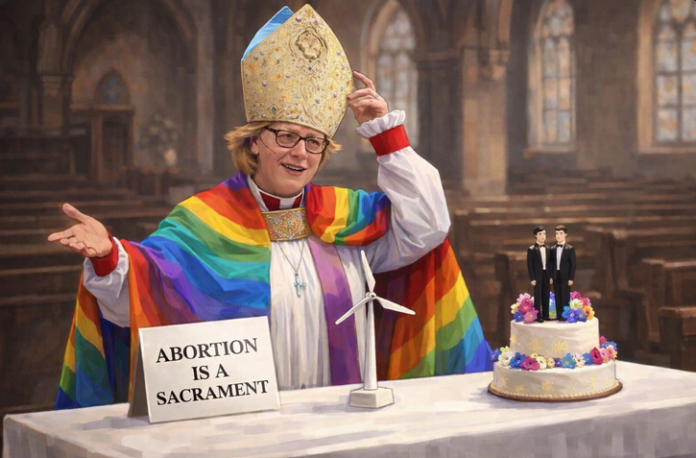
Given Anglicanism is the third largest Christian polity in the world behind Catholicism and Orthodoxy, many are wondering why the reception of Dame Sarah Mullally as the first female Archbishop of Canterbury has been muted. Her gender is part of the reason, of course, but even Rome did not break off ecumenical dialogue with Canterbury over women’s ordination. The deal breaker for Rome was the consecration to the historic episcopate of a practising homosexual in 2003, Gene Robinson, whose “marriage” to his “husband” in 2008 was followed by a “divorce” in 2014. In what can only be called tragic irony, ECUSA (The Episcopal Church in the United States) chose to exhaust its moral capital on the hill of feminism and homosexual rights, wilfully, with open eyes.
In moral terms, progressive Anglicans have abandoned natural law for positive law. In natural law there is a concern for final causes—Aristotle’s “that for the sake of which”; a goal, purpose, or final cause guiding an action, a telos—to explain the nature and structure of reality. In positive law there is a belief that the nature and structure of reality can be legislated, established by legal precedent (and positive law has been legislating against natural law since the sexual revolution). Hence progressive Anglicans in the Global North have followed the zeitgeist in abolishing distinctions between male and female, homosexuality and heterosexuality, reproductive system and digestive tract, treating them all as functionally equivalent.
One consequence of this zeitgeist has been “gynofascism”, the “Great Feminization” of the Church, elevating women to its highest offices while adopting a managerial model of ministry where the primary goal is not preaching the Gospel but creating nesting opportunities for self-actualising women and practising homosexuals.
Regarding the latter, the English House of Bishops and General Synod have recently moved to conclude the “Living in Love and Faith” consultation process over same-sex marriage and blessings. General Synod has voted to end plans for creating separate “stand-alone” blessings for same-sex couples. The consultation process which ran from 2017 to 2025 has formally ended. While human rights activists have vowed to fight until this “injustice” is remedied, General Synod has bowed to the inevitable. The numbers do not support the consultation, God’s mills grind slow, Nature abhors a vacuum, and a Christian anthropology of personhood is not easily gainsaid.
Regarding the former—creating nesting opportunities for self-actualising women instead of preaching the Gospel—Dame Sarah’s appointment as Archbishop of Canterbury was entirely predictable. She has obviously been appointed to be the face of a progressive hierarchy—the spiritual façade of the nanny state—which protects itself by hiding behind bureaucratic, managerial processes. That the English House of Bishops declined to comment on the morality or theology of blessing same-sex relationships and recognising civil same-sex marriages among the clergy, by simply noting what percentages of votes in Synod were required to legislate it, is proof of its moral and theological dereliction.The political calculus behind Mullally’s appointment is that a woman should represent the Great Feminization of the Church to the world. One concern with this calculus, however, is that an Anglican polity should never be an arm of the secular State in a democracy where the separation of Church and State is upheld. The Church of England is established, of course, but only in England; elsewhere Anglicans belong to different national polities with no connection to the State.
Another concern is that the Archbishop of Canterbury does not exist to represent the progressive zeitgeist; the office exists to serve the world’s third-largest Christian polity, as senior bishop and principal leader of the Church of England and ceremonial head of the worldwide Anglican Communion. The office should remain at arm’s length from the State, it should not be seen to represent the interests of the State, particularly one where natural law has been abandoned for positive law, a State which believes the nature and structure of reality can be legislated. In many parts of the Anglosphere, there is an odd belief that Synods can legislate the Church’s faith, as if it is an artefact of positive law, but this is not true.
Here the hard question of Mullally’s ability to fulfil the office must be asked, for she supports issues archbishops of Canterbury should never support, whatever their conscience tells them. She supports same-sex relationships because her understanding of tradition and scripture tells her an appropriate response is “inclusive love”. She supports the inclusion of LGBTQ+ people in the Church because: “What we have to remember is this is about people, and the Church seeks to demonstrate love to all, because it reflects the God of love, who loves everybody.” But the theology of a winsome God who loves everyone, who is non-judgmental and makes no moral demands, is unbiblical; a travesty of what God’s love means.Most serious, perhaps, is her support for abortion. “I would describe my approach to this issue as pro-choice rather than pro-life,” she has said, “although if it were a continuum, I would be somewhere along it moving towards pro-life when it relates to my choice and then enabling choice when it related to others.” In other words, she might not have an abortion, herself, but may empower others to.
Clearly, there is a symbiosis between Mullally’s theological convictions and the progressive politics currently dominating English society. This severely limits her ability to fulfil the role of Archbishop of Canterbury to the global Anglican Communion beyond England, where most Anglicans live (the majority of whom do not embrace progressive English values). Part of the political calculus of her appointment is that the Church of England has vast amounts of institutional wealth—property assets, financial resources, and social capital—and can exploit traditional loyalties to the Crown. In a postcolonial age, however, this becomes a form of neocolonial cultural imperialism, dressed up, packaged, and marketed in a progressive disguise, much like Mullally herself, a kind of winsome confidence trick.
Part of the tragic irony is that the Church of England chose to follow The Episcopal Church in the United States of America (ECUSA), exhausting its moral capital on the hill of feminism and homosexual rights. The implications of this are obvious, the Great Feminization has ensured that women now dominate the institutions, where they manoeuvre the semiotic levers of cultural meaning, and the human rights claims of homosexuals now extend beyond equality to equivalence, the idea that homosexuality and heterosexuality are the same, biologically and morally. Since these implications are indefensible under natural law, the only response the progressive elites who promote them in the Church can make is to accuse those who challenge them of being misogynists and homophobes. The clichéd God is Love defence no longer works.
In other words, as Archbishop of Canterbury, Mullally does not have the theological grammar required to share the essentials of the Christian faith with global Anglicans, or with conservative Anglicans in England, including those in General Synod who killed off the “Living in Love and Faith” consultation process. This is why many Anglicans in the Global Communion cannot accept her as a Bishop, and why the Communion has been forced to reorder itself in a postcolonial world.
The prelude to the reordering began in 1998, with Resolution 1.10 of the Lambeth Conference, which upholds the Bible’s teaching on marriage between a man and a woman, and abstinence before marriage, while urging pastoral care of those of same-sex attraction. The subsequent failure of the Instruments of Communion to find a way of honouring Resolution 1.10 revealed the fundamental fractures in global Anglican governance. In 2002, the Diocese of New Westminster, Anglican Church of Canada, authorised a liturgy to bless same-sex unions, whereupon eight parishes within the Diocese sought alternative episcopal oversight. In 2003, ECUSA’s consecration of a practising homosexual to the historic episcopate put an immediate stop to ecumenical dialogue with Rome and revealed a fundamental unwillingness to honour Resolution 1.10. In 2008, Gafcon was created to guard and proclaim biblical truth globally and provide fellowship for orthodox Anglicans.
Since the 1998 resolution, the Archbishops of Canterbury have been unable to hold the fractured Communion together. There are many reasons for this. In the Anglosphere, expressive individualism is now hegemonic, Christianity is no longer tolerated in the public square, and following and obeying Christ is anathema to the secular multicultural zeitgeist. This has left a religion shaped hole the liberal democracies seek to fill with an incoherent hybrid of green eco-paganism, indigenous spirituality, white guilt, and a sexual revolution driven primarily by advances in medicine and the welfare state.
Until British colonialism ended, the Church of England heroically defended its claim to be part of One, Holy, Catholic, and Apostolic Church. Under postcolonialism, it has separated itself from the Universal Church over feminism and homosexual rights. Each national Anglican polity must now guard and defend the faith of the Universal Church through its creeds and constitutions, its canonical structures of parishes, dioceses, and provinces, and its apostolic ministries of bishops, priests, and deacons.In Australia, Anglicanism’s governing structures and those of Federation evolved in parallel. Before Federation, the Church was a collection of independent dioceses, each with a synod under a bishop, with two houses clerical and lay. Differences in churchmanship between dioceses prevented the Church from modelling its national structure on the new federal structure, but this did not undermine its determination to shape the nation. The Church’s vision of nationhood reflected imperial sentiment and a belief that Australia had an important role to play in the Empire. There was widespread support for the constitutional monarchy within the Westminster system. The Church was structured around the historic episcopate, without which it could not function (even in Evangelical dioceses). While it did not object to party politics in the parliamentary sphere, political parties were thought secular and divisive. There was broad agreement that making the Church a political force would weaken its prophetic role.
In England the churchmanship spectrum was found in nearly every diocese, which diffused tensions within it; however, for historical and geographical reasons, Australian dioceses were isolated, monochrome, and inward looking. The most noticeable differences were between Evangelicals and Anglo-Catholics. Evangelicals focused on lay as well as clerical authority, believing it was vital for each diocese to remain autonomous as a safeguard against outside interference. Anglo-Catholics focused on episcopal authority, promoting a national Church with provincial authority over dioceses. While the Church presented a united front to the idea of Federation, parochialism was hard to overcome.
During the 1930s, Anglo-Catholics became increasingly self-confident, crediting themselves with the major advances in theology, worship, biblical scholarship, and social reform since the 1830s. While liberal Evangelicals were willing to concede this, conservative Evangelicals were not and sought to bolster their cause, particularly in Sydney where they had gained control of the decision-making processes of that large, influential diocese. A committee of General Synod drafted a national constitution which favoured Sydney. The draft was accepted at a Constitutional Convention in 1932, but the final say belonged to diocesan synods. Eighteen dioceses had to approve the draft before it could progress further, but only fourteen did so, while others withheld approvals until future drafts safeguarded episcopal authority. The committee amended the draft, to moderate concessions to Evangelicals, who still feared the Church could become too Catholic. A new draft, which contained concessions to Evangelicals, was not produced until July 1939. A few weeks later the nation entered a new world war with the autonomy issue unresolved.
Read it al in Quadrant
Michael Giffin is a retired Anglican priest in the Diocese of Sydney. He trained for Anglican orders at St Paul’s National Seminary, Kensington, under the House of Bishops, and the Missionaries of the Sacred Heart