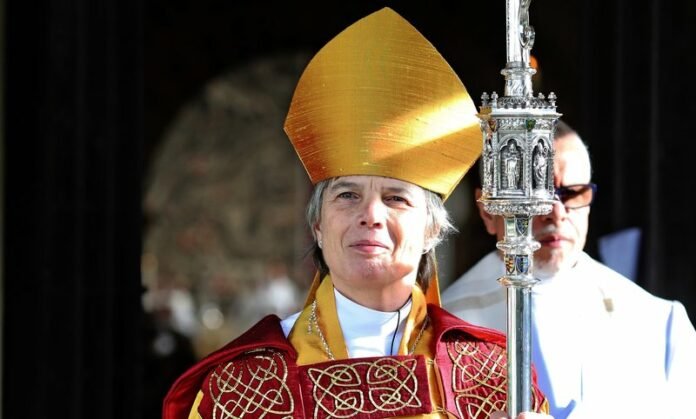
The Church in Wales’ experiment in appointing an interim Bishop of Bangor has collapsed at the final hurdle, after Archbishop Cherry Vann confirmed that interviews had been held but that the discernment process concluded it was “not right to proceed in the way we hoped.”
In her 20 February message to the diocese, published on the Bangor diocesan website and circulated provincially, Archbishop Vann wrote: “Today, we have held interviews of an Interim Bishop of Bangor. I am very grateful for all those, from the diocese and the province, who have been involved in this discernment process.” She continued: “Any process of discernment has to be open to an outcome that it is not right to proceed in the way we hoped. This is what has happened on this occasion and so we will not be proceeding with the appointment of an interim bishop.” Instead, she said, “I am going to ask the Governing Body’s Standing Committee to recommence the electoral college process. The diocese remains in my prayers.”
The statement, only four short paragraphs in English and Welsh, offers no explanation for why the process stalled, beyond the general appeal to discernment and the implication that no configuration emerged in which proceeding would have been appropriate. However, by explicitly signalling that the electoral college process will be restarted, the Archbishop has made clear that the bespoke constitutional route created for an interim bishop will now go unused.
The Governing Body had agreed in November 2025 to time‑limited constitutional changes enabling an interim bishop to be appointed to Bangor for up to two years. The official statement at that time said the amendments would allow “an experienced bishop” to be invited “to serve in Bangor for a period of one to two years,” providing “leadership and stability while work continues to strengthen governance, management, finance, and diocesan structures in preparation for a future episcopal election.” The motion followed an earlier electoral college that had not produced an election, and was carried by 75 votes to 4 (with 7 abstentions).
This extraordinary step came in the wake of a series of reports into Bangor Cathedral and diocesan life. A cathedral visitation report, published in May 2025, identified “weak financial controls,” “a lack of transparency in management,” and “safeguarding failures” including “blurred boundaries and inappropriate conduct,” as well as a culture in which alcohol use and sexual behaviour did “not reflect the professional standards expected in a Christian church.” A separate safeguarding review by Thirtyone:eight and an independent report by Anthony Pierce on safeguarding management in the Church in Wales also highlighted systemic weaknesses and criticised how concerns had been handled. Former Archbishop of Wales and Bishop of Bangor Andrew John resigned as Archbishop in June 2025 and retired from Bangor at the end of August 2025, amid continuing scrutiny but without personal disciplinary findings against him.
Against this backdrop, the interim‑bishop proposal was presented as part of a *package* to bring about “healing, reconciliation and better governance” in a diocese widely seen as damaged by conflict, poor oversight and a loss of confidence in leadership. Archbishop Vann herself, elected Archbishop of Wales in July 2025 while remaining Bishop of Monmouth, said on her election that “the first thing I shall need to do is to ensure that the issues which have been raised in the last six months are properly addressed and that I work to bring healing and reconciliation, and to build a really good level of trust across the Church and the communities the Church serves.”
In a New Year message to the diocese on 6 January 2026, Archbishop Vann gave an unusually detailed account of the interim‑bishop search. She reported that she had already had telephone conversations with five potential candidates and email exchanges with six others, and that “there are two people who are giving the role serious consideration,” while stressing that it was “too early for there to be a preferred candidate.” She outlined a structured process requiring any candidate to complete episcopal application papers, undergo standard safer‑recruitment checks, and meet with local diocesan representatives, members of the electoral college and provincial staff before a mid‑February interview with a panel including diocesan members.
The 20 February announcement confirms that those interviews took place but that the process did not generate an appointment. External observers have speculated about why. Writing on the Thinking Anglicans website, one regular commenter, “Realist,” suggested that the diocese’s reputation and unresolved questions about past leadership may have deterred plausible candidates: “Sadly I’m not at all surprised all credible contenders have given it a wide berth, especially as the ‘retired’ Archbishop is still resident and active in the Diocese, and the person at the heart of the scandals there has as yet not been subject to thorough investigation or received any sanction of any kind.” The same comment added that “there are so many good clergy and laity in the Diocese who are just quietly trying to get on with doing what they can on their patch. They deserve far better than the egotistical mediocrities they’ve been saddled with in leadership for too long.”
Other voices on Thinking Anglicans focused on process rather than personalities. One commenter, Sam Jones, described the episode as “an utter fiasco,” asking: “Why were the rules changed to permit the appointment of an interim bishop without a suitable candidate having been identified? This does not reflect well on Cherry Vann’s leadership.” Another, “Despondent,” raised a more structural concern: “With the benefit of hindsight, I find myself wondering whether this question was asked: ‘If we are going to change the rules and seek to appoint an interim bishop, what sense do we have of the likelihood of this proving impossible, and the likely consequences of that being the case.’”
Not all reaction has been hostile. A commenter identified as “Gordon” argued that exploring an interim appointment had “only added about three months to the process” and that, had it worked, “the diocese would presumably have certainty now.” He suggested that “having had a bit of time pass is not unhelpful if there were suitable candidates who weren’t in a position to move last time, but might be available for a future date,” while warning that “the nightmare scenario for Archbishop Cherry would be a situation where no qualified person was willing to take on the role on anything like acceptable terms in the foreseeable future.”
The abandonment of the interim‑bishop route does not itself resolve the underlying issues that gave rise to it—particularly safeguarding culture, governance standards and trust in episcopal leadership. The Anthony Pierce report, commissioned by the Church in Wales and released in February 2026, found that safeguarding management had been “inadequate” in several respects and recommended substantial reforms in structures, training and independent oversight. The Bangor Cathedral visitation similarly called for stronger financial controls, clearer reporting lines, and a renewed emphasis on transparent, accountable leadership.
Archbishop Vann’s decision to halt the interim process and return to the electoral college can be read in different ways. Critics portray it as evidence of weak strategic planning and an unwillingness to “see through” the exceptional route the Governing Body had endorsed. Others, including some who defended the Archbishop online, argue that building in the possibility of a “no” outcome was precisely what honest discernment required, and that pressing ahead in the absence of a clear, credible candidate would have damaged the very healing and reconciliation the interim post was meant to serve.
What is clear is that the Standing Committee of the Governing Body will now be asked to “recommence the electoral college process,” effectively resetting the search for a Bishop of Bangor. Under the Church in Wales Constitution, an electoral college of bishops, clergy and laity will meet to consider names, seeking to elect by a two‑thirds majority; if no election is made within the allotted time, the right of appointment passes to the Bench of Bishops. For now, episcopal functions in Bangor continue under existing provisional arrangements, while the Archbishop of Wales holds the diocese “in [her] prayers” and in what she has described elsewhere as a “season of rebuilding and hope.”