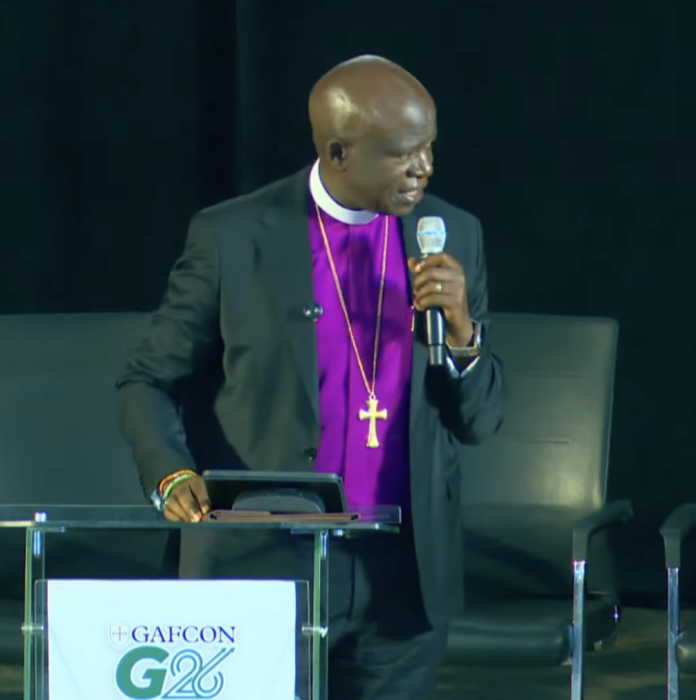
[Abuja, Nigeria] At the GAFCON G26 Mini-Conference, held March 3–6, 2026, at St. Matthias House in Abuja, Nigeria, delegates heard a clear statement from the Rt. Rev. Onesimus Asiimwe, Bishop of North Kigezi Diocese in the Church of Uganda: “The future has arrived.” This encapsulated GAFCON’s role in leading a reconfigured Anglican Communion grounded in the authority of Scripture.
On March 5, Asiimwe delivered the second address in a series of twelve titled “The Road to Reordering.” Hosted by the Church of Nigeria (Anglican Communion), the conference brought together primates, bishops, and delegates from various regions to assess GAFCON’s progress since its founding. His talk built on the GAFCON Primates’ Martyrs’ Day Statement from October 16, 2025, reviewing 18 years of advocacy for biblical fidelity amid doctrinal shifts in the wider Communion.
Asiimwe introduced himself as a husband, father of three, and evangelist in the Church of Uganda. He referenced the East African Revival of the 1930s, which began in Rwanda and emphasized biblical fellowship as in Acts 2:42–47. He described similar spiritual vitality today in North Kigezi, including conversions, healings, and reconciliations. In a pre-address interview, he called GAFCON the “guardian of biblical orthodoxy,” stressing the need for discipleship amid Uganda’s growing number of converts. He opened with a prayer for wisdom in his leadership and the Church of Uganda’s renewal.
A participant in every GAFCON assembly since the 2008 Jerusalem conference, Asiimwe highlighted the Jerusalem Declaration. This document upholds Scripture, the Thirty-Nine Articles, the 1662 Book of Common Prayer, and the Great Commission (Matthew 28:18–20). He outlined a shift from Lambeth’s centralized model to a polycentric structure supported by a primates’ council, adapting orthodox faith to diverse cultures. The diverse G26 delegation, he noted, signals GAFCON’s maturity as it nears its 20th anniversary in 2028.
Asiimwe offered three key observations to support his vision of Anglican reordering. First, the cosmopolitan convocation drew delegates from every inhabited continent, underscoring GAFCON’s broad representation and influence across global Anglicanism beyond any single region’s concerns. Second, confessional cohesion bound participants not through institutional loyalty but via a shared commitment to the historic creeds and core missional imperatives, enabling strong solidarity despite cultural differences. Third, scriptural suzerainty establishes the Bible as the definitive authority in Anglicanism; it counters distortions such as the prosperity gospel prevalent in some African contexts and Western innovations in sexual ethics. Over the past 18 years, GAFCON’s repeated appeals for repentance and reform have been disregarded by Communion instruments like the Lambeth Conferences and the Anglican Consultative Council, whose approaches to collegiality have proven ineffective in maintaining doctrinal standards.
Asiimwe emphasized GAFCON’s proactive and constructive contributions over mere protest. The movement organizes recurrent assemblies and specialized gatherings, such as the current G26 mini-conference. It has nurtured the formation of new provinces, including the Anglican Church in North America (ACNA) and the Anglican Church in Brazil. It has planted and supported new dioceses in difficult terrains, from England and broader Europe to communities of former Muslims who have converted to Christ. It runs capacitating programs like the Bishop’s Training Institute, which Asiimwe personally helped establish in Abuja to equip leaders. Additionally, it pursues holistic service through affiliates such as the Anglican Relief & Development Fund, addressing practical needs alongside spiritual formation. These initiatives reflect diligent church-building that has driven significant membership growth, rather than schism.
The address occurred amid ongoing Anglican changes. For Asiimwe, reordering supports evangelism, teaching, and mission, following biblical patterns of renewal. It avoids triumphalism, focusing on stewardship of the Great Commission. The address ended with discussion and praise.
With Africa’s leading role—seen in Nigeria’s hosting and Rwanda’s primateship—G26 strengthens GAFCON’s global witness. Its outcomes may shape Anglicanism’s path toward unity in truth.