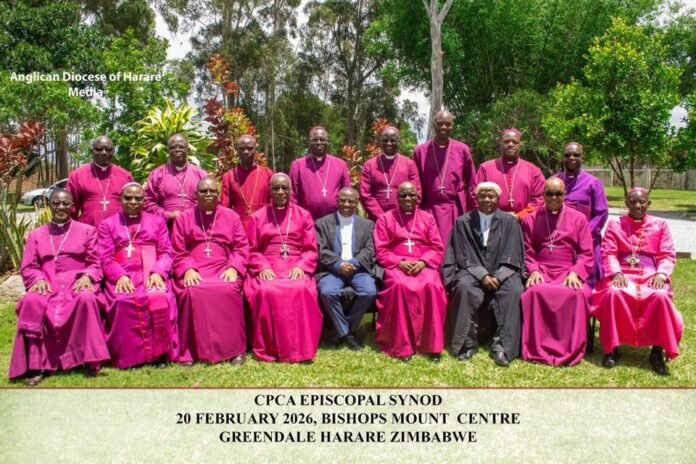
The episcopal synod of the Church of the Province of Central Africa has ratified the provincial synod’s vote last year in Malawi to divide the province into three national churches.
The primate, the Most Rev. Albert Chama on 20 Feb 2026 said all of the bishops from the province’s 15 dioceses met at the Bishops Mount Centre in Harare and agreed to form national churches for Zimbabwe, Malawi and Zambia. The diocese of Botswana would enter the Church of the Province of Southern Africa, he said.
“Now, this is happening not out of selfishness,” Archbishop Chama said, noting, “we’ve been together since 1955, when our province was inaugurated.”
“We’ve had a lot of good things that we’ve done together. Fellowship, going across nations and across borders, just to fellowship and strengthen the Church and strengthen one another. That has been very, very good.”
But “in everything, there must be growth. So when the provincial synod met and resolved that we need to go into national provinces, it was not out of selfish motives”, or national pride, the archbishop said. The bishops believed “ we need to grow now within our own nations,” as Malawi seeks to form three new dioceses and Zambia two new dioceses to accommodate the growth of the church.
“God’s time is the best time,” he explained, “and we feel and feel that God has given us this time. This is now when we are supposed to do this.”
The new provinces were currently at work preparing the constitutional and canonical basis for separation, he said, noting Botswana had already initiated relations with Southern Africa.
The archbishop further stated “we also want to affirm that the Church of the Province of Central Africa is part of the worldwide Anglican Communion family. I know there are groupings within the Anglican Communion because people are disagreeing on certain issues, especially the issue of human sexuality.”
“Hence, some have chosen to depart from the communion into forming these new groups or small groups. However, as the Church of the Province of Central Africa, we still remain within the Anglican communion, and we maintain our orthodox teaching on human sexuality and marriage,” he said.
Archbishop Chama stated that “for us, marriage is between a man and a woman” and “we do not accept same-sex marriages or people who do not want to get married … But we still remain with the orthodox teaching as the scripture that sex is between a man and a woman.”
“We believe that splitting from, running off from each other, we are not going to resolve the issue. Our position is that within the family of the Anglican communion, there is still room to discuss, to dialogue, to see how best we can come together and work together. Of course, keeping it in mind that orthodox teaching can never be changed,” Archbishop Chama said.
In other business the bishops discussed initiatives to create economic self-sufficiency and elected the Bishop of Manicaland, the Rt. Rev. Erick Ruwona, as dean of the province.