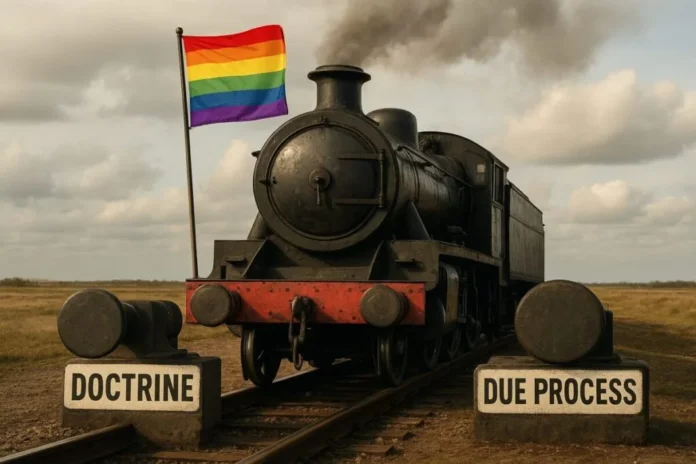
Yesterday in Synod, we spent five hours (yes, five!) on what is likely to be the final debate on the Living in Love and Faith process (LLF), the Church of England’s damaging and divisive debate on sexuality launched by Justin Welby in 2017. Following what was widely seen as a volte face by the House of Bishops in October—both in terms of what they said and their belated commitment to transparency—they offered this motion as ‘settlement’ for the process:
The Archbishop of York to move:
That this Synod:
a) recognise and lament the distress and pain many have suffered during the LLF process, especially LGBTQI+ people;
b) affirm that the LLF Programme and all work initiated by the February 2023 LLF Motion and subsequent LLF Motions will conclude by July 2026;
c) thank the LLF Working Groups for their committed and costly work, which will now draw to a close with the conclusion of this synodical process;
d) commend the House of Bishops in establishing the Relationships, Sexuality and Gender Working Group and Relationships, Sexuality and Gender Pastoral Consultative Group for continuing work.’
As is customary for this debate, both ‘sides’ (excuse the shorthand) viewed it with deep suspicion—revisionists because it understated their pain, and showed no real signs of sorrow, and the ‘orthodox’ because clause (d) seemed like a hostage to fortune, leaving the door ajar for future possible change and further damaging debate. Indeed, Steven Croft, bishop of Oxford, had said as much in the Tuesday afternoon Questions session, talking about ‘affirming’ bishops (as if those believing the teaching of Jesus and the doctrine of the Church were somehow ‘denying’) and an ongoing process.
There were eight amendments tabled, ensuring that the debate would last the whole five hours. Many of them were predictable—from revisionists wanting to amplify the apology, and delete the idea that LLF is over, and some from orthodox wanting to amend or delete the possibility of continuing discussion.
There were two exceptions to that, though, the first from Christopher Landau simply recognising that the ‘LGBTQI+ people’ were actually a diverse lot with different views. This is, of course, anathema to revisionists, who repeatedly talked as though all such people were a monolith who agreed with them—despite the number of gay women and men in the chamber who were orthodox and gave very clear speeches to that effect (I include several below).
The other was a cross-party proposal from Lis Goddard, agreed with Helen King, aiming to bring the fruitful learning of the ‘Leicester’ discussion groups into the proposed working groups. No sooner had Lis proposed this, than Helen King misused a point of order to deny her support for it! It was a clear sign that even the minimum of collaboration is not politically expedient for revisionists.
But we had been told ahead of time that that House of Bishops, having painfully thrashed this motion out as the only way forward for them, would resist every amendment—and the procedure of calling for a ‘vote by Houses’ meant that they effectively had a veto, and used it fairly consistently. I did wonder whether some of the revisionist bishops would break ranks, and perhaps vote for one of the revisionist amendments, but a maximum of six out of the 38 or so present did so.
It was clear that the revisionists really did not want to vote for the unamended motion, because it said clearly that LLF had ended. But if they voted it down, they would also be voted down clause (d) offering a chink of light of continued discussion, so they held their noses and voted ‘for’. Orthodox felt similarly ambivalent for the opposite reasons, and in the end some voted for (drawing a line under LLF) and others voted against (because we don’t want further damaging discussion).
I doubt many on the outside will now sit and watch five hours of discussion. But for me there were two clear features of the debate. The first was that evangelicals and other orthodox have clearly matured and grown in the way they conduct themselves and engage in this contentious discussion over the years since 2023, 2017, and long before, and that is a good sign. I think, almost without fail, the speeches were clear, were full of pastoral wisdom and good theology, and were expressed in a sensitive and winsome tone.
By contrast, many of the revisionist speeches were full of emotion and anger—understandable—but also full of unchanging generalisations and stereotypes. Jesus was ‘inclusive’, and they are ‘inclusive’, so they are being like Jesus, which means that those denying same-sex marriage are…? It is all about love, and love means love, and love means giving people what they want. For me, the theological low point was one women saying that, when her two lesbian friends entered a same-sex marriage, this was equivalent to Simeon and Anna meeting the baby Jesus in the temple in Luke 2: ‘My eyes have seen the salvation of the Lord’.
I am sure that those I disagree with will claim that I am biased—but my strong sense is that, whilst the orthodox have travelling a long way in terms of care of language, level of engagement, and tone, revisionists have not moved one inch. I noted, in my speech at the start of the debate opposing Charlie Bacyk Bell’s amendment, that the whole LLF process, after all this time, has not even delivered the basics of common understanding of the terms of the debate.
Brothers and sisters, we need to face some sobering realities.
After all this time, we have not even agreed on the basic terms. The Jesus of the gospels is fully inclusive (how could we be more inclusive than him?) and yet teaches clearly that marriage and sexual intimacy between one man and one woman, as a reflection of his creation of humanity male and female.
After all this time, we have not recognised the shape of the discussion—not between two different views, as if we were standing nowhere, but between those who uphold the doctrine of the Church—and of the church catholic through all ages—‘according to the teaching of our Lord’, and those who want to see it changed.
After all this time, there is so little recognition that gay people in this chamber do not agree, and are on both—on every—side of this debate.
After all this time, there is so little good will across the debate. I was part of the RMC discussion last week, and I found Chantel Noppan’s expression of anger and disappointment deeply moving. But I honestly doubt that any here wanting change will believe me for a second. What a tragedy that is.
After all this time, we still have not had the openness from the House of Bishops that we have all been asking four. There are four papers we were told of in February 2024 which have still not been published.
This amendment will cement this failure and do nothing to take us forward.
So where do we go now? Interestingly, both the Guardian (‘issue is put in deep freeze’) and the BBC (‘abandons proposals for same-sex blessing ceremonies’) were very clear: the Church of England has put a stop to this debate, and abandoned the possibility of blessing same-sex relationships. By contrast, ‘Together’ (the revisionist group) has declared that it is full steam ahead, and though progress has been slow, change will certainly come.
This complete contrast between what most people see as reality, and the revisionist spin, was evident this morning when I was invited on the Radio 4’s Today programme (at 7.32 am) to debate with Charlie Bączyk-Bell, a vocal campaigner on this issue who went to the US last year to marry his same-sex partner. Here is the transcript:
Justin Webb: The Bishop of Canterbury, Sarah Mullally, said the discussions had left us wounded as individuals and as a church. But she said the bishops’ proposals were a sensible way forward that will take us on to the next steps.
Let us talk to the Revd Dr Ian Paul, author and theologian and a member of the General Synod, and to the Revd Dr Charlie Bączyk Bell, who is a priest in the Diocese of Southwark and a Fellow of Girton College at the University of Cambridge. Good morning to you both.
Dr Paul, first of all — do you think they’ve done the right thing?
Revd Dr Ian Paul: Yes, I think they have. This is the teaching of Jesus, this is the doctrine of the Church, this is what is said very clearly in canon law and in our teaching. And this is what all of us — Charlie, myself, and all the bishops — make a public vow to uphold.
At ordination we are asked: “Do you believe the doctrine of the Church?” and we say yes. Then we are asked, “Will you uphold and teach it?” and we say yes. So in fact all that has happened in Synod is that we have confirmed that we will do what we all promised to do.
I think Sarah Mullally is exactly right — this debate has been damaging. It has hurt people on both sides. And I realise that for people like Charlie, who want to see change, it has been deeply painful. I really hope we can now put … read it all at Psephizo