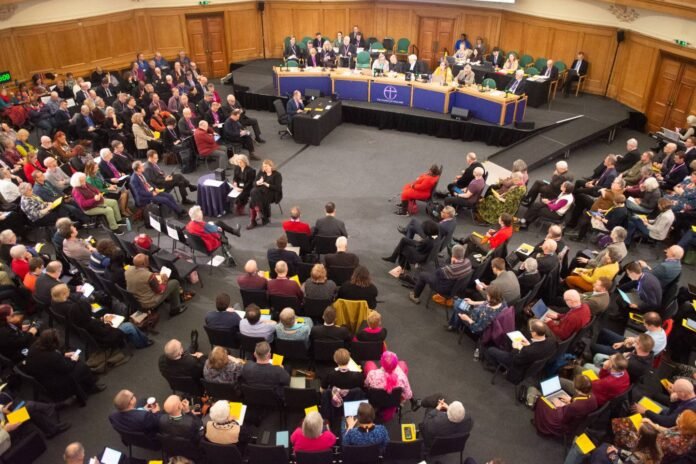
General Synod has given its backing to establishing working and consultative groups to continue work on same-sex relationships and marriage as the Church of England’s Living in Love and Faith (LLF) process comes to a conclusion.
LLF was originally set up in 2017 to explore the Church’s approach to identity, sexuality, relationships and marriage.
It led to the introduction, following a key Synod vote in 2023, of public prayers of dedication, thanksgiving and asking for God’s blessing for same-sex couples – known as the Prayers of Love and Faith (or PLF).
The Prayers of Love and Faith are now in use as part of regular Church of England services but the House of Bishops confirmed last month that new special or ‘bespoke’ services for same-sex couples would need full formal authorisation under canon law.
Synod last night approved proposals from the Bishops to set up a Relationships, Sexuality and Gender Working Group which will, among other things, explore the approval process for bespoke services under canon law. The Working group will also explore what legislation would be needed to licence or ordain same-sex married clergy.
The group will have a remit to resource the House of Bishops on wider issues around Relationships, Sexuality and Gender, recognising the Church’s ongoing call to share a Christian worldview of what it means to be human.
There will also be a Sexuality and Gender Pastoral Consultative Group to give pastoral advice to bishops and archdeacons on specific cases in the interim and facilitate consistent practice across the Church.
After an impassioned five-hour debate, Synod backed a motion recognising and affirming “the pain many have felt during the LLF process, especially LGBTQI+ people” and that the LLF programme will conclude by July, when Synod next meets.
The motion also “commends” the House of Bishops setting up the two new structures and thanks all those who took part in the LLF working groups for their “committed and costly work” in recent years.
Opening the debate the Archbishop of York, Stephen Cottrell, said: “This is not where I want us to be, nor where I hoped we would be three years ago.
“And I want to acknowledge that wherever you stand on the LLF debate, I know that many of you are feeling angry and disappointed.
“There is a lot of pain and that pain cuts across so called ‘party lines’ or theological convictions held.”
Recognising that the Church remains “deeply divided” on questions of sexuality and marriage, he added: “The Bible tells us that when one of us is hurting, we all hurt.
“Therefore let us continue to reach out to one another; to recognise the face of Christ in each other; to avoid scapegoating, belittling or rubbishing one another’s conscientiously held views. Let us continue to pray that the Holy Spirt will lead us into all truth.
“I give thanks that LLF has enabled us to commend prayers that are being used to bless faithful Christan people in same-sex relationships or civil marriage. I have met and spoken to some of them and rejoice that it has helped them feel more included in our Church.
“But I also recognise that we are not yet at a place where other developments can be made. We do now know what questions must be asked theologically, liturgically, synodically and legally to map a way forward, and we need to bring LLF to a close so as to create the space where this work can breathe.”
During the session, members debated eight possible amendments to the motion which were all ultimately rejected, all but one of them in all three Houses of Synod (Bishops, Clergy and Laity).
Speaking as the debate came to its conclusion the Archbishop of Canterbury, Sarah Mullally, said: “I want to thank you for the way in which you have engaged in the debate this afternoon, but also for the way in which you have engaged in LLF over many years.
“I know that has come at personal cost.
“For many of you, it has touched some of our deepest theological views, but also the core part of our identity.
“I recognise that LLF has been hard. It has left us wounded as individuals and also as a church, and therefore I am grateful that you are still here, and I want to honour the fact that despite the wounds that many of you carry and have expressed, not just this afternoon but in other debates, that you are still here with us.
“I know that the proposals this afternoon may well be disappointing for some, but I do believe it proposes a sensible way forward that provides us with a structured framework that I believe will take us to the next steps.
“Earlier this week, I talked about hope. Hope is a muscle that we need to flex. So I would encourage you today not to have hope in the church, but to have hope in God upon whom our foundation is made, who sees each one of us, who sees each one of us made in the image of God, and to take that step and flex that muscle of hope, trusting in God in these next steps.”
The motion was:
That this Synod:
- recognise and lament the distress and pain many have suffered during the LLF process, especially LGBTQI+ people;
- affirm that the LLF Programme and all work initiated by the February 2023 LLF Motion and subsequent LLF Motions will conclude by July 2026;
- thank the LLF Working Groups for their committed and costly work, which will now draw to a close with the conclusion of this synodical process;
- commend the House of Bishops in establishing the Relationships, Sexuality and Gender Working Group and Relationships, Sexuality and Gender Pastoral Consultative Group for continuing work.’
It was approved as follows:
Bishops: 34 for; 0 against; 2 abstentions
Clergy: 109 for; 62 against; 10 abstentions
Laity: 109 for; 70 against; nine abstentions