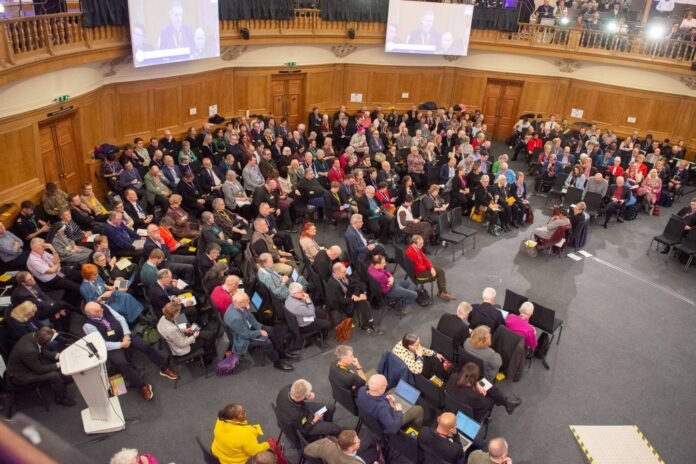
The second day of Synod began, after Worship, with new Archbishop of Canterbury, Sarah Mullally’s, first Presidential Address. In it she spoke of approaching her ministry with calm, consistency and compassion; of nurturing confidence and hope rooted in the Gospel; and of recommitting the Church to transparency, safeguarding, and the flourishing of the local parish and communities.
Legislative Business
Synod then turned to a number of legislative items. Amending Canon No. 44, relating to the exercise of ministry by Armed Forces chaplains, which was enacted.
The Clergy Conduct Measure (CCM) was then reintroduced to synod following feedback from the Parliamentary Ecclesiastical Committee. Synod agreed an amendment, reversing the presumption of private hearings so that tribunals and courts will normally sit in public. Final approval for the Measure was then secured comfortably across all three Houses.
Bishops – For: 21, Against: 0, Abstained: 0
Clergy – For: 142, Against: 0, Abstained: 3
Laity – For: 149, Against:0, Abstained: 0
Synod then approved changes to the Church Representation Rules concerning PCC decisions taken by correspondence, introducing the requirement that at least one third of members must give written approval and that no member objects. The motion passed with strong support.
(Votes – Bishops: 17–0–0; Clergy: 94–6–3; Laity: 104–1–5).
Bishop of Guildford
Just before the break for lunch, prayers were said for the Bishop of Guildford, Andrew Watson, following his announcement of a cancer diagnosis.
Living in Love and Faith
The afternoon began with a presentation and extended Q&A on Living in Love and Faith. Members engaged with the House of Bishops’ January 2026 statement, which outlines the conclusion of the LLF programme in its current form, the continued monitoring of Prayers of Love and Faith within regular services under Canon B5, and the establishment of new governance structures – the Relationships, Sexuality and Gender Working Group and its Pastoral Consultative Group.
Reimagining Care
Synod then endorsed the vision of the Archbishops’ Commission on Reimagining Care, commending parish level good practice and urging national policymakers to draw on the Commission’s proposals as they develop a National Care Service. The debate emphasised the importance of listening to disabled and older people in shaping the future of adult social care.
(Votes – For: 245, Against: 0, Abstained: 1)
Lowest Income Communities Funding
With additional time available, The Business Committee moved to bring the Lowest Income Communities (LInC) Funding debate forward from contingency business to this sitting, which was approved. Synod considered the Chester Diocesan Synod motion, which highlighted a mismatch between deprivation and current diocesan level allocations and called for parish level analysis of need. Background material included research showing that significant proportions of LInC funding may not reach the most deprived communities.
Alongside this, members considered background information emphasising the complexity of revising the formula and the need to align any changes with the overall review of the Church’s funding framework.
After debate, Synod agreed an amendment from Carl Hughes, to remit LInC funding reform to the wider review of the Church’s funding framework. The amended motion asks the Archbishops’ Council and Church Commissioners to report back to Synod on alternative approaches to LInC distribution that align with the outcomes of that broader review. The amended motion was carried by a show of hands.
Questions
The day concluded with Synod’s second questions session, with members exploring a wide range of issues across the Church’s national life.