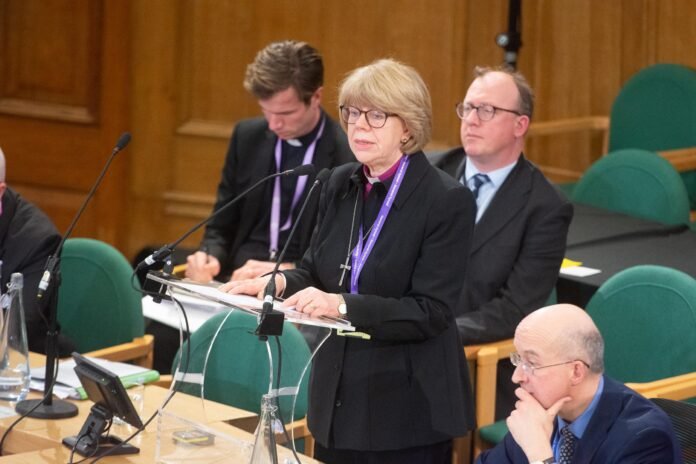
10 February 2026
It’s a pleasure to bring this important topic before Synod for our discussion. I want to start by thanking everyone who was involved in the Reimagining Care Commission for their work.
I know that the members of Synod bring much wisdom and experience to this area, and so I look forward to what I know will be a good debate.
According to the Government’s report, People at the Heart of Care, 10 million people are affected by adult social care in England at any one time. They receive care and support, others provide paid or unpaid care. Care, delivered well, can be transformative and enables us to live lives to the full.
However, too many struggle to access the care that they need. Local authorities face mounting pressure to deliver care with insufficient funds. As the system struggles, more and more work is falling on unpaid carers. And as I mention unpaid carers, I want to recognise the hard work that unpaid carers give day after day.
It has been suggested that 2 million people over the age of 65 and 1.5 million people of working age are not getting the care that they need. Even those receiving care may not have the right care and may not find it accessible in the right place.
Just over two or three years ago, the Reimagining Care Commission published its report Care and Support Reimagined. The Commission was led by the former bishop of Carlise, +James Newcombe, and Dr Anna Dixon, now Labour MP for Shipley. The wide membership included experts from across the sector, and also those with lived experience of care. The Commission also engaged a broadly with stakeholders, in person and virtually, to consider how the system was working. Their conclusion was clear: there is urgent need for reform. This means not only change at the margins, but a holistic reimagining of how social care is conceived, organised, delivered and experienced. This remains as true today as it was when the report was published.
The Commission offered three recommendations: firstly, to rethink attitudes to care and support, secondly to rebalance roles and responsibilities, and finally to redesign the system. These recommendations are more than just ideas for policy change; they call for moral and spiritual change too.
The headline recommendation is to establish a National Care Covenant as a mechanism for reform. This would be government-led process. It would set out the role of citizens, families, communities and the state in providing and funding care and support.
Synod, the Commission called for a covenant because that concept includes more than just impersonal transactions. It represents a relationship and an obligation between people. A covenant is a statement of solidarity with others. It is a pledge to work together with one another towards a common goal, even when that work becomes hard and complex.
Though the government would facilitate the development of the covenant, the Commission is clear about the role of the church, because of the role that the church already plays in care – and should continue to do. That role reflects how many of you and the churches you represent already show solidarity with your communities by providing care.
Synod, our care system is not working in large part because our society has forgotten that living in community requires all to contribute and to receive.
The Commission reminds us that there is inherent dignity in every human being, all are made in the image of God. That dignity is not eroded by disability, illness, or the need for care. It may be ignored by how we, as a society, decide to offer and receive care. Whenever that does occur, the Church is called to say again that people are not economic units for productivity, but people, people worthy of access to care and support, which each one of us require at some point in our lives.
Synod, just before I conclude I want to note the excellent examples so many churches provide in this area. One of the most innovative is social prescribing – a method of engaging with health and care services that enables people to utilise the wonderful activities already run in churches.
And can I commend to you the work of the Church Urban Fund (CUF), who already make available many useful tools to equip churches in social action and mission. In response to the Commission’s report, CUF are developing a further package of resources aimed at ensuring older people are empowered to participate fully in churches and to receive appropriate care when needed.
It is time that we recognise as faith leaders that we play an important role in the health of our communities – spiritual health, of course, but also physical, social and emotional health. Our cure of souls involves care and support of people’s whole lives.
This debate comes at a significant time as Baroness Casey continues her work in chairing the independent commission on adult social care set up by the government.
Synod, I encourage you to share your stories and your hopes for how the Church may contribute to the flourishing of all those who receive care – and those who provide it to them.
Notes
- Department of Health and Social Care, People at the Heart of Care: Adult Social Care Reform White Paper, CP 560, December 2021, p 10.
- Commons Health and Social Care Select Committee Report, Adult Social Care Reform: the cost of inaction, ;HC 368, May 2025, p2: Adult Social Care Reform: the cost of inaction
- The referenced recommendation is “The Church of England, with partners, to develop resources for local churches to adopt an asset-based approach and to increase awareness of and engagement with disabled people and older people in their communities.” Care and Support Reimagined: A National Care Covenant for England, P35. Reimagining Care Commission