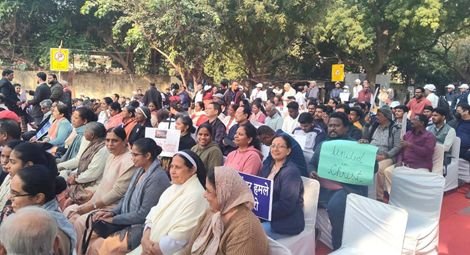
Approximately 2,000 Christians representing more than 200 denominations gathered at Jantar Mantar in New Delhi, India on 29 November to draw attention to increasing hostility faced by Christians and to advocate for long-delayed legal and constitutional reforms.
The day-long National Christian Convention, organised by a coalition including the All Indian Catholic Union and the United Christian Forum (UCF) under the theme ‘towards a self-reliant, progressive, and united India’, featured contributions from bishops, pastors, civil society leaders, journalists, lawyers and representatives from Hindu, Muslim, and Sikh communities who stood in solidarity with the gathering.
The convention amplified testimonies from some of the most vulnerable regions in the country. Speakers detailed a sharp rise in targeted violence, including a reported 500% increase in attacks against Christians between 2014 and 2024, with 834 cases recorded in 2024 alone. These ranged from mob vandalism of churches and schools to physical assaults on pastors, often triggered by unverified allegations of forced conversions. First Information Reports (FIRs), which are required for the police to open investigations, were registered in fewer than 20% of the cases, leaving victims without legal recourse.
Participants also raised serious concerns regarding the Presidential Order of 1950, which continues to deny Scheduled Caste status to Dalit Christians and Dalit Muslims on the basis of their religion. Speakers emphasised that this policy continues to trap millions in generational poverty by denying access to education reservations, employment opportunities and land rights. Delegates from tribal communities highlighted mounting pressure in mineral-rich belts like Chhattisgarh, Jharkhand and Odisha where tribal Christians are at risk of being delisted from the Schedule Tribe list and thereby also excluded from benefits including reservations in education and government jobs, and protections for land and forest rights.
Legal experts at the convention analysed the misuse of state-level anti-conversion laws, stressing that these provisions have emboldened non-state actors and contributed to a climate of impunity. Others underscored the Christian community’s longstanding contribution to the nation, noting that Christian organisations operate the vast majority of non-governmental health facilities and private educational institutions in India, serving people of all backgrounds without discrimination. The event incorporated reflections, folk performances, and hymns that affirmed the community’s commitment to peace, nation-building and interfaith harmony.
The convention concluded with a collective decision to draft a national manifesto calling for protection for all Christians, equality for Dalits, and justice for those facing persecution. Once finalised, the manifesto will be submitted to the President of India, the Prime Minister, the Union Home Minister, the Minister for Minority Affairs, and the Chief Justice of India.
CSW’s Founder President Mervyn Thomas said: ‘CSW stands in solidarity with India’s Christian community and joins them in their call on the government of India to uphold constitutional protections for freedom of religion or belief, to ensure accountability for perpetrators of targeted violence, and to remove discriminatory provisions that impact vulnerable communities.’