
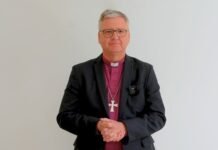
Archbishop Foley Beach, Primate of the Anglican Church in North America, and Archbishop Nicholas Okoh, Primate of the Church of Nigeria (Anglican Communion), have signed an agreement regarding the status of the Convocation of Anglicans in North America (CANA) dioceses in both provinces.
CANA was originally a missionary movement in North America under the Church of Nigeria. CANA fulfilled two main objectives: they provided a connection between the Church of Nigeria and Nigerian immigrants in the United States, and they provided oversight to those leaving the Episcopal Church before the inception of the Anglican Church in North America. At the formation of the Anglican Church in North America, CANA became a founding jurisdiction of the province while also retaining membership in Church of Nigeria. Eventually, CANA subdivided into dioceses who applied and were received as dioceses of the Anglican Church in North America with their bishops having seat, voice, and vote in the Anglican Church in North America College of Bishops and in the Church of Nigeria.
In January of this year, the Church of Nigeria elected four suffragan bishops for the Diocese of the Trinity, a CANA diocese composed primarily of expatriate Nigerians in North America. These elections surprised the Anglican Church in North America and led both provinces to desire clearer lines of authority for the CANA dioceses. A joint committee of representatives from both provinces met in Houston, Texas on March 12, 2019, and the final agreement was signed by both primates this week in Sydney, Australia during the Gafcon Primates Council Meeting.
The agreement provides that CANA become solely a mission of the Church of Nigeria but allows each of the three dioceses (Cana East, Cana West, Trinity) to make its own decision regarding its provincial relationships.
Each diocese will amend its constitution and canons as necessary, and may request to be a ministry partner of the alternative province. Both provinces are thankful that this resolution has been reached and look forward to continued collaboration in Gospel ministry, sharing full communion as provinces in the Anglican Communion.
This agreement enables a diocese which desires to emphasize reaching expatriate Nigerians to have a direct connection with the Anglican Church of Nigeria, and it allows a diocese with a broader ministry focus to remain directly connected with the Anglican Church in North America.
Archbishop Beach commented on the situation, “In one of my recent trips in the United States I came across an old French Catholic Church and an old German Catholic church within a couple blocks of each other. It reminded me how many Americans over the centuries have maintained cultural and ecclesial connections with their country of origin while starting new lives here in North America. This agreement helps us honor the desire of our Nigerian brothers and sisters in North America to remain connected with the Church of Nigeria, while providing for future ministry partnership.”


Just a grammatical note — I’m sure the expatriates are still patriots and not ex-patriots!
That sounds more lexicographical than grammatical,
I stand corrected 🙂
Never underestimate the aging who have little but pedantry left.
A step in precisely the wrong direction.
Agreed. When the split of CANA into dioceses was done, that should have been the point in time at which every diocese makes a decision to be part of the Church of Nigeria or ACNA but *not both*. This is just fueling the fires of jurisdiction rivalry. Not good.
Actually puts an end to whatever jurisdictional conflicts there were because the CANA dioceses overlap now with ACNA in the same way Lutherans and Episcopalians overlap…of no consequence because they are not within the same structure, but also like with the Lutheran Pastor in Colorado Springs, we can be good friends because we don’t have our noses in each other’s business.
You are right alphaTomega, the ecumenical analogy doesn’t work in this circumstance since both the Anglican Church in North America and the Church of Nigeria are provinces of the Anglican Communion. Having multiple, overlapping, orthodox, Anglican provincial jurisdictions isn’t always consistent with Anglican or catholic order. It would be incoherent unless one of the entities had a specific missional remit that differentiated it from the other. Even then, such accommodations are not ideal. However, the ideal sometimes needs to give way to the pragmatic, at least for a time.
Good to clear up the situation cleanly. I see this as a step to unity, not division. Nigeria will keep the Diocese of the Trinity as a mission to Nigerians in America and release the rest to join ACNA unencumbered by the awkward relationship with Nigeria.
It certainly is religious extraterritoriality. That’s been the new kid on the block since the Singapore consecrations 19 years ago.
I don’t understand your first sentence. As for the second, anyone can join a parish in the mission diocese.
Three of the four are, which is why Nigeria released them to join ACNA fully.
I think it makes little difference whether they are citizens or permanent resident aliens (green card holders). They want to worship as Anglicans in their native languages and maintain their connection to their native land in this way. When they, or their fully Americanized children, decide this is no longer a primary consideration, they’ll join an English-language Anglican parish wherever they move. It’s not racial, certainly not on the part of the ACNA. My own REC parish is multi-racial and multi-cultural, as are many others throughout the ACNA, I’m sure.
This view seems to me to impute some pretty ugly motives to the Nigerian Anglicans. I know a few here in the USA. Like many new immigrants and first-generation Americans, they cling to the languages and traditions of their native land, not in hatred of their new country, but to keep their family traditions and habits. I don’t really see the problem which concerns you. Accusing people of racial discrimination is not something we should do lightly. Yes, I’d like to see all one Anglican Church here, in unity. We don’t have that now, and we’re not likely to for some time to come. Exercising charity towards our newer neighbors is Christian behavior.
Wow, what a racist perspective, let alone historically inaccurate. Nigeria offered cover and communion continuation to those being drummed out of TEC 25 years ago…so most to CANA’s parishes are primarily English speaking Anglicans from long standing Episcopal background.
If that’s the case, Don Armstrong, then I apologize for not knowing much about CANA. I know local Nigerian Anglicans who fit my description of the situation, and I don’t think my perspective is in any way “racist.” To my knowledge, we have no CANA parishes in this area. My Nigerian acquaintances worship with us from time to time but are trying to establish a Nigerian parish for what seem to me to be perfectly good reasons.
Here, in San Diego, I used to belong to a local Serbian Orthodox parish. There are also Russian, Greek, Arab, etc. parishes here. Some ethnic Bulgarians attended our parish, but they were trying very hard to start up a Bulgarian one. Also, a small Romanian parish here met at a Russian parish, using the Russian’s facilities. In other words, each ethnic group wanted their own ethnic parish, regardless of the number of Orthodox parishes already here. Sad.
Katherine, what are the results (of the agreement)? I suggest viewing Anglican Ink Episode 501, if you haven’t. Love, charity, is used to cover many sins, e.g. TEC.
Reading through these comments makes it clear that we are still the church militant- or at least Anglican Ink militant!
Not really, read it carefully. There is no release to allow them (the dioceses) to join ACNA. BTW the dioceses are *already* part of ACNA. So they can not be released to join something of which they are already a part! Bascially I read it as the Diocese of the Holy Trinity does not want to be part of ACNA. Perhaps this needs to be taken up at ACNA’s provincial assembly? There is a way to diocese to be removed from ACNA. Perhaps it is time to consider that for the Diocese of the Holy Trinity? If they want to be part of the Church of Nigeria, terrific! Just leave ACNA and all will be good! Problem solved!
“The agreement provides that CANA become solely a mission of the Church of Nigeria but allows each of the three dioceses (Cana East, Cana West, Trinity) to make its own decision regarding its provincial relationships”
So, yes, the dioceses, and possible parishes, can make an individual determination of which province to remain with. The use of the term “CANA” will remain with the Church of Nigeria. But the dioceses, as organizations, can remain part of ACNA if they choose.
At least, that is my conclusion when I “read it carefully”.
I would change application of the word ‘remain’…we cannot remain in ACNA because we have never been relinquished to ACNA by Nigeria, so we remind in Nigeria of which we have always been and are now even more clearly apart, or leave to join ACNA.
No need for any of us to leave ACNA to join Nigerian, because we have never been structurally a part of ACNA, but always and already member churches of Nigeria…under Nigerian consecrated Bishops.
FWIW, Don, Bp Dobbs, Diocesan of CANA East, Bp Felix Orji, Diocesan of CANA West and Bp Amos F. Diocesan of Diocese of the Trinity are all members of the ACNA College of Bishops.
You’ve got it right SCBlueCatLady, the dioceses are all currently ACNA dioceses and have been for years. They can choose to leave the ACNA to be solely under Nigeria. If they leave the ACNA, but want to be an official ministry partner, then they can engage that process. That process goes through the Provincial Council. One clarifying note, the chaplains are a special jurisdiction (not a diocese) and already relate solely and directly to the ACNA.
This article and the responses indicate a real misunderstanding…for example our CANA East Diocese is for all people from
all nations and are firmly in The Church of Nigeria…not ACNA.
Don, all the CANA dioceses *are* part of the ACNA.
Well, firstly I was talking about Foley’s misrepresentation that CANA is a mission to expatriate-Nigerians…CANA is a church with wide cultural and ethnic membership. To your point about our relationship to ACNA, it has always been one of ministry partnership with ACNA and not one of structural authority. Unlike Rwanda for example, there never has been a handing over of CANA, which pre-dates ACNA, by the Church of Nigeria to ACNA. Our Bishops attend the House of Bishops in Nigeria. I am a registered priest into the Diocese of Abuja in the Anglican Communion Province of Nigeria, not in anyway having a letter dimissory on file with the ACNA. All our certificates of preferment and membership are from Nigeria, with never as much as an e-mail from ACNA mentioning a relationship with them. I have sat at the dinning room table in my own house with both Archbishop Akinola and Archbishop Okoh and confirmed my understanding of this. It is important as well, that our structural relationship makes clear our larger Anglican Communion membership…something that ACNA cannot offer, but the Church of Nigeria as a Province of the Anglican Communion does. Having also sat around the table with Bishop Minns and Duncan from the earliest days of this conflict with TEC, they were two distinct people operating out of two different realms of authority…never did I subject myself or my parish to Bishop Duncan’s flawed ecclesiology.
A direct quote from the CANA Diocese of the West website:
So, yes, CANA is part of the Church of Nigeria. BUT, it is also a diocese of ACNA. Although, obviously due to the recent agreement, that is subject to change at the will of the diocese.
That is correct TJ. The Cana dioceses are ACNA dioceses at the present. Due to this recent agreement they may choose to leave the ACNA to come solely under Nigeria. To clear up one misunderstanding above, The Anglican Church in North America is a province of the Anglican Communion as the Church of Nigeria and the other Gafcon provinces have recognized for quite some time.
Thank you Andrew. Archbishop Welby’s posturing notwithstanding, I have not yet received notice of my own excommunication, so I still consider myself a member of the Anglican Communion as well. Not to mention, that unless the last couple TEC dioceses I lived in have become much more efficient than they used to be, I am probably still counted as a communicant in good standing in at least 2 TEC parishes, as though the past decade hadn’t happened.
It is actually a more involved process to become a member church of the Anglican Communion…although I wish your process were the case…it is not.
When I said the Anglican Church in North America is a province of the Anglican Communion I was quoting Archbishop Okoh. I would be keen to hear why you think he is wrong.
I don’t think he is wrong…he is speaking within the context of GAFCON’s resistance to Canterbury and describing something of a reformatted Anglicanism that is becoming more and more a possibility and necessity, but for official get an invitation to the Lambeth Conference status of membership still requires another process involving the ACC and the ABC…Nigerian Bishops actually meet that criteria.
The Anglican Church in North America’s status as a province of the Anglican Communion is official. Reference to the ABC or ACC is a red herring. As the Jerusalem Statement and Declaration said in 2008, the See of Canterbury does not determine Anglican identity. As for the ACC Constitution, it also does not determine Anglican Communion membership. It merely determines ACC membership. If ACC membership were a requirement for Anglican identity then there were no Anglicans before 1968. What the Primates representing the vast majority of the Anglican Communion have been saying for some time now is that The Anglican Church in North America is a province of the Anglican Communion. It’s official, regardless of the opinions of the See of Canterbury or the pretentions of the ACC.
I think letters dimissory, bishop’s consecrations, diocesan and clergy registrations, and our clear internal long standing working understandings pretty much outweigh a static web site no one particularly monitors…so, still a relationship with no authority or oversight with ACNA. Good try!
OK- how about the Constitution and Canons of the Diocese of CANA West (this part is almost word for word identical with the wording of the C&C of CANA East).
Understand, we all acknowledge that any of the CANA dioceses is free to leave ACNA (pending reading the actual agreement, but there is no reason to think the press release is in error). Under the ACNA constitution, they are free to leave in any case. If they choose to leave their association with ACNA, then may they go in peace, and be successful in their mission, and bring many people to Christ.
But let’s drop the pretense that CANA has not been part of ACNA for most of the past decade.
I guess I have been living the dream thinking I had no relationship with ACNA, certainly there is nothing about our parish indicating any relationship to it nor have we ever subjected ourselves to its authority or leadership…although we are very fond of Archbishop Beach, and delighted to have ACNA Bishop Mike Williams as a Bishop in residence. But thanks be to God who gives us the victory the dream I have been living is now our reality…and that the asymmetrical ecumenical relationship I have always thought we had with ACNA is in fact the ministry partnership that is now official. In all these years, much important to me, CANA has been fully in the Anglican Communion…something we would not have had without being under the authority and within the Church of Nigeria ((Anglican Communion), a gift of our primate for which I am most thankful.
I might also suggest that the whole reason for this clarifying protocol that was just signed at the highest levels by the two Primates is that there was a very real conflict of understanding between ACNA and CANA as articulated between us, that has now been set to rights, that CANA is a member church and under the authority of the Church of Nigeria, and is in a ministry partnership without structural connectivity with ACNA.
Of course it is the gospel proclaimed…come to our church and hear it! But these instruments of a rightly ordered church are essential within our Anglican customary for right order, accountability, and discipline…in our case within the Church of Nigeria.
Some REC parishes that participated in the first synod after the ACNA and REC hookup have retreated back within the REC. The relationship continues at the level of bishop.
Firstly, Kevin and George…once again you guys have chased down a rabbit hole that is beside the point, sowing discord and hysteria that is not helpful. The real issue involves a certain confusion now made clear about ACNA’s involvement in the life of CANA, which is a member church of the Church of Nigeria…in Anglican Polity then not subject to interference or needing approval from even another Anglican province, let alone what is essentially an Anglican Use Denomination not recognized as a province or church of the Anglican Communion. We are certainly churches with the same goals and hope for the Kingdom, but separate in our chains of command, our structures of authority. It has been this way for the 12 years, with confusion among some, that I have been in CANA. Now that is settled, and a matter of contention settled by the Primates of the two organizations in happy right order. Certainly there is racism among both black and white camps in the church, something that is true of the culture in general most unfortunately…but speaking for CANA West, Bishop Orji has created a bond among us that transcends our origins, making them interesting to share, but our affection and trust firmly in the Lord.
Wow…WHAT A MESS! More division with a clout of “unity.” Way to go boys!!
A few years ago, I did some research into ethnic congregations, churches and dioceses in countries other than in their native soil. The study involved episcopal, non-episcopal and many other denominational expressions of Christianity. In short, my conclusion was that these ethnic congregations become ghettos where the native customs, traditions and rivalries — nicely dressed up in a Christian garb — thrive outside the locale of their origin. I know that many would disagree with me in saying this. However, this is the truth. Since there needs to be room for such expressions of cultural life, they could be well achieved through a Cultural Club than a “church”.
I used to be Orthodox and I completely agree with you. All too often, these ethnic churches are focused on being culture clubs for expatriates.
We have some of these African ethnic churches here in the UK, particularly London. It is a human desire for folk to want to meet together, especially if they are a minority, but there is only one Body of Christ.
Revelation 7:9
After this I beheld, and, lo, a great multitude, which no man could number, of all nations, and kindreds, and people, and tongues, stood before the throne, and before the Lamb, clothed with white robes, and palms in their hands…”
To meet culturally is not a problem, but to move to another country and set up an identical church to what you left behind and never integrate with the Church in your adopted country, is not unity in the Holy Spirit. In fact the enemy of our souls can use that ‘isolationism’ to sow discord and evil practices bringing shame on the Lord’s name..
Forgive me but even after seven years membership of an Anglican parish church I am no more the wiser (or interested) in the intricate workings of Anglicanism. For me Christianity is all about the process of revelation that makes one aware of one’s moral culpability before the Creator God, receiving through the sacrifice of our Lord Jesus Christ forgiveness and sanctification through the workings of the Holy Spirit in our life, changing us from glory to glory.
Therefore in the Body of Christ our human birth, our upbringing our cultural values must all be put away as we seek to become disciples of the Lord Jesus Christ as revealed in Scripture.
The Body of Christ can also be likened to the family of God’s adopted children, in which after our cultural clashes, our prideful falseness and deceitfulness we begin to expose ourselves as we really are.
Through tears and humility we confess our faults and learn to understand and love one another.
This cannot be achieved through separate (national, cultural) churches; only by belonging to one Church in our country of origin or adoption.
The Bible has to be our guide through which we all seek to conform to the image of Christ..
The sins committed by Western nations such as slavery, colonialism and exploitation cannot be used as excuses for being separate from other Christians.
If we say we recognise the sins and failings of those Western Christian nations it implies we know better.
We cannot then use our superior moral understanding as an excuse for continuing in our own sins and failings.
Wouldn’t you agree?
Forgive me but even after seven years membership of an Anglican parish church I am no more the wiser (or interested) in the intricate workings of Anglicanism. For me Christianity is all about the process of revelation that makes one aware of one’s moral culpability before the Creator God, receiving through the sacrifice of our Lord Jesus Christ forgiveness and sanctification through the workings of the Holy Spirit in our life, changing us from glory to glory.
Therefore in the Body of Christ our human birth, our upbringing our cultural values must all be put away as we seek to become disciples of the Lord Jesus Christ as revealed in Scripture.
The Body of Christ can also be likened to the family of God’s adopted children, in which after our cultural clashes, our prideful falseness and deceitfulness we begin to expose ourselves as we really are.
Through tears and humility we confess our faults and learn to understand and love one another.
This cannot be achieved through separate (national, cultural) churches; only by belonging to one Church in our country of origin or adoption.
The Bible has to be our guide through which we all seek to conform to the image of Christ..
The sins committed by Western nations such as slavery, colonialism and exploitation cannot be used as excuses for being separate from other Christians.
If we say we recognise the sins and failings of those Western Christian nations it implies we know better.
We cannot then use our superior moral understanding as an excuse for continuing in our own sins and failings.
Wouldn’t you agree?
Well if He don’t I’m in big trouble..
Further to our discussion I have to tell you that I finally found and watched episode 501 Anglicans Unscripted.
It took me a while because I am old, and we didn’t even have a phone or a refrigerator when I was young. My mother was nervous of electricity and the toilet was outside of the house…
So I listened to the episode whilst washing and shaving, and paid attention to what George was saying about this situation.
And I agreed with him.
The Body of Christ is made up of people from all nations and backgrounds.
What unites us is our love for the Lord Jesus Christ who is the Son of God.
Our leaders should be men who have submitted themselves to Him, who recognise that to lead is to serve, to teach is from a place of brokenness before our most holy God.
Regardless of nationality or culture, regardless of class or breeding..
2nd letter to the Corinthians 5:17
“Therefore, if anyone is in Christ, he is a new creation.[a] The old has passed away; behold, the new has come. 18 All this is from God, who through Christ reconciled us to himself and gave us the ministry of reconciliation; 19 that is, in Christ God was reconciling[b] the world to himself, not counting their trespasses against them, and entrusting to us the message of reconciliation”
That’s where our priority lies, not in documents and demarcations..
Yes Scripture was used to excuse slavery, segregation and colonisation, and that was wrong.
Cultural differences around men and women, family structure, social structures and hierarchies; these I think are where the differences lie and make true fellowship and unity difficult.
It’s not a question of saying Western culture is superior, because in some ways it isn’t. Take for example how we deal with the elderly, some of the stupid social and sexual ideas we come up with, or how good we are at screwing up our young.
Other cultures are much better than ours say in terms of social cohesion and an absence of violent crime for example.
But the differences become really apparent when folk from different cultural backgrounds start interacting with each other.
And this is not simply a white/black racist issue. The fact is that these cultural tensions and clashes exist between peoples from the same continent (Africa/Asia ), but who come from different tribes or nations.
Well, it was the English taking their particular form of Christianity with them and founding Church of England congregations wherever they went, rather than adopting the Catholicism that got there hundreds or thousands of years earlier that resulted in the Anglican Communion. Only 50 years ago, the majority of African Anglican bishops were white men raised in the Church of England, and not long before that, many of what are now Anglican provinces were called the “Church of England diocese of __________”
Perhaps the long term outcome of what we are now seeing will be a world wide church, with a central see located in the Global South (or Jerusalem) and leadership drawn from Africa.
My own prediction is that with modern communications, the “network diocese” will evolve and replace the “territorial diocese.” ACNA allows for such in its own constitution, but perhaps we will see this evolve into a a single world wide Global South centered church, with many networks in various languages, cultures, worship styles, worshiping the same God and holding common doctrine, replacing the loose federated “communion” of “autonomous” churches (how can one be both “in communion” and “autonomous”?)
It was inevitable that some countries in the first flush of nationalism would seek to spread their power, influence and values around the world..
Human beings have been behaving this way since Adam lost his tenancy in the garden of Eden..
I certainly believe in the kind of Church you describe, led by men full of the Holy Spirit, humble and wise. I very much hope that it will be structured more along the lines of the Book of Acts, rather than the archaic, dare I say it, class ridden hierarchical structures we have now.
?
Around the area close to Joint Base Lewis McChord many of the churches with cars in their parking lots on Sunday have Korean signs in addition to English. There are 3 or 4 very large Korean churches in Tacoma ( Presbyterian?) Why not? I think it’s great people with strong family values find a place to worship God without a bunch of dysfunctional SJWs wanting to infuse discord (minister). I recently overheard a conversation at the teriyaki cafe where the owners’s 700 ASA church had a separate service for the youth that lack Korean language. God smiles upon them.
Your point being??
From Virtue Online: ANGLICAN-TV and its resident Episcopal spokesman, (the Rev.) George Conger, spinning what took place, likening it to the situation in the Anglican Mission in America (AMIA). This is total spin and nonsense. There is no possible parallel. The AMiA under Chuck Murphy never joined with anyone and the AMIA’s refusal to come under the ACNA has left it split and in tatters. It has no future.
The ACNA is 30-strong dioceses with just two no longer officially part of the ACNA. It’s a bump in the road. Conger accused CANA of building a kingdom, untrue. That the Church of Nigeria has not accepted the protocols of the ACNA and wants to have its own people in the US and Canada is very troubling. It is a reverse form of colonialism and ACNA should reject such a compromise. We are way beyond nationalism and colonialism of every form. That the most segregated hour in America is Sunday morning worship is a stain on American Christianity and the actions of Archbishop Nicholas Okoh only confirms that. Kevin Kallsen and ANGLICAN-TV should offer a correction and an apology for its egregious misstatements about the ACNA. That Conger stays in TEC under a morally compromised bishop like Greg Brewer speaks volumes; throwing stones in glass houses comes to mind,
[…] They put a good face on a messy situation: […]
It would seem to me that the historic ties Catholic Churches have in this country to their homeland is an argument for canonical unity and not against it. Even the heavily entrenched Orthodox communities have a name for this situation: phyletism, and it’s considered a heresy since the 1870’s.
I thought the previous situation of the CANA diocese was good enough, with dual membership at the Church of Nigeria and the Anglican Church in North America. I hope that the new situation will not damage the fellowship of both churches.
[…] of the Church of Nigeria, and Foley Beach, Primate of the Anglican Church in North America, reached an agreement, whereby three dioceses of the Convocation of Anglicans in North America (CANA) might choose to […]
[…] of the Church of Nigeria, and Foley Beach, Primate of the Anglican Church in North America, reached an agreement, whereby three dioceses of the Convocation of Anglicans in North America (CANA) might choose to […]