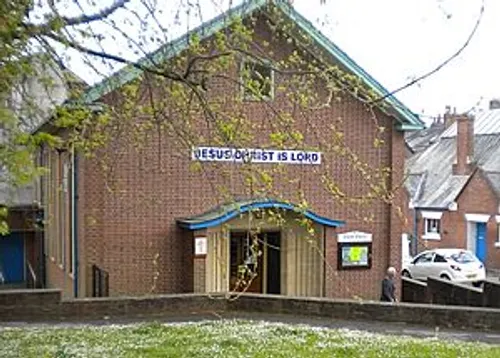
The High Court in London has put off orders that would evict the breakaway congregation of Christ Church Exeter and remove its trustees. Master Brightwell gave the congregation’s leaders one last chance to set out a legal case against the Free Church of England Central Trust, but ordered them to pay the trust’s costs of the hearing that went against them in May.
In a ruling handed down on 12 Nov 2026 in The Free Church of England Central Trust v Revd Steven Hanna [2026] EWHC 2883, Master Brightwell said it would not be appropriate to order the defendants “to relinquish possession of the properties and cease to act as trustees” until they had made a final attempt to plead their case and get any permission they need from the Charity Commission. He sits in the Property, Trusts and Probate List of the High Court’s new Business and Property Division. He added that such orders “would almost certainly follow from the findings already made” if they could not.
The defendants are the Rev. Steven Hanna, his wife Rachel Hanna, and Lazlo and Ludivinia Flores, trustees of the registered charity Christ Church Exeter. They have 28 days from the 2 November hearing to serve a final draft statement of case and submit any application to the Charity Commission.
The ruling follows the court’s September judgment, which found that the Central Trust, not the local trustees, is the charity trustee of the church at Grosvenor Place and its associated properties. It also held that a charity formed to advance the faith “in union with” the Free Church of England must operate within the denomination’s formal structures.
After that defeat, the defendants said they wished to file a defence and counterclaim and to convert the proceedings into a full trial under Part 7 of the Civil Procedure Rules. The Central Trust argued that no further fact-finding was needed. In its view, the September findings already established that the defendants had left the FCE and were therefore in breach of trust, and the court could order possession and their removal as trustees.
Ahead of the November hearing, the defendants filed a draft defence and counterclaim. Their counsel, Paul Stafford, said it was not in final form. It alleges that “the schism has been generated by the Trust and/or its individual members including Bishops Fenwick and Hunt.” These were references to the Rt. Rev. John Fenwick, the FCE’s Primus when the congregation left in 2023, and the Rt. Rev. Dr. Paul Hunt, now the Bishop Primus. The draft says this happened through “the profession of new doctrine inconsistent with the historic doctrine” on which the denomination was founded.
The draft names five churches, in Leeds, Farnham, Workington, Tuebrook in Liverpool, and Fleetwood, that it says “believe they are the true FCE” and are inviting Christ Church Exeter to join them. It argues that the trust itself is in breach of trust, and that “the defendants’ departure from the structures of the FCE has been necessary in order for the advancement of the Christian faith to be pursued.”
Master Brightwell found that the document “does not provide a coherent counterclaim.” He said it seeks no relief and does not explain why the defendants have a defence when the properties are held for the purposes of the FCE. He noted that it “does not assert that the defendants themselves believe that they … are or are part of a body which is the true FCE.” He also said that the usual remedy against a trustee in breach is replacement, not forfeiture of the charity’s property.
Any claim by the defendants that the trust has breached a charitable trust would probably need Charity Commission permission under section 115 of the Charities Act 2011. Mr. Stafford also said the defendants may ask the Commission for a scheme covering the properties.
The court did not spare the defendants. Master Brightwell agreed with the trust’s counsel, Maxim Cardew, that they “can be criticised for not having set out the legal (as opposed to the theological) basis of their position much sooner.” He said they should have done so before the November hearing.
He gave them more time anyway. One reason was that the November 2025 directions order of Master Kaye expressly allowed for further directions, including on factual issues. The other was that the defendants’ late access to legal representation, which he described as “pro bono as far as their solicitors are concerned,” may have slowed the preparation of their case. He stressed that the extension “does not pre-empt” a later finding that their arguments have no basis in law, no real prospect of success, or come too late.
The court settled the wording of its declarations. The original church site is held by the trust “for the charitable purposes of the Free Church of England,” and the trust “must permit the Original Church Site to be used for these purposes under the name of ‘Christ Church (Free Church of England)’.” The adjoining Laburnum Cottage site is held for the FCE’s charitable purposes. The schoolrooms are held for use as a Sunday school or church hall in connection with Christ Church.
The parties agreed that the former manse at 140 Pinhoe Road, bought in 1986, is held for the FCE’s charitable purposes. The court rejected the defendants’ request to require that the house be used with the Exeter church, noting that the church operated without a manse until 1986.
The court restated the objects of the local charity: the faith is to be advanced “as part of (i.e. and in adherence to the formal structures of)” the FCE and, as a separate requirement, in accordance with its Principles and practices. It declined to define the denomination’s “practices,” saying it “has not yet had cause to identify the fundamental doctrines of the church.”
Master Brightwell found that the Central Trust “was, quite clearly, the successful party” in September, having won “on every substantial issue.” He rejected the argument that the trust had exaggerated its claim. He said the defendants’ theological arguments in May “significantly lengthened the hearing.”
The defendants must pay, on the standard basis, the trust’s costs of preparing for and attending the May hearing and the costs of the consequentials hearing. Costs incurred before preparation for the May hearing remain reserved.
He postponed the trust’s request for an interim payment on account of costs. He accepted that such an order “could potentially stifle a defence,” and he invited the defendants to file evidence of their means. The congregation has said in a public fundraising appeal that the trustees are personally liable for the costs of the case.
Christ Church Exeter, which Anglican.Ink described in 2023 as the FCE’s oldest surviving congregation, voted on Good Friday 2023 to leave the denomination. The congregation said it had called on the FCE to repent of “its departure from the historic Protestant faith upon which it was founded” and of its treatment of former ministers.
Mr. Hanna was appointed minister in March 2020, but that appointment was later revoked and his permission to officiate was withdrawn in June 2022. He continues to lead a congregation of more than 30 at Grosvenor Place. In 2021, he was among 15 clergy and churchwardens who urged Bishop Fenwick to step down as Primus.
The FCE was founded in 1863 by evangelicals opposed to the Oxford Movement and is a member of Gafcon. In September the court expressly declined to rule on whether the FCE’s bishops or the departing congregation have kept faith with its founding Declaration of Principles. Master Brightwell has said that question could arise if the case goes on to a factual trial.
The parties must now try to agree an order putting the ruling into effect. The question of a payment on account will be decided at the next hearing, once the court has the defendants’ final statement of case and knows whether they have applied to the Charity Commission.