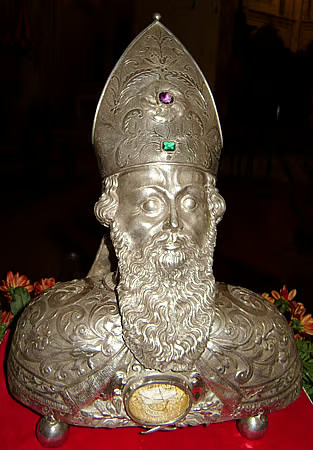
A man arrested by French police has admitted breaking a glass case in the Basilica of Saint-Nicolas-de-Port, taking a bone fragment venerated as a relic of St. Nicholas of Myra, and burning and crushing it, according to a statement issued on Nov. 6 by the parish of Saint-Nicolas-en-Lorraine. Denis Bourquin, president of the basilica’s heritage association, said the relic was a bone fragment one or two centimeters long.[]() It was kept beneath a statue of the saint in the church’s St. Nicholas chapel. The basilica’s principal relics, kept in its treasury, were not touched.
The French Catholic site Catholix reported that the suspect admitted acting on impulse, out of a “désir de destruction de la relique” (desire to destroy the relic), which he equated with “fétichisme.” Radio France’s ICI Lorraine reported that he will be tried in December. Mayor Luc Binsinger told France 3 Grand Est that the man should be tried “d’ici à quelques jours” (within a few days).
Police have declined to identify the suspect. On Nov. 9, the Swiss daily 20 Minuten reported that neither the judicial authorities nor the Diocese of Nancy had commented publicly. It added that nothing was known about the suspect’s name, age or origin.
Some outlets and social media accounts have said the man is Muslim. PJ Media’s headline called him a “suspected Muslim,” and its article described him as “reportedly Muslim.” Its only named source for the claim was the verified X account Wasson Watch Co.; PJ Media did not reproduce that account’s post. LifeSiteNews said that “some on social media suspect” the man is Muslim but cited no posts or accounts. None of the sources reviewed for this report quotes a police, judicial, church or municipal official on the suspect’s religion.
Local officials have described the man only in general terms. Mayor Binsinger called him “un monsieur un peu désœuvré” (a somewhat idle man) who had wandered through the basilica. Aleteia described the suspect as young and reported that the Rt. Rev. Pierre-Yves Michel, Bishop of Nancy and Toul, called him “un peu désorienté” (somewhat disoriented). Bishop Michel asked Catholics to keep him in their prayers.
The regional daily L’Est Républicain broke the story on Nov. 5. It reported that the basilica’s priest had filed a complaint at the police station in Dombasle-sur-Meurthe on Nov. 2. L’Est Républicain also reported that the suspect appeared before the court in Nancy and that a psychiatric evaluation found him legally responsible for his actions. The French verification site Prodpress has said that the reported psychiatric findings lacked sufficient public corroboration.
Accounts of the fragment’s history also differ. Bourquin told ICI Lorraine that the bone had been authenticated and had been there “depuis 1098” (since 1098). Famille Chrétienne reported that the medallion holding the relic dated from 1908. According to Brussels Signal, the heritage association said on Nov. 7 that the fragment had been placed beneath the statue in the early 2000s. The basilica’s rector, the Rev. Apollinaire Ngun, told Famille Chrétienne that the incident was “une profanation d’un petit maillon de reliquaire” (the profanation of a small link of a reliquary).
## Church response
The parish called the destruction “a profound attack on our history, our faith and the devotion of generations of pilgrims.” Bishop Michel rejected the suspect’s reported explanation. “We believe in the resurrection of the flesh. The saints are part of our family and connect us to the Lord. Venerating relics is not fetishism; it is an act of faith that connects us to Christ,” he told Aleteia. He also argued against closing churches as a security measure: “Churches are made to be visited. We are not here to protect stones.”
AGRIF, a Catholic association, said it would file a complaint and join the proceedings as a civil party. It described the act as one of “anti-Christian hatred” and asked the court to treat that motive as an aggravating circumstance.
France 3 reported that this was the third act of vandalism or theft at the basilica in a year. On Feb. 4, two small fires were deliberately set inside the church. They singed a statue of the Virgin and burned two chairs, and witnesses reported seeing “un tout jeune homme” (a very young man).
The basilica is about 12 kilometers southeast of Nancy. The Flamboyant Gothic church grew from devotion to a finger bone of the saint’s right hand that the crusader Aubert de Varangéville brought from Bari in the late 11th century. That relic, known as the “dextre bénissante” (blessing right hand), is carried in the annual torchlight procession for St. Nicholas.[]( This year’s procession will be held on Dec. 5.
The Lorraine case comes amid a rise in reported anti-Christian acts in France. The Interior Ministry recorded 843 such acts in 2025, an increase of 9 percent from 2024; 87 percent were attacks on property. Aggressions against people made up 13 percent of the total but rose by 70 percent. The ministry said 2025 was marked by the killing on Sept. 10 of Ashur Sarnaya, a “chrétien d’Orient” (Eastern Christian), in the Rhône department, and that 2026 marks ten years since the terrorist killing of Fr. Jacques Hamel.
According to Evangelical Focus‘s summary of the ministry report, 627 incidents targeted Christian places of worship. These were mainly thefts or attempted thefts (362) and vandalism (254), and there were 45 arson attacks on churches during the year. Maire-info reported that most of the incidents were recorded in Nouvelle-Aquitaine, Île-de-France and the Grand Est, which includes Lorraine. It said that was partly explained by local gangs stealing art objects from churches.
Other recent cases include:
Indre-et-Loire. Six churches were broken into and desecrated between July 22 and Aug. 25. Consecrated hosts were thrown to the floor and excrement was left behind. On Sept. 8, police arrested two suspects, aged 20 and 17.
Vendée. Nine young teenagers, the oldest aged 14, filmed themselves inside the Church of Saint-Hilaire in Soullans playing a rap song that refers to the terrorists Mohamed Merah and Salah Abdeslam. The juvenile prosecutor’s office in La Roche-sur-Yon has taken up the case.
Die. A 19-year-old was arrested after a witness reportedly saw him lighting a fire inside the town’s cathedral, according to the Observatory on Intolerance and Discrimination against Christians in Europe.
Alongside these documented cases, false claims have also circulated online. Posts during October’s unrest claimed that Muslims had set fire to five churches in a single day. Maxime Cumunel, vice president of the Observatory of Religious Heritage (OPR), told France 24 Observers that no fires since Oct. 17 had been attributed to anyone of Muslim faith.
The OPR records 25 to 50 fires in French religious buildings each year from all causes. According to 20 Minutes, 10 to 20 of those are deliberately set. Cumunel cautioned that “criminel ne veut pas non plus dire antireligieux” (criminal does not mean anti-religious, either).
A Mass of reparation will be celebrated in the basilica on Nov. 20. The suspect’s trial is expected in December.