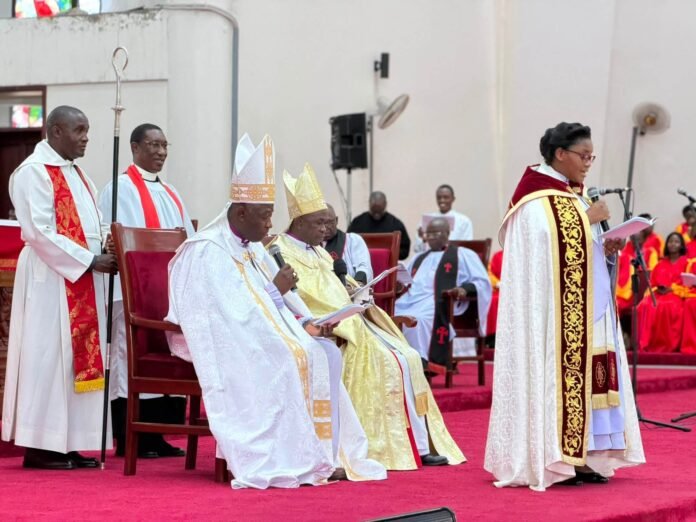
Kampala’s All Saints’ Cathedral has been elevated to a deanery, with its serving provost, the Very Rev Canon Dr Rebecca Margaret Nyegenye, installed as its first dean in an administrative reorganisation of the Church of Uganda’s Diocese of Kampala.
The Most Rev. Stephen Samuel Kaziimba Mugalu, who is also Bishop of Kampala, presided at the service on Sunday, 1 Nov 2026. The change replaces the cathedral’s traditional title of provost with that of dean and is intended to decentralise diocesan administration, Uganda’s *Daily Monitor* reported.
Dean Nyegenye’s installation represents a new office for an existing cathedral leader, rather than the first appointment of a woman to lead All Saints’. She became the Church of Uganda’s first female cathedral provost in 2019 and has already served at the head of the Kampala cathedral for more than seven years.
The development illustrates the established place of women priests in Uganda, while the wider Gafcon movement continues to accommodate sharply differing convictions over women’s ordination. Those disagreements concern both admission to the priesthood and consecration as bishops—questions on which Gafcon’s churches have not reached a common position.
“Our Cathedral has become a deanery, which means it is now independent of other churches, and it is now going to be led by a Dean,” Archbishop Kaziimba told journalists, according to the *Monitor*. Diocesan Secretary the Rev Henry Majwala said the decision had been taken by diocesan senior management on 3 September 2026.
The Assistant Bishop of Kampala, the Rt Rev Frederick Jackson Baalwa, described the reorganisation as a means of bringing administration and decision-making closer to congregations, reducing the number of matters requiring direct attention at diocesan headquarters.
“The decentralisation of the diocese is more about making the operations of the diocese easier,” he said, comparing the arrangement with decentralised government administration.
The service also included the ordination of six deacons and one priest. Kaziimba urged the newly installed and ordained leaders to exercise humility and serve the faithful diligently.
Dean Nyegenye was ordained deacon in 1997 and priest in 2000 in Bukedi Diocese, according to the cathedral’s account of her ministry. She served at St John’s Church in Busia before moving into chaplaincy at Uganda Christian University, where she became university chaplain in 2012.
Her theological education included training at Buwalasi, a master’s degree from Trinity Episcopal School for Ministry in the United States and a doctorate from the University of KwaZulu-Natal. Archbishop Stanley Ntagali presided at her installation as provost on 10 July 2019.
All Saints’, situated on Nakasero Hill, began in 1912 as a hospital chaplaincy and garrison chapel serving European expatriates and medical personnel. It became a full parish at Uganda’s independence in 1962 and the pro-cathedral of the newly created Diocese of Kampala in 1972. It subsequently became the seat of the Bishop of Kampala, an office held by the Archbishop of the Church of Uganda.
The cathedral’s expanding ministry has been accompanied by a substantial building programme. At Sunday’s service, Kaziimba said approximately Shs32 billion had been spent on the cathedral project, with a further Shs1.56 billion needed for completion. The complex includes a 5,000-seat sanctuary, 16 offices and parking for about 150 vehicles.
He also announced the acquisition of adjoining land valued at approximately Shs8 billion for additional parking, accommodation and a conference hall, with the proposed facilities intended partly to generate income for the Church.
Uganda’s acceptance of women priests distinguishes it from fellow Gafcon churches and jurisdictions that reserve the priesthood to men. A 2023 explanation published by Gafcon Europe identified Uganda among those ordaining women, while naming Nigeria, the Diocese of Sydney and the Anglican Mission in England among those that do not. It described the movement’s approach as maintaining fellowship between churches with differing convictions while retaining common commitments on the gospel and biblical sexual morality.
The disagreement has been particularly acute over women bishops. In April 2018, Gafcon’s primates, meeting in Entebbe, endorsed a task-force recommendation that member provinces retain “the historic practice of the consecration only of men as bishops” unless a strong consensus for change emerged through prayer, consultation and continued study of Scripture, agreeing to a moratorium on further consecrations of women to the episcopate.
That arrangement came under pressure when the Anglican Church of Kenya consecrated women bishops in 2021, including a female diocesan bishop. Following the primates’ meeting in Nairobi that September, then-Gafcon chairman Archbishop Foley Beach acknowledged that the movement had not reached agreement on women in holy orders, “and specifically women in the episcopate.”
“I recognize that this decision will come as a deep disappointment to some. I share in that disappointment,” Archbishop Beach wrote in a pastoral message to the Anglican Church in North America. “I wish Gafcon were of a common mind on this topic, but the reality is that we are not.”
The September 2021 primates’ communiqué, subsequently quoted by former task-force convener the Rev Dr Stephen Noll, stated that disagreements over women as deacons, priests and bishops were “not salvation issues” and would not disrupt the movement’s mission to proclaim Christ.
That approach has itself been challenged from within Gafcon. Writing in October 2025, Noll argued that the primates’ treatment of women bishops as a secondary issue left unresolved the underlying question of whether the practice accords with Scripture and the Church’s received teaching. Noll, a former vice-chancellor of Uganda Christian University, called for renewed consideration of Gafcon’s doctrine and discipline of holy orders.
The North American church embodies a similar tension within its own structures. Its bishops’ September 2017 statement acknowledged differing approaches to biblical interpretation and the nature of the Church that could produce divergent conclusions about women priests. It nevertheless described women’s ordination to the priesthood as “a recent innovation to Apostolic Tradition and Catholic Order” and said there was “insufficient scriptural warrant” to make it standard practice throughout the province.
The same statement reaffirmed individual dioceses’ constitutional authority to ordain women as priests, while maintaining the province’s prohibition on women bishops.
Gafcon’s 2023 Kigali Commitment, meanwhile, pledged to “affirm and encourage the vital and diverse ministries, including leadership roles,” of women in family, church and society. That commitment did not establish a common policy on ordination.
The issue remains relevant to Gafcon’s developing claims about Anglican identity and authority. Its March 2026 Abuja Affirmation announced the replacement of the Gafcon Primates Council with a Global Anglican Council and presented its “Global Anglican Communion” as a confessional fellowship grounded in the Jerusalem Declaration. The affirmation strongly defended Scripture’s authority but did not announce a settlement of the disagreement over women’s orders.
At All Saints’, the immediate development is administrative continuity under a new title: the woman who became provost in 2019 now serves as dean. Across Gafcon, the larger question remains how churches sharing a commitment to biblical authority should sustain fellowship when they reach conflicting conclusions about who may exercise ordained ministry.