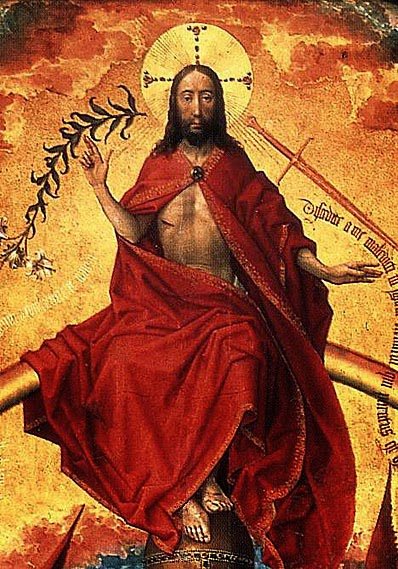
The Rt. Rev. Justin Holcomb has sent the clergy of the Diocese of Central Florida a theological essay on the body of Christ. He wants them ready to answer parishioners’ questions about a sermon preached at New York’s Cathedral of St. John the Divine, which said Jesus “transitioned” at the resurrection.
In the 13-page essay, “The Body of Jesus Christ: Incarnate, Crucified, Risen, Ascended, Returning”, Bishop Holcomb traces the creeds’ account of Christ’s body from the manger to the Second Coming. He argues that at every stage the Church has confessed the same thing: “The body is real. The body is his. The body is forever.”
In a cover letter to his clergy dated 23 October 2026, the bishop wrote that “some questions have come up about a recent sermon by an Episcopal clergyperson.” He said he was sending the essay “so that you have a clear account of what the church has confessed about the body of Jesus if you are asked about it.” He described it as “a pastoral reminder of what the scriptures teach and what the church has always confessed about the body of Jesus.”
Bishop Holcomb also set limits on what the essay tries to do. “This essay is not intended as a broader discussion of gender,” he wrote. He noted that the sermon had opened with a pastoral concern, that it is “extraordinarily difficult to be a trans person in this moment.” He added: “This essay does not take up that concern, and the church owes the people who carry it our care.”
The letter also gave clergy three short answers for parishioners who ask. To the question “Is God male?” the bishop answered: “No. God is beyond sex and gender, and the Father and the Spirit have no body. The Son took a body from Mary, and that body was male.” Asked whether Jesus changed at the resurrection, he wrote: “He was glorified, not replaced. He showed the disciples his hands and feet and said, ‘It is I myself’ (Luke 24:39).”
The third question asks whether this means God does not understand those who are rejected and weary. “No,” Bishop Holcomb wrote. “The Son took our flesh, was despised and rejected, and is able to sympathize with our weaknesses (Isa 53:3; Heb 4:15). The good news is that God is for us in Jesus Christ, in a real body.”
He invited clergy to use the essay in their own teaching or to share it with parishioners “if it helps them.” He also asked for correction: “If you find an error or something that should be clearer, please let me know.”
Neither the essay nor the cover letter names the preacher or the cathedral. It does, however, describe the argument it answers: “Some now say that the particular body Jesus had in Nazareth, including its sex, was a kind of provisional assignment, and that the resurrection corrected it, so that the one who walked out of the tomb had shed what he was and become at last his true self.”
The essay responds to a homily preached by the Rev. Flourish Klink, an assistant priest at Christ & St. Stephen’s Church in Manhattan, on March 21, 2026, at the cathedral’s Celebration of Trans Joy and Resilience. The cathedral’s service program lists the Rt. Rev. Matthew Heyd, Bishop of New York, as presiding and Fr. Klink as preacher.
The sermon got little attention until a video clip spread on social media in late September. Coverage followed in [The Christian Post and other outlets.
In the text published on Fr. Klink’s website, the preacher said “it isn’t controversial at all to say that God is non-binary” and then went further: “God is trans.” Fr. Klink argued that when God was born as Jesus, “Mary said ‘Oh, look! A baby boy!’ But God isn’t a boy … God was assigned a gender at birth, and later on, it became clear that that gender wasn’t quite right.”
Turning to the resurrection narratives, in which the disciples did not at first recognize the risen Lord, Fr. Klink acknowledged that “the Bible doesn’t tell us” why, adding, “I don’t know for sure … But I have an idea. I think Jesus was resurrected as Jesus’s true self, which is beyond male or female. I think that Jesus was not only transfigured. I think that Jesus transitioned.”
Bishop Holcomb begins where the sermon began, with the doctrine of God, and grants its premise. “Christians rightly confess that God is beyond sex and gender,” he writes. He cites Gregory of Nazianzus, who ridiculed anyone who concluded from the word “Father” that God must be male.
But he argues that the premise leads the other way. “The Father has no body. Neither does the Spirit. The Son had none until Mary. That is the whole point of the incarnation.” The Son entered creaturely existence “in particular, in a womb, in a manger, in a town, in a body that could be held. His maleness is not a divine attribute showing through the flesh. It is the flesh.”
The bishop rests his case on the Definition of Chalcedon, which confesses Christ as “truly God and truly man,” with the two natures united “without confusion, without change, without division, without separation.” He argues that the “newer error” revives two condemned positions at once. “To say that the maleness of Jesus was an appearance that concealed a truer self beyond male or female is to say that at least one feature of his humanity was not real, and that is Docetism. To say that the divine nature, which is beyond sex, overrode the human nature in this respect is to confuse the natures, and that is Eutyches. The old errors did not die. They moved to a different part of the body.”
He also takes up an objection: if the Savior was male, how is he the Savior of women? Quoting Gregory’s maxim that “that which he has not assumed he has not healed,” he answers that what Christ assumed was human nature. “Christ saves women not by sharing their sex but by sharing their nature. He saves Gentiles not by sharing their nation but by sharing their nature … The scandal of particularity is not a flaw in the incarnation. It is the incarnation.”
The essay answers most directly in its treatment of Easter. Bishop Holcomb argues that the Gospels “go out of their way to establish the identity” of the risen body. He points to the hands and feet shown in the upper room, the broiled fish eaten before the disciples, the wounds offered to Thomas, and the breakfast cooked by the Sea of Galilee. “If the risen body were a different body, the wounds would be a deception.”
He then addresses the non-recognition passages that the sermon relied on. They “are sometimes pressed into saying that the risen Jesus looked like a different person. He did not,” he writes. In each account, he argues, the evangelist places the failure in the people looking, not in the one seen. On the Emmaus road “their eyes were kept from recognizing him,” and “the passive voice is the point. God was doing something to their sight, not to his face.” Mary Magdalene knew him by his voice. The disciples in the boat were a hundred yards offshore at dawn. “Grief, distance, dawn, and the sheer impossibility of what they were seeing explain every one of these scenes. None of them says the body was different.”
He sets the “true self” reading alongside the second-century Gnostic texts. He cites the Gospel of Thomas promise that the disciples will enter the kingdom when “the male is not male and the female is not female.” In his reading, “This is not a resurrection. It is an escape, and the thing escaped from is the body … The resurrection does not reveal a truer Jesus beneath the Jesus of Nazareth. It vindicates the Jesus of Nazareth.”
The bishop carries the argument through the ascension and Second Coming. He contends that the Son did not lay aside his humanity: “The body that went up is the body that will come down. Nothing was shed on the way.” He cites the Heidelberg Catechism’s teaching that “we have our flesh in heaven as a sure pledge.”
He argues that the question reaches beyond Christology to Christian hope. Because Christ is the firstfruits of the resurrection, “If his body was a provisional appearance corrected in glory, then our bodies are provisional appearances, and the resurrection is not the raising of what we are but its replacement by something else.” He also rejects the view that the body is “a costume over a truer self.” Against it he writes: “The body is not a prison and it is not a costume. It is you. God made it, the Son took one like it, and the Spirit will raise it.”
The essay’s final pages take a pastoral turn, and they echo the sermon’s own language. Fr. Klink had told the cathedral congregation, “Lord, I am so tired of justifying myself,” and closed with the words, “The world is against us. But God is for us. God sees us and loves us and will justify us as we work to live our lives honestly.”
Bishop Holcomb writes that “many people are exhausted from justifying themselves” and are waiting to hear whether the self they present is acceptable. “The gospel does not ask anyone to locate a true self and offer it up for approval,” he writes. “The approval comes first. It comes from outside. It is not earned by honesty or authenticity or any other achievement. It is given, in a body, on a cross.” Quoting Romans 8, he writes that God’s being “for us” rests “not on God’s sympathy with our situation” but on “Christ Jesus the one who died, more than that, who was raised, who is at the right hand of God, who indeed is interceding for us … Four verbs, one body.”
No response from the Diocese of New York or the cathedral. Fr. Klink answered the criticism in an Instagram post quoted by Scene Magazine writing, “I’m very happy to discuss my opinions and beliefs with anyone who cares to have a serious, non-abusive conversation. I’m sure I’m not right about everything; how can any of us know the mind of God?”