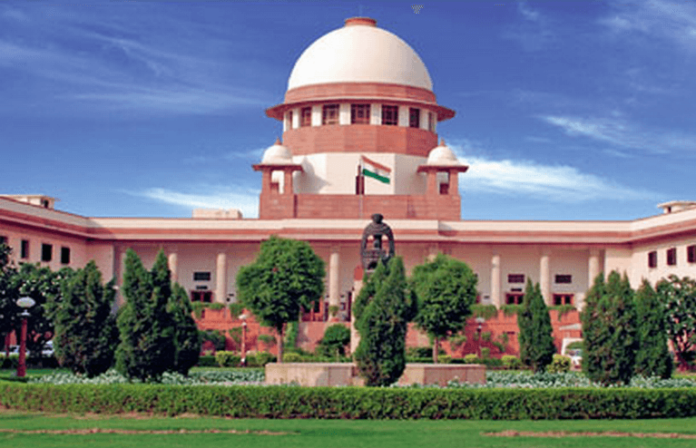
India’s Supreme Court on Friday stopped the demolition of a Church of South India church in Thippanampatti, a village in Tamil Nadu’s Tenkasi district. The order sets aside, for now, a ruling of the Madras High Court that would have pulled down the church’s 97-foot spire and returned the building to use as a community hall. The High Court had based its ruling partly on the arithmetic of the village: about 450 Hindu families and 10 Christian ones.
On Oct. 16, 2026, a bench of Justices Vikram Nath, R. Mahadevan and Aparesh Kumar Singh issued notice to the Tamil Nadu government and the other respondents on a special leave petition filed by the Tirunelveli Diocesan Trust Association, the property-holding body of the CSI Diocese of Tirunelveli. The bench also stayed the High Court’s demolition directions while the appeal is heard, [Bar and Bench reported. The case is listed as Tirunelveli Diocesan Trust Association v. District Collector, SLP(C) No. 37197/2026. Senior Advocate Huzefa Ahmadi appeared for the diocese.
The stay came with little time to spare. On Oct. 1 the High Court had given the Tenkasi district collector four weeks from receipt of its judgment to tear down the “unapproved structure.”
The Christians of Thippanampatti worshipped in a small church built around 1972. As the congregation outgrew it, a CSI trust bought 10 cents of land (about a tenth of an acre) in 2014. It obtained permission from the village panchayat to build what the approval called a “Church of South India Community Hall.” In 2016 a spire went up on the building, and the congregation began holding its services there.
That June, a local resident, Balakrishna Prabhu, went to the Madras High Court. He asked that the district collector be directed to stop the building from being built and used as a church. During those proceedings the state told the court that no application had ever been made to use the building for worship, and counsel for the diocese agreed to file one. On Feb. 20, 2024, the High Court allowed the diocese to apply to the collector and directed that the application be decided according to 24Law. The trust applied on March 4, 2024, seeking recognition of the hall as a place of worship and approval for the spire. The collector refused on June 25, 2024.
The refusal rested on a single sentence of Tamil Nadu law. Rule 4(3) of the [Tamil Nadu Panchayats Building Rules, 1997 provides: “No site shall be used for the construction of a building intended for public worship or religious purposes without the prior approval of the Collector of the district who may refuse such approval, if in his opinion, the use of the site and buildings is likely to endanger public peace and order.” Before deciding, the collector called for reports from the Revenue Divisional Officer and the Superintendent of Police of Tenkasi. Both predicted law-and-order trouble if the church were allowed to continue.
The diocese challenged the refusal in the High Court’s Madurai Bench (W.P.(MD) No. 15380 of 2024), and a division bench of Justices M. Dhandapani and N. Dilipkumar dismissed the petition on Oct. 1. The judges found that the 2014 permission covered a community hall and nothing more. The diocese itself conceded that the spire had gone up without approval. “In the present case, the mandate of Rule 4 (3) has not been complied with and necessarily it has to be held that the building put up is a structure, which is illegal and impermissible,” the court held, according to Verdictum.
The bench also accepted the collector’s reasoning on public order. It cited the reports of the revenue and police officials, the demographic make-up of the village, and a state standard operating procedure requiring a no-objection certificate from the collector before any religious structure is planned. It treated Mr. Prabhu’s original petition as evidence of tension in the village, calling it a “clear sign that there is definitely a rift between two religious groups, though not it has brewed to a greater extent”. The collector’s order, the court concluded, was “cogent, reasonable and sustainable,” and demolition was “a necessary consequence” of the refusal.
In the Supreme Court, the diocese argues that the order rests on a public-order problem that does not exist. The petition invokes the guarantees of equality and free exercise of religion in Articles 14, 25 and 26 of the Constitution. It also says that Christians have prayed weekly in Thippanampatti for more than a century without a single clash.
“Over the century, no law-and-order issue or conflict with other groups has arisen,” the trust told the court. “The only averment to suggest that there are law and order issues has been made to the fact that there are 450 Hindu families in the village and only about 10 Christians families. These numbers, by themselves, however do not remotely suggest that there is any law and-order situation in the area”.
The petition presents the objection to the church as the work of one man rather than a village. “The only one person objecting to the functioning of the church is Respondent No. 7 (Prabhu), who does not represent the 450 Hindu families in the village who have cordial relations with the Christians families,” it states. It calls the High Court’s finding of a “rift between two religious groups” “wholly baseless and unsubstantiated,” and argues that “demographic predominance cannot, by itself, justify refusing a minority congregation permission for peaceful worship”. The diocese also says the church has generated no complaints, police reports or confrontations in the years it has been in use.
Rule 4(3) has become a familiar feature of Tamil Nadu church litigation, and the Thippanampatti case shows how much depends on the collector’s opinion. Barely a month before the Oct. 1 ruling, the same two judges reached the opposite result in a case from Dhayapuram village. There, a district executive member of the Hindu Munnani, a Hindu nationalist organization, sought to stop the rebuilding of a Christian prayer hall near a Muthumariamman temple, warning of law-and-order trouble. In that case the collector had granted permission after a field inspection found no local objection. The bench declined to interfere, holding that “the constitutional guarantee of peaceful coexistence of persons professing different faiths cannot be curtailed merely on the basis of an unsubstantiated apprehension”.
The two rulings are consistent in their deference to the district administration: in each case the court upheld what the collector had decided. But they leave the fate of a congregation resting largely on the judgment of a revenue officer and a police superintendent. The Supreme Court will now consider whether the size of a religious minority, together with a single objector’s lawsuit, is enough to support that judgment.
The diocese bringing the appeal is one of the oldest centres of Anglican mission in Asia. Its history begins with a congregation of 40 people gathered at Palayamkottai in 1785 around a convert named Clarinda. It grew through the work of the Society for Promoting Christian Knowledge, the Church Missionary Society and the Society for the Propagation of the Gospel, and through missionaries such as C.T.E. Rhenius, who planted 371 churches across the region, and Robert Caldwell. It became a separate diocese in 1896 and joined the united Church of South India at its formation in 1947. The diocese reports some 185,000 members in 107 pastorates across 736 villages. Among those it has produced is V.S. Azariah, the first Indian bishop. It is led by the Rt. Rev. A.R.G.S.T. Barnabas, consecrated in 2021 as its sixteenth bishop.
The Tamil Nadu government, the Tenkasi collector, the police and Mr. Prabhu must now answer the petition. No date for the next hearing was reported. Until the Supreme Court rules, the spire at Thippanampatti stays up.