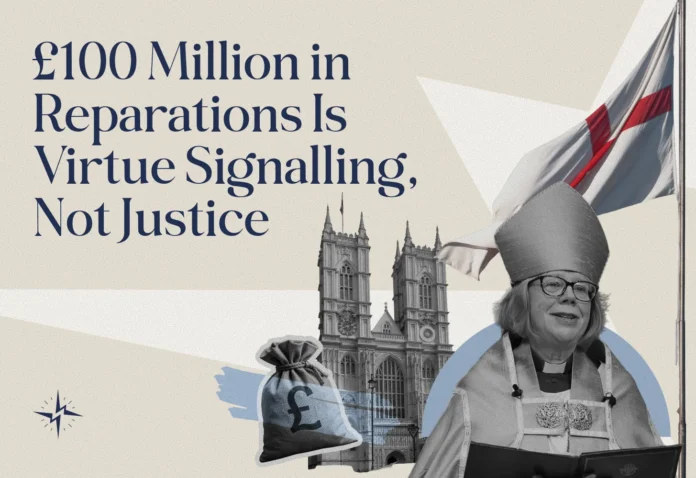
The Archbishop of Canterbury has reaffirmed the Church’s commitment to a controversial £100 million reparations fund for communities affected by the transatlantic slave trade. This is about more than a single financial pledge. It reflects a growing cultural expectation that institutions should respond to historical wrongs through ideological gestures and identity-based politics. If left unchallenged, symbolic acts of collective guilt will replace principled stewardship and biblical justice allowing moral signalling to take precedence over meaningful Christian charity. Justice means giving each person what is truly due, not distributing resources according to political symbolism.
The Church of England has long been called to stand apart from the shifting moral fashions of the age, yet this decision suggests an institution increasingly shaped by them. We live in a culture preoccupied with inherited identity and historical grievance, where moral authority is often claimed through ancestral victimhood rather than personal responsibility. Instead of scrutinizing this worldview through the lens of Christian justice, the Church appears to have embraced it uncritically. Its calling is to proclaim timeless truth, exercise wise stewardship and give each person their due, not baptise the ideological assumptions of the age.
The BBC reported that, during Dame Sarah Mullally’s visit to Ghana, she laid a foundation stone for accommodation linked to the government’s “Year of Return“ initiative, which encourages members of the African diaspora to reconnect with their heritage. Since its launch in 2019, the Year of Return has been promoted as both a cultural and economic program, attracting significant numbers of visitors from the diaspora. The government has also led an international campaign urging nations and institutions connected to the transatlantic slave trade to pay reparations. Foreign Minister Samuel Okudzeto Ablakwa praised the Archbishop’s commitment for sending “the right signals” to others. These developments raise a legitimate question: is this £100 million commitment primarily intended to deliver practical justice, or to support a wider reparations campaign intertwined with Ghana’s cultural and tourism strategy?
Advocates of reparations argue that descendants of enslaved people continue to experience disadvantages rooted in historical injustice and that institutions which profited from slavery have a moral responsibility to respond. Yet this logic establishes a standard applied almost nowhere else. The descendants of those who endured famine, persecution, war or forced displacement do not ordinarily claim to have inherited the victimhood of their ancestors or seek compensation for centuries-old wrongs. Remembering history is not the same as inheriting its injuries. True justice also requires us to confront the suffering that exists today, not only the injustices of the distant past. Today, millions of people are trapped in modern slavery, trafficked across borders or exploited as children. We should resist a culture that elevates inherited victimhood over present suffering and allows historical identity to become a shield against scrutiny rather than a call to personal responsibility and genuine justice.