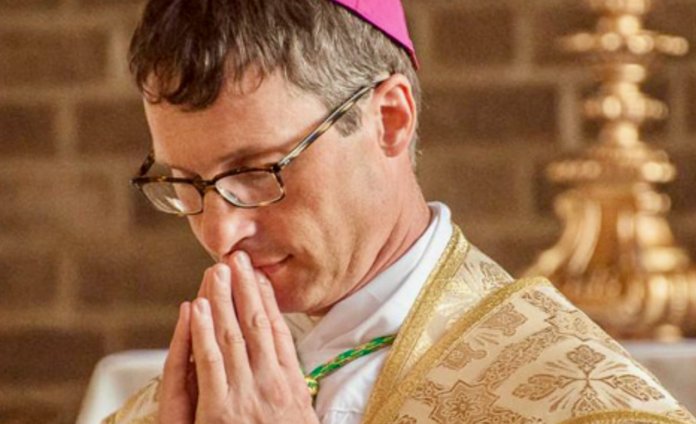
ON THE streets of urban Lancashire, war in the Middle East looms large.
“Just down the road from me,” says the Bishop of Blackburn, the Rt Rev Philip North, “is an enormous, very complex, overlapping set of Muslim communities. What unites them is Gaza and a really visceral, intense antipathy towards the state of Israel.”
But there is also what he calls a “tiny, beleaguered” Jewish community. “Part of my job is to listen to the leaders of both sides, and that Jewish community is close to no longer feeling welcome in the UK,” he says.
That task has been made all the harder, he believes, by a document heard by the General Synod this week describing Israel as a “colonial enterprise” that unleashed a “genocidal war on Gaza”.
Titled A Moment of Truth: Faith in a Time of Genocide, and known as Kairos II, the report was produced by a group of Palestinian Christians. It was one of a list of documents contained in a Synod motion expressing the Church’s solidarity with them and their fellow Palestinians.
While the final motion lamented the loss of Israeli and Palestinian lives, and “the violations of human dignity and rights on both sides”, Bishop North fears the Church’s decision to “hear” Kairos II could have real repercussions for British Jews.
“We’ve been forced to take a binary position, and whatever binary position we take, one side celebrates and the other feels bitterly betrayed,” he says. “The situation we’ve seen is there’s a Palestinian Muslim and Christian side celebrating, and I fear what this vote has done is add to a growing tide of anti-Semitism in our country.”
That the Church voted to “hear” rather than “receive” the document won’t make the least bit of difference in the outside world, he suggests. The distinction means something in the Synod, where receiving is a legal term meaning accepting, while hearing means members are listening but don’t necessarily agree. But such nuance, he fears, will be lost beyond the walls of the chamber.
“This is, locally, on the streets, an unbelievably visceral, complex, nuanced argument, which is incredibly intense, including in Lancashire,” he says. “That nice distinction around words in a synod chamber means absolutely nothing in the Middle East or on the streets of urban towns where this is particularly an issue.”
In Blackburn, where he lives, he has seen first-hand how the war in Gaza has affected local sentiment. The Church should be building bridges, he believes, not appearing to side with one group over another.
While anti-Israel sentiment and Palestinian solidarity have always existed in the area, it has, he says, intensified “significantly” since the war that started after Hamas’s terror attack on Israel on Oct 7 2023, and has been accompanied by great anger towards Benjamin Netanyahu’s Israeli regime.
“There have been unacceptable levels of bloodshed and violence shown by the state of Israel in Gaza, so I understand that,” says Bishop North, warning that the “bombardment of Gaza, the death and destruction… undermines local social cohesion” in his area.
This makes it all the more important, he feels, that faith leaders such as himself can model good relationships with the wider community.
Read it all in The Sunday Telegraph