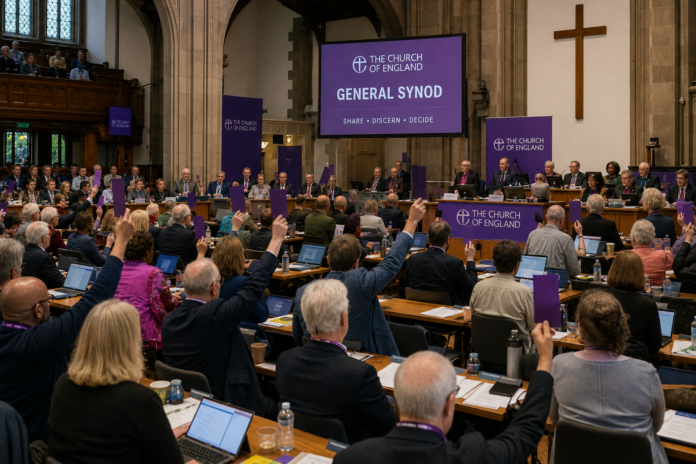
This article analyses the July 2026 General Synod’s debate on Helen King’s Private Members’ Motion concerning same-sex relationships and Christian discipleship explored in a previous article.
It traces the two competing amendments before explaining why the eventual amended motion failed in the House of Bishops.
It notes the significant shift in voting among the bishops since they introduced PLF in January 2023 and points to ten possible reasons contributing to this. It then offers three substantive reasons why the motion was opposed by so many:
- 1) it failed to address conservative’s concerns by replacing “no fundamental objection” with a claim as to the “legitimate range” of views,
- 2) it seems not to understand the reasons why, based on Scripture and Tradition, most conservatives cannot accept the legitimacy of the view King advocates,
- 3) it failed to name conservative views and added to the original motion’s ambiguity by not clarifying what range of views was being deemed legitimate.
It shows that the central unresolved issue is not simply disagreement over sexuality and discipleship, but disagreement over whether differing theological positions on this can be recognised as legitimate within the Church of England.
The piece concludes that the next Synod must learn from all this: further unresolvable conflict and pain is unavoidable unless we address with greater honesty and theological rigour (1) questions of discipleship and the recognisability of the legitimacy of different viewpoints, (2) how to recognise and respond to the differences over how serious our disagreements on discipleship are to be viewed, and (3) possible ecclesial reconfiguration to provide spaces for the pluralist reality now present within the Church of England when many cannot accept that pluralism as legitimate.
On Monday morning, on the penultimate day of its existence before being prorogued for new elections, General Synod returned once more to the question that has been a focus of division in its life since early 2023: the Church of England’s teaching in relation to same-sex relationships. It did so, despite the decision of the last Synod in February this year to draw the Living in Love and Faith process to an end, because of a Private Members Motion (PMM) introduced by Professor Helen King, though formally presented in her absence, by Professor Muriel Robinson. As proposed it read
“That this Synod affirm that there are no fundamental objections to being in a committed, faithful, intimate same-sex relationship, and that such a relationship can be entirely compatible with Christian discipleship.”
In contrast to the very long debates of earlier Synods this, despite its significant substance, was only scheduled for an hour’s debate (though with the possibility, unsurprisingly realised, of an additional quarter of an hour).
In an earlier article I explored the original motion in some detail, highlighting its significance, seven positives in its wording and six problems, particularly relating to areas of ambiguity and likely consequences. I asked whether it was simply an attempt, with a degree of “sleight of hand”, to advance the position of those pressing for change or whether it was being “offered as a form of wording about same-sex relationships and discipleship which might be able to help Synod find more widespread agreement across the church’s divisions and put questions of ethics and discipleship more to the forefront of whatever process follows the Living in Love and Faith project?”. If it was the latter then I hoped that
“it might just be possible that, as last year [a debate about Issues in Human Sexuality], with careful conversation and agreed amendments, this PMM could enable the Synod to draw to a close in a more constructive way. It may be that it is possible to discern a form of words for a motion that could clarify where there is a wider consensus than we have yet acknowledged.”
Sadly this proved not to be possible.
Some time after I wrote, Helen King’s paper explaining her motion was published (GS 2455A) along with a paper from the Secretary General (GS 2455B). The latter concluded with this summary:
“the passage of this motion would express the view of this Synod but would not effect any change to doctrine, law or teaching. However, it could introduce some ambiguity and confusion, with potential implications for practice.”
Perhaps because of this strong warning there were two amendments put before Synod of the most comprehensive form possible (“Leave out everything after “That this Synod” and insert…). A third amendment seeking to add “lamenting the way divisions over sexuality have wounded the church and undermined its mission” to the original motion was not called.
Read it all at Psephizo