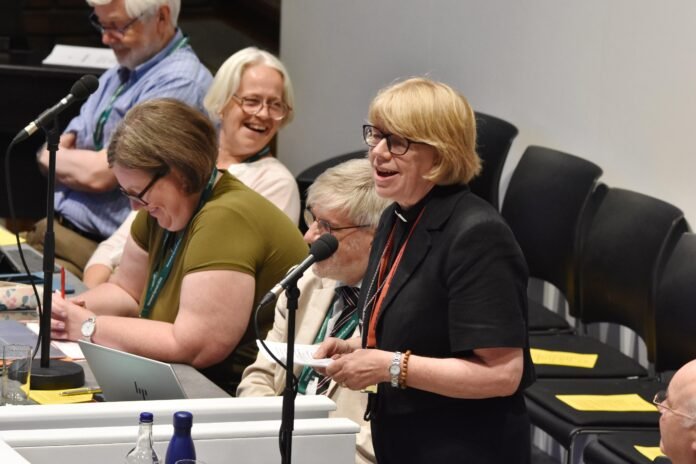
In a debate spread over Sunday evening and Monday morning, Synod discussed a wide-ranging motion brought by the Diocese of Carlisle which laments the loss of Palestinian and Israeli lives and seeks peace and security for all the peoples of the Holy Land.
The motion was amended, changing a proposed call to “receive” the Kairos Palestine declarations – statements produced by Palestinian Christians – to a call to “hear” them as “heartfelt expressions” of their experiences.
Another amendment also speaks of repentance for the Church’s historic contribution both to antisemitism and to the situation now affecting the Palestinian people, reaffirming commitment to inter-faith dialogue, including Christian Jewish dialogue.
Much of the debate focussed on terms in the Kairos Palestine declarations written between 2009 and 2025 which have been criticised by some Jewish leaders in the UK.
Supporting the amended wording, the Archbishop of Canterbury, Sarah Mullally, told Synod that hearing the “heartfelt expressions of the lived experience of Palestinian Christians” in the documents does not mean agreeing with everything in them.
“The urgency of the situation in the Holy Land demands that we have difficult conversations,” she said.
“We must listen to those things that are hard to hear, and take the risk of engaging across divides.
I also hear the concerns of the Chief Rabbi, the Co-Leads of the Movement for Progressive Judaism, and the Board of Deputies, and I thank them for their honesty. During my recent visit to the Nova Exhibition in London, I was reminded once again that the pain and trauma of the appalling events of the 7th October attacks have not receded: they remain a daily reminder for the Jewish people in this country, Israel and around the world.
More than ever we need a critical, respectful dialogue – that includes the voices of Palestinian Christians, as well as our Jewish and Muslim friends.
To hear the heartfelt expressions of the lived experiences of the Palestinian Christians does not mean we agree with everything in these documents – but it does mean that we listen with compassion, and stand in solidarity with them amidst the many injustices they face.”
She added: “As a pastor, I hear the cry of our Palestinian Christian sisters and brothers – a cry that rises from the ruins of Gaza, and from the violence and oppression of the West Bank.” Church of England/Sam Atkins
Opening the debate, the Ven Stewart Fyfe, Archdeacon of West Cumberland, in the Diocese of Carlisle, addressed criticism of the most recent of the documents, Kairos II.
Offering a perspective from his experience of being caught up in the October 7 attacks, he acknowledged that some of the language was “challenging” but that it was written after “trauma” of the war in Gaza and illegal settlement activity across the West Bank.
He continued: “And if the language is challenging, it comes from a place of deep trauma.
“Would we, in any other circumstances, say to survivors of trauma, ‘you can’t use that language; you are wrong; this is not true?’
“Would we not receive their disclosure and seek understanding? That is what this motion calls for.” Church of England/Sam Atkins
The Bishop of Lichfield, Dr Michael Ipgrave, a former chair of the Council of Christians and Jews, said: “I am glad that we have accepted [the] amendment changing the word receive to hear but I hope we can be clear about the meaning of that change.
“If it is to be more than cosmetic, it must mean while we recognize the Kairos II document as springing from the trauma of the Palestinian people we are not recognizing all its language as language we as a church we accept to be used by ourselves.”
The Archbishop of York, Stephen Cottrell, referenced Fr Fadi Diab, [pictured above], Vicar of St Andrew’s Anglican Church in Ramallah, who was present at the debate.
“When I was in Ramallah last year, I met with some amazing women who told me their story, and they said their story today is so similar to the stories we hear in scripture of people under persecution, he said.
“By passing this now, I think, really helpfully, improved and amended and clarified motion, we can say to the women of Ramallah, to you, Father Fadi, to Archbishop Hosam, we hear you. We stand alongside you.
“We want to deepen our engagement with you. We want to ask our government to help us.
“We are opposed to all antisemitism, to all Islamophobia, but we are also for the people of Palestine and the Church in Palestine.
“Jesus doesn’t just call us to be peace lovers. He calls us to be peacemakers. And by passing this motion, we can begin to do that.”
The motion, including amendments, as passed was:
‘That this Synod respond to the call of Palestinian Christians to stand in solidarity with them and their fellow Palestinians in non-violent resistance to the ongoing occupation. We lament the loss of Israeli and Palestinian lives and the violations of human dignity and rights on both sides, as well as the displacement of population. We commit to a better understanding of the situation in Israel and the occupied Palestinian territory, seeking peace and security for all the peoples of those lands and pursuing that which leads to the establishment of a just and lasting peace.
In particular, we:
- reject antisemitism, anti-Muslim hostility and all forms of prejudice based on religious affiliation and ethnicity;
- acknowledge with repentance the Church’s historic contribution to antisemitism and to the situation now affecting the Palestinian people, reaffirm our commitment to inter-faith dialogue, including Christian-Jewish dialogue and encourage a deeper understanding of Judaism and other faiths;
- pray for all victims of the current conflicts in Israel and the occupied Palestinian territory and for a lasting peace;
- hear the Kairos Palestine Declaration (2009), the Cry for Hope (2020), the Call for Repentance (2023) and Kairos Palestine II (2025) as heartfelt expressions of the lived experience of Palestinian Christians and:
- encourage the Church of England at all levels to engage with those documents as part of a quest for greater understanding of the situation;
- ask the Faith and Public Life Division to commend resources that enable Dioceses and local churches to promote a full understanding of the situation and to respond through prayer, theological study, advocacy and practical support for the work undertaken by the Episcopal Diocese of Jerusalem and other Churches in the service of the people of Israel and the occupied Palestinian territory;
- encourage the Church of England at all levels to engage with those documents as part of a quest for greater understanding of the situation, alongside continued dialogue with Jewish and Muslim voices in the pursuit of justice, equality, peace and reconciliation;
- call on Church investors to implement and demonstrate a leading approach to responsible investment relating to the Occupied Palestinian Territory, and:
- to review their investment policies in the light of the International Court of Justice Advisory Opinion of 19 July 2024 on the illegality of the occupation of Palestinian territory;
- to request the Church Commissioners and Church of England Pensions Board to report back, on a triennium basis, on the progress and success of their approaches;
- the bodies named above to support the EIAG to develop guidance for wider Church of England investors on how to manage human rights risks relating to occupied territories and conflict.
- ask His Majesty’s Government to work urgently for a lasting peace in Israel and the occupied Palestinian territory, that will ensure safety and security for all parties and the upholding of the rights and inherent dignity of all people.’
Voting:
The motion was carried in all three houses as follows
Bishops: for 25; against 0; abstentions 5
Clergy: for 115; against 20; abstentions 30
Laity: for 113; against 27; abstentions 35