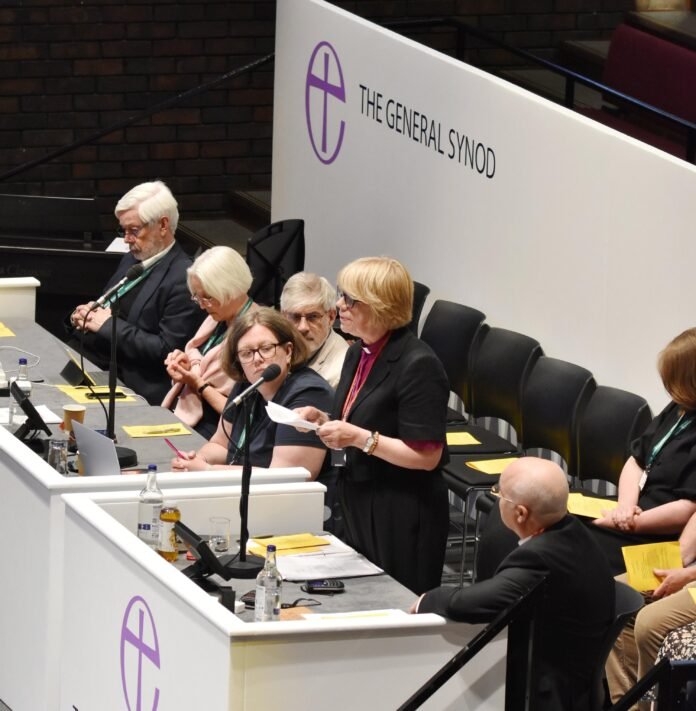
Synod,
The situation in Israel and Palestine is gravely serious. Last month I made my pilgrimage with my dear brother, Archbishop Hosam, across the Diocese of Jerusalem. The fear was palpable among everyone we met, Palestinian and Israeli. From Gaza to the north of Israel, from southern Lebanon to the West Bank, people across the region are traumatised by ongoing conflicts.
In the West Bank, I saw how settlements are expanding at unprecedented rates. Thousands of Palestinians are being forced from their land. Christian villages such as Taybeh are on the brink of disappearing – ground down by settler violence, and social, economic and political hopelessness.
Put simply: Palestine, which the British government recognised last year, is disappearing.
The threat to Palestinian Christians in particular – whose numbers are becoming ever smaller – is existential. Against this desperate backdrop, we are called to a new and active solidarity. We must not ignore the urgency of this moment.
The Jewish and Palestinian peoples have a profoundly deep connection to the Holy Land. Both have the right to self-determination, safety and flourishing.
This motion rightly notes that we lament – equally, without qualification – the loss of Israeli and Palestinian lives. We affirm our rejection of antisemitism and anti-Muslim hostility.
Especially with the abhorrent rise in antisemitism in this country, we must be vigilant about the long and terrible history of Christian anti-Jewish hatred. We must not add to this history: we must continue our journey of repentance and ongoing dialogue.
Synod, there has been much public discussion of the Kairos II in recent days. This document reflects the pain and trauma of the Palestinian people. As a pastor, I hear the cry of our Palestinian Christian sisters and brothers – a cry that rises from the ruins of Gaza, and from the violence and oppression of the West Bank. I heard these same cries as I visited Fr Fadi and his congregations in Birzeit last month.
The urgency of the situation in the Holy Land demands that we have difficult conversations. We must listen to those things that are hard to hear, and take the risk of engaging across divides.
I also hear the concerns of the Chief Rabbi, the Co-Leads of the Movement for Progressive Judaism, and the Board of Deputies, and I thank them for their honesty. During my recent visit to the Nova Exhibition in London, I was reminded once again that the pain and trauma of the appalling events of the 7th October attacks have not receded: they remain a daily reminder for the Jewish people in this country, Israel and around the world.
More than ever we need a critical, respectful dialogue – that includes the voices of Palestinian Christians, as well as our Jewish and Muslim friends.
To hear the heartfelt expressions of the lived experiences of the Palestinian Christians does not mean we agree with everything in these documents – but it does mean that we listen with compassion, and stand in solidarity with them amidst the many injustices they face. That is why I support amendments 46, 48, and 49.
I am a pastor, not a politician. When I say the Palestinian people deserve their freedom, that is not a political statement, but a moral and spiritual one. Both Palestinians and Israelis deserve to live free from the horrors of war, terrorism, occupation, displacement, and oppression.
International humanitarian law offers the best protection from all such violations of human rights and dignity – it must be upheld across Israel and Palestine.
We may feel the pressure to take sides, but we are called instead to human solidarity. Our duty is to defend freedom and human dignity. Our calling is to build bridges – believing that all people are made in the image of God.
I say this as a follower of Christ, the Prince of Peace, who was born to a Jewish family in Bethlehem, lived under Roman occupation, was crucified and rose again in Jerusalem.
So Synod, let us hear this call to prayer and active solidarity. Let us commit ourselves to work for a just peace for every person in Israel and Palestine – let us pray without ceasing for the Peace of Jerusalem.
(York) July 12, 2026