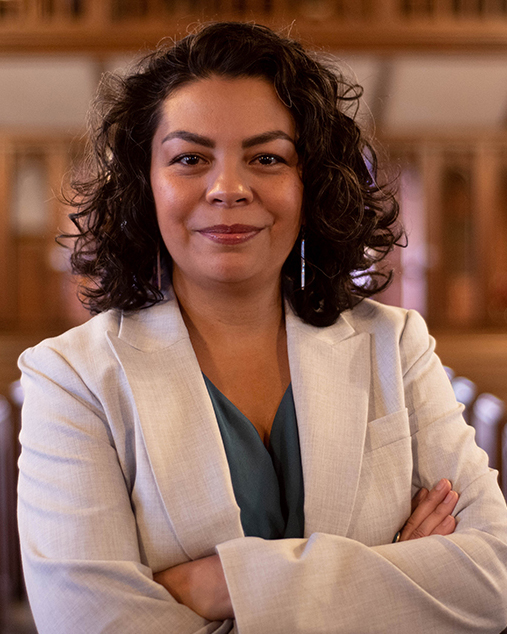
Following are opening remarks, as prepared for delivery, by House of Deputies President Julia Ayala Harris to the Executive Council of The Episcopal Church, which met in San Juan, Puerto Rico, this week.
Good morning,
I want to begin by expressing my gratitude to the people of the Diocese of Puerto Rico and Bishop (Rafael) Morales for their hospitality, generosity, and witness throughout our time together these last few days. Thank you to all who have welcomed us so warmly during our days in San Juan and for sharing your ministries, your stories, and your faith with us.
As we enter these final moments together, I’ve been reflecting on the contrast between what we’ve experienced here and much of what confronts us when we return fully to our phones, our inboxes, and our news feeds.
There is no shortage of reasons to be discouraged right now.
Globally, we are a witness to war, violence, displacement, political instability, and profound human suffering. Our communities are strained by division, and public trust in our institutions has eroded.
It can sometimes feel as though the dominant forces shaping our common life are those that pull people apart.
And yet, over the last several days, Executive Council, we have seen something very different.
We have seen people building.
Building relationships.
Building trust.
Building plans for the future.
Building systems that will enable this church to carry out its mission more faithfully, more effectively.
In a world that often rewards division, we have spent the last several days practicing something else entirely: the patient work of remaining at the table together and building something larger than ourselves.
As we’ve been meeting here in Puerto Rico, we’ve all been made aware of a reality that residents of San Juan are living with right now.
Just beyond the walls of our hotel and meeting spaces, many people have been without reliable water service. While many of us could turn on a faucet without giving it a second thought, families, businesses, and schools across this city have been navigating a very different reality.
It reminded me how easy it is to overlook the systems that sustain our lives until they fail.
Infrastructure matters.
Institutions matter.
Governance matters.
And even in the midst of this crisis, we did not hear from our Puerto Rican neighbors any sense of resignation or despair, but determination—people who continue showing up for one another, serving their neighbors, and strengthening their communities despite challenges and uncertainty.
Yesterday we were given a window into the remarkable ministry of the Diocese of Puerto Rico. What we encountered was not simply a collection of programs, but an interconnected network of ministry that accompanies people throughout every stage of life, inviting them into deeper relationship with God and with one another.
The Diocese of Puerto Rico has cultivated a holistic network of ministries that reflects a deep commitment to walking with people from cradle to grave, meeting spiritual, educational, social, wellness, and practical needs along the way.
They have illustrated for us the example of an institution that does not mirror the world’s polarization, but demonstrates another way of living together.
This is the work of governance at its best—the quiet work of nurturing and investing in the conditions in which ministry can flourish. Behind every ministry we encountered—the hospital, the seminary, the school, the funeral home, the work of the congregations—we know there are decision-makers, relationship-builders, structure-tenders, budget-makers: leaders who invested in a future they themselves may never see.
That is what faithful leadership looks like. And it is not so different from the work entrusted to Executive Council.
Our calling is not simply to oversee an institution. Our calling is to nurture and invest in the structures, resources, and relationships that make transformational ministry possible—to create the conditions in which the Gospel can flourish.
Over the last several days, we have not simply talked about the future of this church. We have taken responsibility for helping to shape it.
Together, we engaged in strategic planning. We wrestled with difficult questions. We brought different experiences, different concerns, and different hopes for the future of this church into the room. We remained at the table together.
In a culture increasingly tempted to sort, separate, and divide, we practiced something different. We practiced the discipline of discernment in community.
We chose to build together rather than pull apart.
And perhaps unexpectedly, I found another reason for hope in a place that may not sound especially inspiring: governance technology.
Over the last several months, a cross-functional team has been building the next generation of legislative software for General Convention, bringing together the Office of the President of the House of Deputies, the Information Technology Department of the Church Center, and volunteers who care deeply about the governance of this church.
I want especially to recognize Chancellor Michael Glass; Darvin Darling, director of information technology; Ethan Macdonald; Richard Lamb; and the many others whose faithful work often happens behind the scenes.
We are not building software for software’s sake.
We are creating the conditions—providing the tools—so that deputies, bishops, and others who care about the governance of this church can better understand, access, and participate in our common life.
When we gather at General Convention, technology should serve the ministry of governance, not stand in its way. It should free us to do the holy work of listening, discerning, debating, and deciding together.
That is an act of stewardship.
And it is an act of faith in the future of this church.
The same is true of the governance work that lies ahead of us. The conversations we have begun about structures, leadership, and how we equip this church for the future are not simply organizational exercises. They are opportunities to strengthen the systems that enable the mission we have been given.
One of the lessons I continue to learn is that institutions are not sustained by structures alone.
They are sustained by people who choose, again and again, to build together rather than pull apart.
People willing to confront today’s challenges head on, to prepare the way for those who will come after them.
People willing to offer their gifts for the sake of the church and our collective witness as followers of Christ.
Friends, in a season when it is easy to find examples of division, conflict, and destruction, I am grateful that over the last several days I have been surrounded by people committed to another way.
A way of building rather than tearing down.
Building trust.
Building leaders.
Building ministries.
Building a church that will serve generations we may never meet.
The work before us is not finished.
But I leave this gathering hopeful because I have seen what is possible when faithful people remain at the table together and commit themselves to building something larger than any one of us could build alone.
This church continues to be blessed with people willing to accept exactly that kind of responsibility. Today, I have the privilege of highlighting two such leaders.
As many of you know, the Rev. Steve Pankey, who has served faithfully these past two years as vice president of the House of Deputies, has agreed to step into the role of secretary pro tempore of the House of Deputies.
Steve’s gifts for governance, institutional knowledge, and deep commitment to the life of this church make him uniquely suited for this role, and I am grateful for his willingness to serve.
Among his responsibilities will be helping to guide and support many of the governance initiatives that will shape the work of General Convention and the House of Deputies in the years ahead, including the legislative and governance systems I have just described.
Steve’s transition into this office means the house now looks to its next vice president.
And so, as many of you may have read in my recent letter to deputies, I come before Executive Council today with some business of the house.
Pursuant to the canons, in the case of a vacancy, the appointment of a vice president of the House of Deputies requires the consent of the clergy and lay members of Executive Council.
It is my privilege to nominate the Rev. Canon John E. Kitagawa of the Diocese of Arizona to serve as the next vice president of the House of Deputies.
John Kitagawa is a 12-time deputy, a trusted leader, and a faithful servant of this church whose wisdom, experience, and commitment to collaborative leadership are well known to many of us gathered here today.
If confirmed, Deputy Kitagawa will become the first Asian American to serve as vice president of the House of Deputies. It is an important milestone in the life of our church—one that honors both John’s faithful leadership and the generations of Asian American Episcopalians whose contributions have helped build this church, even when our highest offices did not yet reflect their leadership.
I’m grateful for Deputy Kitagawa’s willingness to serve the House of Deputies and our wider church in this role.
So now, concluding my remarks and in accordance with the canons, Presiding Bishop, I move EC007, requesting the consent of the clergy and lay members of Executive Council to appoint the Rev. Canon John E. Kitagawa as the 17th vice president of the House of Deputies.