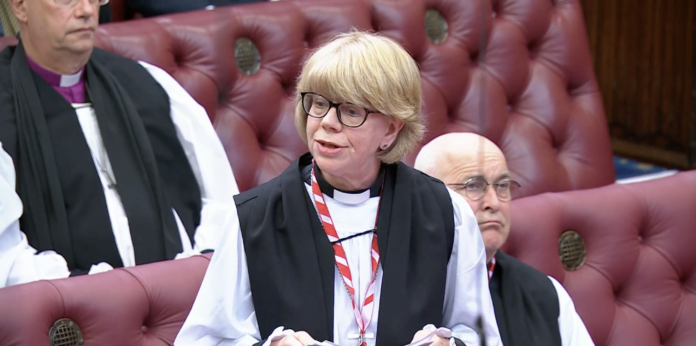
The 106th Archbishop of Canterbury used her first major intervention in the House of Lords on the subject of artificial intelligence to plant a distinctly theological flag — and to align herself, point for point on the human person, with the Roman Pontiff whose first encyclical preceded her speech by eleven days.
Speaking on 5 June 2026 in a debate she had herself secured, Dame Sarah Mullally opened not with policy but with Hebrews: “You made them a little lower than the angels, you crowned them with glory and honour.” From that text she derived what she called the “lens” for all that followed — that human dignity is “not in spite of our weakness, vulnerabilities and limitations, but in many ways because of them.” God, she said, “made us to be relational beings, in need of him and in need of others, not sufficient on our own.”
It is a starting point she immediately attributed to another author. “Pope Leo’s encyclical, Magnifica Humanitas, begins here too.”
The Archbishop organised her remarks around three questions: What does it mean to be human? What are we here for, and what gives our lives meaning and purpose? What is truth? The structure is recognizably Augustinian, and it tracks the architecture of Magnifica Humanitas — Pope Leo XIV’s 82-page treatise, subtitled On Safeguarding the Human Person in the Time of Artificial Intelligence and released on 25 May.
On the first question, Mullally praised AI’s contribution to healthcare — “automated ultrasound… predictive tools for pre-eclampsia… consistent fetal monitoring” — but insisted that the bedside, the delivery room, and the moment of difficult news remain “deeply vulnerable moments where human touch, human eye contact, human emotional intelligence, are irreplaceable.” Against these, she set a Durham University report documenting how chatbots are now “facilitating violence against women and girls: allowing role-plays of incest, child sexual abuse and rape with few safeguards.” Existing regulation, she said bluntly, is “wholly inadequate.”
On meaning and purpose, the Archbishop pointed to “record numbers of young people, 16-24 year olds neither in education, training, nor employment” — a crisis she warned “is only set to worsen as agentic AI starts to replace more jobs.” She cited Mary Harrington’s essay “Thinking is Becoming a Lost Art,” the levelling-off of adult literacy across the OECD, the decline of children’s cognition with heavy screen exposure, and a study showing that “heavy users of AI struggle more with critical thinking, as they stop thinking for themselves, their capability atrophies.” The irony, she observed, is that AI “might make us feel like we are more creative,” but its statistical nature means “ideas will in fact become more predictable, unoriginal, homogenized.”
At this point she quoted Pope Leo directly — from his November address to the National Catholic Youth Festival in Indianapolis: “Use it in a way that if it disappears tomorrow, you would still know how to think, how to create, how to act and how to form authentic friendships. Remember, AI can never replace that unique gift that you are to the world.”
On truth, Mullally was at her sharpest. Generative AI, she said, “cannot tell right from wrong, fact from fiction. Instead of truth it produces a statistical prediction of what would have been said before, in material it has been trained on.” Hallucination rates run “at least 3% of the time, some as much as 27%.” Worse, AI is “the perfect tool for sophisticated actors to create fake news,” with the power “to distort and rewrite reality, to present fiction as fact, and attack objective truth… What is often presented as a tool in the democratization of knowledge could all too easily become the tool of the autocrat.”
The deepest danger, she warned, is not credulity but its opposite: “The real danger is not our rising gullibility, but our rising cynicism — not that we will believe anything, it is that we will believe nothing.”
The convergence with Pope Leo’s encyclical is striking and, plainly, deliberate. The Archbishop met the Pope at the Vatican on — the first official encounter between a Pope and a female leader of the Church of England — and her speech reads in places as a Reformed echo of the Augustinian original.
Both leaders insist that technology is not neutral. Pope Leo writes that technology “takes on the characteristics of those who devise, finance, regulate, and use it”; Mullally tells the Lords that “there is no such thing as values-neutral technology.” Both invoke an anthropology of dignity that resists replacement: Pope Leo’s claim that “humanity — in all its grandeur and woundedness — can never be replaced or surpassed” is quoted by the Archbishop verbatim. Both pose AI as a question of formation: Pope Leo warns against outsourcing “what makes us human — to think and reason and love”; Mullally devotes a substantial section to cognitive atrophy and the homogenization of imagination.
Both insist on the priority of the human person over profit and over the concentration of technological power. Both name the protection of children, workers, and the vulnerable as non-negotiable. And both reach for a frankly theological vocabulary — the imago Dei, sacrifice, the call to service — that secular debates about AI ethics conspicuously lack.
Mullally also borrows William Temple’s triad — “man’s dignity, fallenness and destiny” — to land her ethical conclusion: that the antidote to the lust for power is sacrificial service modeled on the Cross. That framing is recognizably Anglican; it is also entirely compatible with Pope Leo’s appeal, in the encyclical’s closing chapter, for a renewal of St Paul VI’s “civilization of love.”
There is, however, one substantial dimension of Magnifica Humanitas that the Archbishop did not address: war.
Pope Leo’s encyclical does not merely raise ethical concerns about AI in the abstract. Its fifth chapter is devoted to AI and war, and there the Pontiff makes one of the most consequential doctrinal moves of his young pontificate: he declares that the Church’s centuries-old just war framework “is now outdated.” Except in cases of “self-defense in the strictest sense,” he writes, the doctrine “has all too often been used to justify any kind of war.” He calls for AI to be “disarmed,” demands “the most rigorous ethical constraints” on AI in weapons systems, and lays down three non-negotiable requirements: a verifiable chain of human responsibility, a “moral timeframe” that prevents algorithmic speed from collapsing deliberation, and effective human control over any decision to use lethal force.
None of this appears in the Archbishop’s speech. The words “war,” “weapons,” “autonomous,” “military,” “lethal,” and “just war” do not occur. The closest she comes is a passing reference to AI as potentially “the tool of the autocrat” and a general observation about “power” and its corruptions. Lethal autonomous weapons — arguably the single most urgent AI question now before legislatures, and the subject on which Pope Leo has spoken with the greatest doctrinal weight — go entirely unmentioned.
The omission is interesting on at least three counts.
First, it is a substantive theological choice. The Anglican tradition has its own long engagement with just war reasoning, from the Articles of Religion through to the bishops’ statements on nuclear deterrence in the 1980s. An Archbishop of Canterbury speaking in the House of Lords on AI had every reason to engage Pope Leo’s challenge directly — either to second it, to qualify it, or to defend the classical Augustinian-Thomist framework that the Pope has now placed in question. She did none of these.
Second, it is a missed institutional opportunity. The Lords debated the human impact of AI the same week several European governments were weighing fresh procurement of AI-enabled weapons systems, and the same month UN talks on lethal autonomous weapons resumed in Geneva. A bishop’s bench intervention on those questions would have carried weight.
Third, it leaves the Archbishop’s framework incomplete on its own terms. If the question is “does AI make human life more human?”, then a technology being designed to take human life at machine speed is precisely where the question bites hardest. The Pope’s three criteria — chain of responsibility, moral timeframe, protection of civilians — are the operational expression of exactly the anthropology Mullally proclaimed. By stopping short of them, she gave the Lords the principles without the application.
Archbishop Mullally’s first major Lords speech is a serious, theologically grounded, recognizably Anglican intervention. It is unembarrassed about the imago Dei, candid about fallenness, and properly attentive to the cognitive and moral costs of a technology many of her listeners encounter chiefly as a productivity tool. Its alignment with Magnifica Humanitas on the dignity of the human person, the non-neutrality of technology, and the priority of the common good over profit is so close as to suggest a deliberate ecumenical signal in the weeks following her Vatican meeting with Pope Leo.
But the speech also reveals where Canterbury is not yet ready to follow Rome. Pope Leo has used AI as the occasion to reopen, and effectively to retire, a doctrinal tradition of fifteen centuries. The Archbishop of Canterbury, addressing the same subject in the upper chamber of a nuclear-armed state, declined to engage that question at all. Whether that silence is prudent reserve, considered disagreement, or simply an early hesitation in a new primacy will be among the more interesting things to watch as her tenure unfolds.