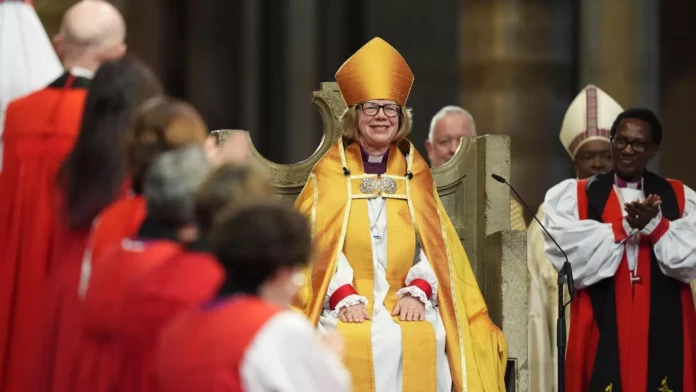
.On March 20, 2026, Pope Leo XIV addressed a message to the “Most Reverend and Most Honorable Dame Sarah Mullally, Archbishop of Canterbury,” on the occasion of her enthronement. This missive is not without raising serious questions, at various levels, which should not be left unanswered.
The letter stresses the “responsibilities” of the Lady, “not only within the diocese of Canterbury but also throughout the Church of England and the Anglican Communion.” Which immediately requires asking a first question.
Of which “Anglican Communion” Does He Speak?….
…..
Since Leo XIV does not recognize any power of orders in the Anglican Church, and even less so if it concerns a woman, as recalled by the quotation from the Joint Declaration between Francis and Justin Welby, to what does the title of Archbishop so generously granted by this correspond to?
The terms of “responsibilities,” the demand for the “gift of wisdom,” and the inspiration of the Holy Spirit can only difficultly be compatible with pure “political” power. But they rather mean that the title given by Leo XIV signifies recognition of a power of jurisdiction over the Church of England (name given to the Anglican Church in the United Kingdom).
And it is undoubtedly this aspect that attracts his interest: a “sister” Church, led by a woman, presents a good idea of what Leo XIV conceives, following Francis, concerning the power of jurisdiction. The same idea is reflected in the final document of Study Group 5, on “women’s participation in the life and governance of the Church.”
After the appointments of women to head dicasteries and the regular promotion of women in government positions, denying Dame Mullally the title linked to her election would be an intolerable backward step for the world and for the “synodal” members of the Church.
We thus find ourselves in the grotesque situation of a woman placed at the head of the Anglican Diocese of Canterbury, rejected by a majority of Anglicans – who see in this election a betrayal of the reformative ideal – but supported and encouraged by the reigning pope. There is also a plan for the latter to receive Dame Mullally at the Vatican at the end of April on the occasion of her visit to Rome.
In these circumstances, the absurdity of ecumenism manifests itself with a very special acuity, which should cause reflection in all those who are not yet anesthetized by ambient modernism. It is, in any case, a new manifestation of the state of necessity in the Holy Church.
Read it all at SSPX News