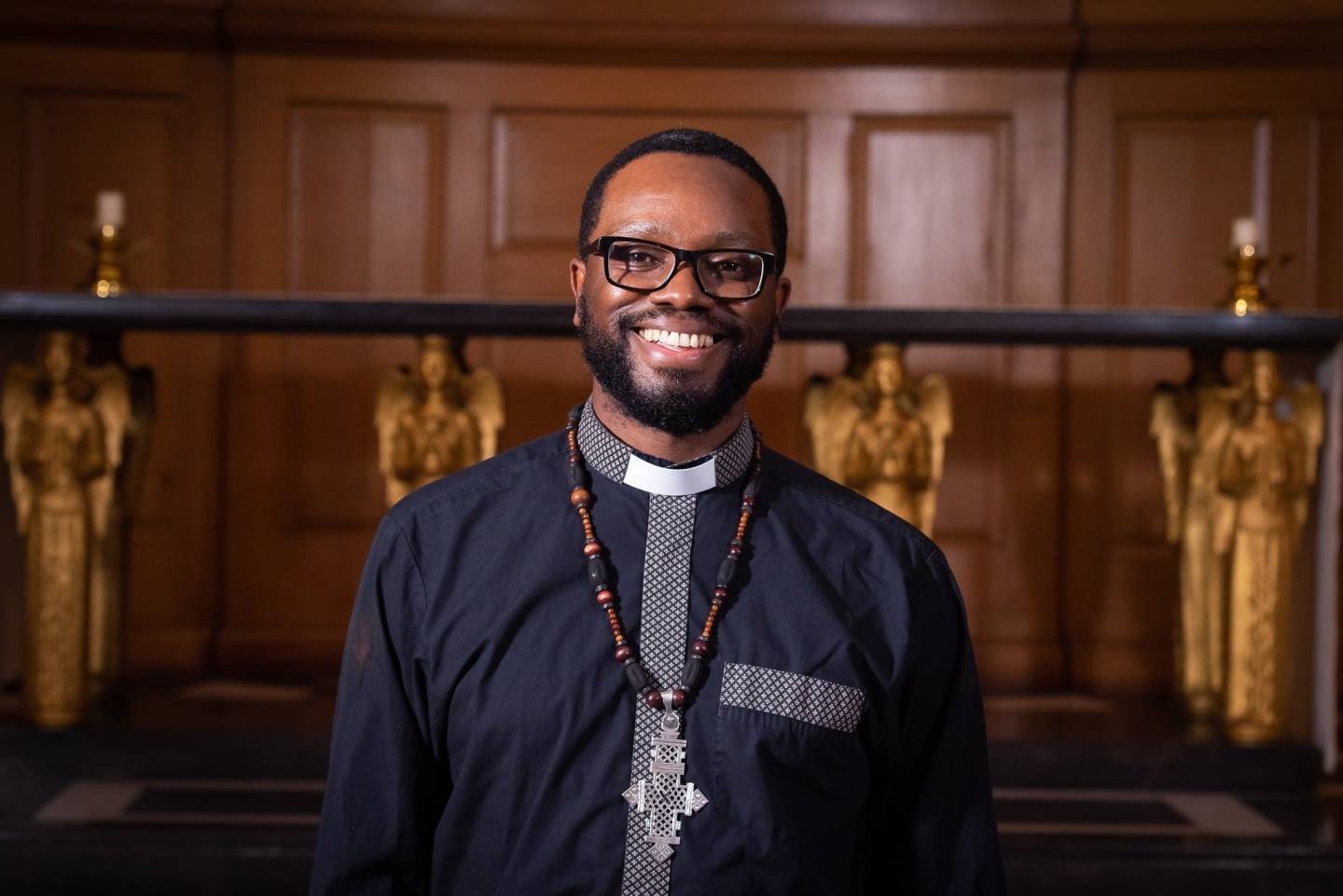
Bishop Lusa said:
“In recent days, the public iftar held in Trafalgar Square has prompted a range of responses from political figures. Their comments, expressing unease or criticism, deserve a serious and measured reply, not in the spirit of point-scoring, but out of concern for the kind of country we are, and the kind of country we are becoming.
“I write as the Bishop of Willesden, serving a richly diverse part of London that includes the borough of Harrow, often described as the most religiously diverse in the United Kingdom. I also write as the Church of England’s lead bishop for interfaith engagement. In both roles, I encounter daily the reality, and the gift, of a society shaped not by uniformity, but by a deep and textured plurality of belief, practice and identity.
“The public iftar in Trafalgar Square was not an act of cultural imposition, nor a signal of division. It was, rather, a moment of hospitality: an invitation to share in the breaking of the fast during Ramadan, extended by one community to the wider public. It was open, generous and peaceful. It reflected something profoundly British; the instinct to gather, to mark significant moments together, and to make space in our common life for the traditions that shape our neighbours.
“To suggest that such an event is somehow threatening risks misunderstanding both the nature of religious expression and the character of our national life. Religious freedom in this country has never meant the privatisation of belief. It has meant the opposite: the right of individuals and communities to live out their faith openly, visibly and without fear. That principle applies as much to Muslims observing Ramadan as it does to Christians celebrating Easter, Jews marking Passover, Hindus celebrating Diwali, or Sikhs observing Vaisakhi.
“Indeed, the Church of England itself exists within a constitutional framework that assumes the public significance of faith. We cannot, with integrity, defend the public role of Christianity while questioning the visibility of other traditions. To do so would be not only inconsistent, but unjust.
“There is a deeper concern here. At a time when conversations about anti-Muslim hatred are increasingly present in our national discourse, the tone and content of our public commentary matter greatly. Words shape perception; perception shapes behaviour. When we speak about particular communities in ways that cast suspicion or diminish their place in our shared life, we risk contributing, however unintentionally, to a climate in which exclusion becomes normalised.
“This is not about silencing debate. It is entirely right that we discuss the use of public space, the nature of national identity, and the evolving character of our society. But such conversations must be conducted with care, with accuracy, and with a commitment to the dignity of all. They must resist the temptation to single out particular groups as emblematic of wider anxieties.
“From my vantage point in northwest London, I see daily what is possible when we choose a different path. In Harrow and beyond, people of many faiths and none live alongside one another not without difference, but with a shared commitment to the common good. Schools, charities, neighbourhood initiatives and places of worship become sites of encounter and cooperation. Friendships are formed across lines that, in other contexts, might divide. This is not a utopian vision; it is a lived reality.
“Such a society does not emerge by accident. It is sustained by habits of respect, by legal protections, and by a willingness to affirm that our diversity is not a problem to be solved, but a resource to be cherished. It requires us to defend, consistently and unequivocally, the right of every person to express their faith, or their lack of it, in public life.
“The alternative is a narrowing of our common space: a subtle but real pressure for some to retreat from visibility, to practice their beliefs more quietly, more privately, more cautiously. That is not the direction in which a confident, democratic society should travel.
“The public iftar in Trafalgar Square was, in its own way, a sign of confidence: confidence that we can share space, that we can honour one another’s traditions, and that we can do so without diminishing our own. It was a reminder that belonging in this country is not a zero-sum game.
“If we are to navigate the complexities of our present moment well, we will need more, not fewer, such moments. We will need public expressions of faith that are generous rather than defensive, and public conversations that are expansive rather than reductive.
“The question before us is not whether Britain should be a plural society, it already is. The question is whether we will choose to inhabit that reality with generosity and courage, or with suspicion and fear.
“For my part, I believe we are at our best when we choose the former.”