A new bishop has been elected in South Kerala, but the real question is whether his arrival will challenge or consolidate the culture of impunity that has defined the diocese’s recent past.
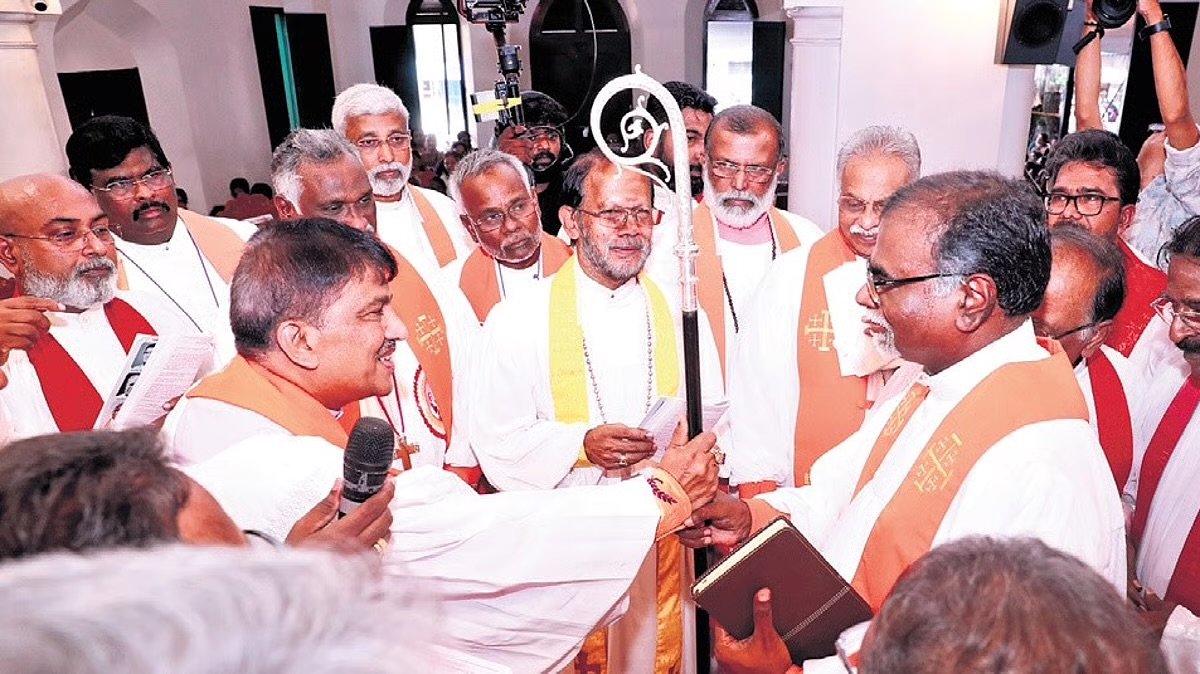
The Rev Dr Princeton Ben’s installation at Mateer Memorial CSI Cathedral in Thiruvananthapuram on Sunday bishop in the Church of South India’s South Kerala Diocese formally ends an extended vacancy in the see, yet it does so against a backdrop of unresolved legal disputes, contested governance, and deep erosion of trust. He assumes office in a diocese whose recent episcopal leadership has been repeatedly questioned in civil courts and by its own members, and where many now regard institutional assurances with skepticism. His appointment becomes a test case of whether entrenched patterns of power and patronage will be subjected to meaningful scrutiny or quietly normalized under new management.
A new bishop in a damaged system
Dr. Ben is not an outsider brought in to clean house, but a long‑serving CSI presbyter and missiologist whose entire ministry has unfolded within the Church’s existing structures. He has been elected as the seventh bishop in South Kerala by the Synod and has been received in the diocese with the customary liturgical and civic observances. He is a product of South Kerala’s own formation, trained at Kerala United Theological Seminary and further shaped by missionary work among Bhil communities in Gujarat, where he was involved in expanding CSI mission initiatives. In the wider Church, he has held significant posts, including Director of the Board for Mission, Director of Pastoral Concerns at the Synod, and Vice‑Chairman in South Kerala, positions that have given him both influence and detailed knowledge of CSI governance.
This trajectory marks him as a figure of continuity as much as change. He knows the internal machinery of the Church intimately, including the very synodical and diocesan processes that have come under criticism in recent years. That familiarity can be a strength if deployed in the service of reform, but it inevitably raises the question of how far someone so deeply embedded in the system will be willing—or able—to reshape it.
The Rasalam years and their aftermath
The see in South Kerala fell vacant in 2024 following the departure of the Rt. Rev. A Dharmaraj Rasalam, whose episcopate became synonymous with controversy. His administration was dogged by serious allegations linked to the Dr Somervell Memorial CSI Medical College in Karakonam: claims of capitation fees for students, irregular admissions practices, and financial improprieties that attracted the attention of state and federal investigative agencies. Parallel to the diocesan turmoil, Rasalam’s role in the wider Church culminated in the annulment of his election as Moderator by the Madras High Court, after judges found fault with the electoral process and associated constitutional manoeuvres.
For many clergy and lay members, these episodes were not isolated missteps but symptoms of deeper structural decay: an episcopal culture in which financial dealings, appointments, and rule‑changes appeared increasingly insulated from scrutiny. The controversies damaged the public standing of the Church and hardened internal divisions. Those who raised concerns about governance and finance often felt marginalised or dismissed as troublemakers, while others saw legal challenges and media coverage as attacks on the Church itself rather than calls to integrity.
The extended interregnum that followed Rasalam’s departure did little to rebuild confidence. The diocese was administered through temporary arrangements; committees met and institutions continued to function, but key decisions were either postponed or taken without the clarity that comes from a settled episcopal authority. The result was a sense of drift. For many, the vacancy period felt less like a deliberate space for repentance and reform and more like a holding pattern in which no one wished to confront the systemic issues that had brought South Kerala to this point.
Competing narratives about the past
Assessment of Rasalam’s legacy remains sharply divided. His defenders argue that he was targeted by factions within the Church and by external political interests, and they characterise the legal actions and media investigations as orchestrated campaigns. In this view, the bishop’s readiness to take “progressive stands” and to engage with educational and institutional expansion exposed him to vested interests determined to resist change.
His critics offer a very different narrative. They point to what they describe as a sustained weakening of synodical checks and balances, a pattern of constitutional amendments and administrative decisions that concentrated power in the hands of a small circle, and a series of financial and institutional controversies in which transparency was conspicuously lacking. For them, the issues surrounding Karakonam and the Moderator’s election are emblematic of a wider malaise: a polity in which rules can be bent, processes manipulated, and serious allegations managed rather than addressed.
It is this contested terrain—between claims of persecution and accusations of systemic abuse—that Dr. Ben now steps into. Whatever he says or does not say about his predecessor will inevitably be read as siding with one narrative or the other; there is no neutral ground.
Early signals from the new episcopate
In his initial public statements, Dr. Ben has adopted a measured tone that emphasizes consultation, prayer, and procedure. He has indicated that the diocese will take seriously the recently released Justice J B Koshy Commission report, a voluminous state‑appointed study by a retired High Court judge into the educational, social, and economic condition of Christian communities in Kerala, with hundreds of recommendations on reservations, welfare, and legal recognition. He has also spoken of issuing a considered diocesan response to the report and to forthcoming political developments in the state, underlining the Church’s continuing engagement with public life and its desire to position itself carefully in relation to the government.
On the more contentious question of his predecessor, however, his language has been careful and, in some respects, conciliatory. He has underlined that Rasalam left office in accordance with Church law rather than as a result of formal ecclesiastical discipline, and he has acknowledged what he describes as the “progressive” dimensions of the previous episcopate. Such comments may be designed to cool internal tensions and avoid further personal vilification, but they sit uneasily with those who believe that a much more candid assessment of past failures is indispensable if trust is to be restored.
Ben has also spoken of addressing divisions within the diocese “through prayer” and pastoral engagement. While no serious Christian would dismiss the necessity of prayer, there is a risk that such language can be heard, particularly by victims and whistle‑blowers, as a substitute for the hard work of investigation, disclosure, and restitution. In a context where allegations concern not merely personal conflicts but institutional integrity, pious generalities will not satisfy those looking for specific, verifiable change.
The demands of accountability
The fundamental issue facing South Kerala now is whether the new episcopal administration will be content to manage perceptions or will instead undertake the costly work of genuine accountability. That work has at least three identifiable components.
First, the findings of the Koshy Commission—and any other internal or external inquiries must be made available in a manner that allows informed discussion. Sanitized summaries will not do. If the Church wishes to be trusted, it must be willing to allow its own members, and where appropriate the wider public, to see what has been uncovered and how those findings will be acted upon.
Second, the diocese’s key financial and institutional operations, especially the Karakonam medical college and related educational and property arrangements, require scrutiny from bodies that are independent of those who have presided over them. Internal committees alone, particularly if comprised of individuals previously associated with disputed decisions, cannot command confidence. Transparent audits, clear publication of accounts, and robust conflict‑of‑interest safeguards are not optional extras; they are the minimum conditions for rebuilding credibility.
Third, there must be a serious re‑examination of constitutional and procedural changes that have facilitated the concentration of authority. If rules were altered in ways that weakened synodical oversight or extended tenures contrary to earlier norms, these changes should be revisited in open forum, not as technical adjustments but as matters that go to the heart of episcopal accountability.
A wider test for the Church of South India
What happens in South Kerala will not remain confined to one diocese. The Church of South India has, over decades, accumulated a reputation—for good or ill—for complex internal politics, contested property issues, and tensions between its constitutional ideals and its lived practice. If a diocese as publicly troubled as South Kerala emerges from crisis by means of cosmetic changes and carefully managed messaging, it will confirm the suspicion that the CSI’s structures are adept at absorbing scandal without being transformed by it.
Conversely, if the new bishop in South Kerala is prepared to expose wrongdoing where it is found, to accept that accountability may touch senior figures, and to align his episcopal ministry with a clear commitment to transparent governance, the implications will reach far beyond his own jurisdiction. In that respect, the Koshy Commission report is more than a policy document: it has become a touchstone for how churches in Kerala will relate to the state, to their own marginalised members, and to demands for probity in public life. How Ben’s administration receives, interprets, and implements—or sidelines—its findings will signal whether South Kerala is prepared to embrace uncomfortable reform or prefers a managed accommodation with the political status quo.
Princeton Ben’s election thus stands at a hinge moment. He inherits not only the symbols and prerogatives of the episcopal office, but also a network of expectations, loyalties, and unresolved grievances. Whether he will exercise that office as a guardian of an embattled status quo or as a bishop willing to bring uncomfortable truths into the light will not be determined by ordination rites or official communiqués. It will be measured over time—in what is disclosed, what is reformed, and who, if anyone, is finally held to account.