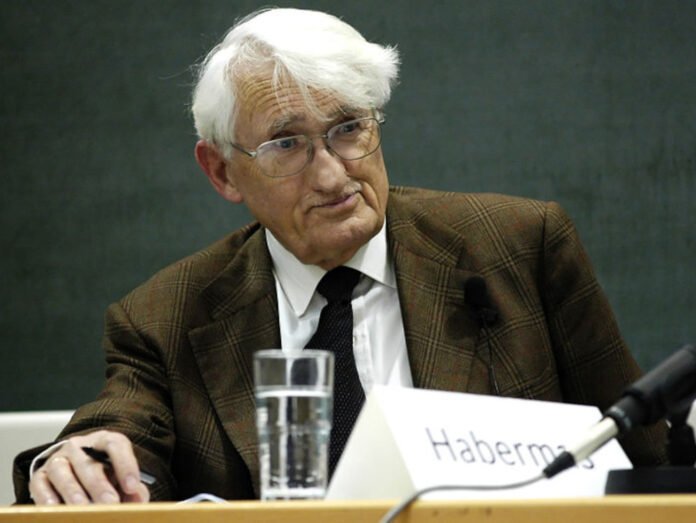
The influential German philosopher Jürgen Habermas has died aged 96, leaving behind a body of work famous for a theory of political consensus-building. Despite being a member of the post-Marxist Frankfurt school that founded critical theory, he believed that Jewish and Christian thinking had formed the foundation of “moral universalism” that lies behind democratic egalitarian societies.
“In spite of his background in the neo-Marxist Frankfurt school and his reputation as a court philosopher of the Social Democratic party, his influence cut across party lines,” The Guardian reports. “German chancellor, Friedrich Merz, of the conservative Christian Democratic Union, described him as “one of the most significant thinkers of our time”.
“His analytical acuity shaped democratic discourse far beyond our country’s borders and served as a beacon in a stormy sea,” Merz said in a statement. “His voice will be missed”.
In a 1999 interview, “A Conversation About God and the World” published in his book “Time of Transitions” (Polity Press, 2006), he makes a bold claim.
“Egalitarian universalism, from which sprang the ideas of freedom and social solidarity, of an autonomous conduct of life and emancipation, of the individual morality of conscience, human rights and democracy, is the direct heir of the Judaic ethic of justice and the Christian ethic of love. This legacy, substantially unchanged, has been the object of continual critical appropriation and reinterpretation. To this day, there is no alternative to it. And in light of the current challenges of a postnational constellation, we continue to draw on the substance of this heritage. Everything else is just idle postmodern talk.”
Sometimes that quote is over-simplified to a claim that Christianity and nothing else directly led to democracy and Western civilisation, which, from a point of view that believes in a supernatural God guiding history, may be true, but Habermas was not as specific. Yet, given his eminence as a leader of the second wave of critical theorists, his statement still reads very boldly.
Habermas and Ratzinger
The future Pope Benedict XVI and Habermas had a remarkable exchange in 2004 in which the philosopher conceded the origins of Western democracy and egalitarian impulses, and the theologian accepted that religious people face a task in communicating to their wider society
“The starting point for the philosophical discourse about reason and revelation is a recurrent idea: namely, that when reason reflects on its deepest foundations, it discovers that it owes its origin to something else.” Habermas wrote. “… Without initially having any theological intention, the reason that becomes aware of its limitations thus transcends itself in the direction of something else. This can take the form of the mystical fusion with a consciousness that embraces the universe; it may be the despairing hope that a redeeming message will occur in history; or it may take the shape of a solidarity with those who are oppressed and insulted, which presses forward in order to hasten on the coming of the messianic salvation. These anonymous gods of the post-Hegelian metaphysics – the encompassing consciousness, the event from time immemorial, the nonalienated society – are an easy prey for theology. There is no difficulty in deciphering them as pseudonyms of the Trinity of the personal God who communicates his own self.”
Ratzinger’s response acknowledges the Christian faithful should play their part as religion and rationality are “called to purify and help one another.”
“This basic principle must take on concrete form in practice in the intercultural context of the present day. There can be no doubt that the two main partners in this mutual relatedness are the Christian faith and Western secular rationality; one can and must affirm this, without thereby succumbing to a false Eurocentrism. These two determine the situation of the world to an extent not matched by another cultural force; but this does not mean that one could dismiss the other cultures as a kind of quantite negligeable. For a western hubris of that kind, there would be a high price to pay – and, indeed, we are already paying a part of it. It is important that both great components of the Western culture learn to listen and to accept a genuine relatedness to these other cultures, too.”